
Which of the following statements about Ragi crop grown in India is correct?
- (a)It is a millet crop grown in drier parts of south India.
- (b)It is a Rabi crop sown between November and March.
- (c)It is a rainfed crop grown on red, light black and sandy loam soil.
- (d)It is grown between 20 degree Celsius and 30 degree Celsius of temperature and 50–100 cm rainfall.
The Commission dropped this question and credited no option, and the reason is visible the moment the four statements are checked one by one: three of them are defensible descriptions of the crop, and a question that asks which single statement is correct cannot survive that. Ragi, or finger millet, is a millet and it is grown in the drier parts of peninsular India, with Karnataka much the largest producer — so the first statement holds. It is overwhelmingly a rainfed crop, and the soils named for it in the standard accounts are exactly red, light black and sandy loam, often shallow and gravelly — so the third statement holds too. The fourth statement's band of temperature and rainfall is the kind of range on which published figures differ, and the values printed here are within the range that standard sources give, so it cannot be struck out with any confidence. Only the second statement is plainly wrong, because ragi is a kharif crop sown with the onset of the south-west monsoon in June and July and harvested from September, not a rabi crop of the cold season. With one clearly false statement and three defensible ones, the item has no single answer.
- (a)It is a millet crop grown in drier parts of south India. — This is a fair description of the crop. Finger millet is a millet of the drier parts of the peninsula, and Karnataka alone accounts for the largest share of the Indian area under it.
- (b)It is a Rabi crop sown between November and March. — This is the one statement that fails. Ragi is sown with the arrival of the monsoon and harvested in the autumn, which makes it a kharif crop; the November-to-March window belongs to the rabi season of wheat, gram, barley and mustard. Some irrigated summer ragi is grown in parts of the south, but that is a local practice and not the classification of the crop.
- (c)It is a rainfed crop grown on red, light black and sandy loam soil. — This is also a fair description. Ragi is grown largely without irrigation, and red, light black and sandy loam soils are precisely the ones named for it.
- (d)It is grown between 20 degree Celsius and 30 degree Celsius of temperature and 50–100 cm rainfall. — The temperature and rainfall band printed here falls within the range that standard accounts give for the crop, so a candidate cannot safely reject it — and that is part of what makes the item unkeyable.
Finger millet is one of the coarse cereals grouped as millets, and its agronomy is the agronomy of a hardy rainfed crop. It tolerates drought, poor soils and shallow profiles, ripens in three to four months, and grows from the plains up to considerable altitudes in the southern hills. Nutritionally it is notable for calcium and iron, and it stores unusually well, which is why it has long been a food-security crop in the dry tracts rather than a commercial one.
The examination lesson here is about how a well-set single-answer question has to be built. Three of these statements describe the same crop from three different angles — botanical family and region, water regime and soil, climatic range — and all three are true at once, so none of them can be the unique answer. A question of this form needs three statements that are positively false, and this one has only one. It is worth noticing what made the false statement false, because that is the fact the paper was really after: the sowing season. Kharif is sown with the south-west monsoon and harvested in autumn; rabi is sown after the monsoon withdraws and harvested in spring. Ragi sits squarely in the first group with jowar, bajra, maize, rice, cotton and groundnut.
- Ragi, or finger millet, is a kharif crop sown with the onset of the south-west monsoon and harvested from about September.
- Karnataka is the largest producer of ragi in India; it is also grown in Tamil Nadu, Andhra Pradesh, Telangana, Odisha, Maharashtra and the Uttarakhand hills.
- It is grown mainly without irrigation on red, light black and sandy loam soils, including shallow and gravelly land.
- Ragi is valued for its calcium and iron content and for keeping well in storage.
- The rabi season runs from about October to April and carries wheat, barley, gram, peas and mustard — not ragi.
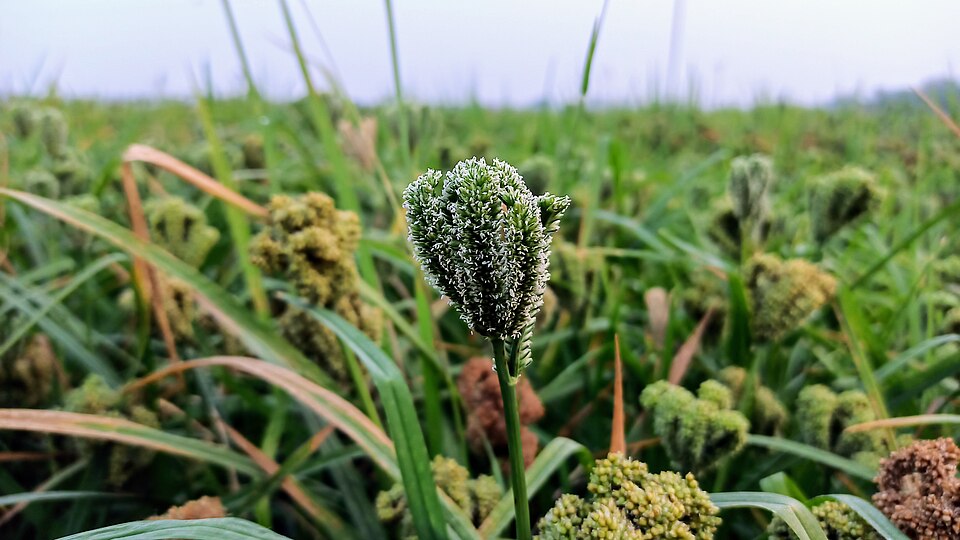
- Assuming that any hardy cereal must be a rabi crop because wheat and barley are.
- Treating a printed temperature and rainfall range as precise when published ranges for the same crop differ.
- Reading a 'which statement is correct' stem as if only one statement could possibly be true.
Millets are asked as season, soil, producing State and nutritional value. The season is the most reliably keyable of these, and it is the one this paper got right while the rest of the item came apart.
Which one of the following crops is not cultivated under dryland farming?
- (a) Jowar
- (b) Ragi
- (c) Sugarcane
- (d) Groundnut
Answer(c) Sugarcane
Places ragi where the syllabus places it — among the hardy crops of dryland farming in regions with under 75 cm of annual rainfall, alongside bajra, moong, gram and guar.
Consider the following statements about millets: 1. Millets are often referred to as climate-resilient crops because they can grow on arid lands with minimal inputs and maintenance. 2. Millets are a good source of minerals, dietary fibre, antioxidants and protein. 3. Millets, including sorghum, account for less than 3% of the global grains trade. Which of the statements given above are correct?
- (a) 1 and 2 only
- (b) 1 and 3 only
- (c) 2 and 3 only
- (d) 1, 2 and 3
Answer(d) 1, 2 and 3
The same paper asks about millets in general and keys it cleanly, which is instructive. There the three statements are each independently verifiable and all three hold; here three statements about one millet also hold, but the stem demands a single correct one.
- practice — not a real PYQ
Which one of the following is a kharif crop?
- (a)Barley
- (b)Ragi
- (c)Mustard
- (d)Gram
Answer(b) Ragi — sown with the south-west monsoon; the other three are rabi crops.
- practice — not a real PYQ
The largest producer of ragi in India is
- (a)Karnataka
- (b)Punjab
- (c)West Bengal
- (d)Gujarat
Answer(a) Karnataka — the crop's principal home in the drier southern plateau.