
Consider the following statements about Laterite soil found in India: 1. Laterite soil is found in high altitudes of Himalaya. 2. It is a very fertile soil. 3. It is a red colour soil due to presence of iron oxide. 4. It is poor in Nitrogen, Potash and organic matter. Which of the statements given above is/are correct?
- (a)3 only
- (b)2 and 4 only
- (c)3 and 4 only
- (d)1, 3 and 4 only
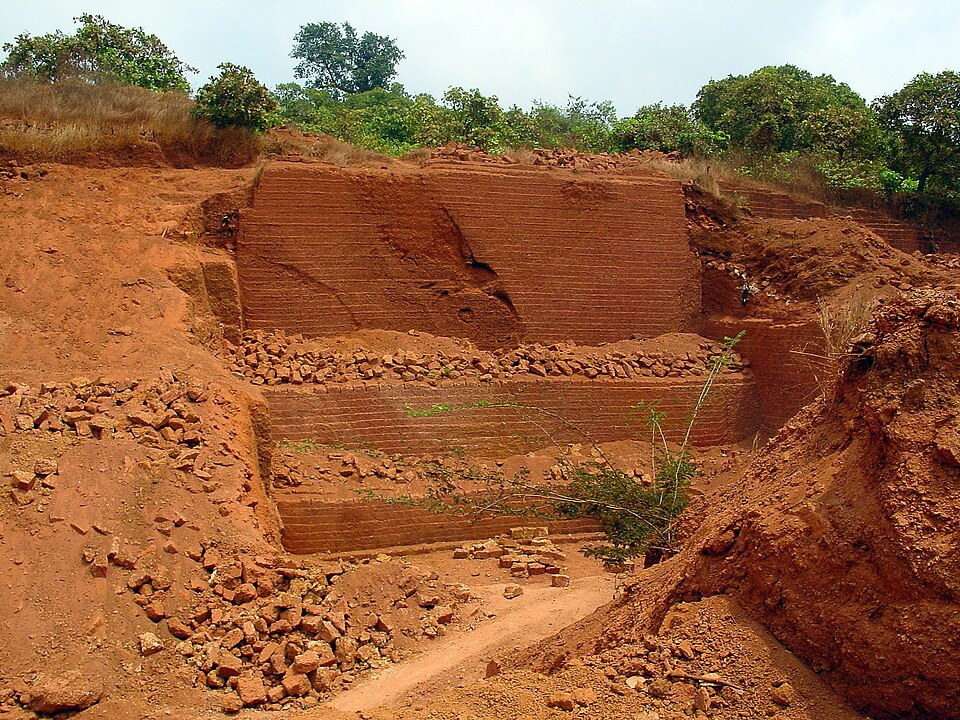
Correct — C, 3 and 4 only. Laterite forms in the humid tropics where heavy seasonal rain leaches silica and the soluble bases out of the parent rock and leaves behind a residue of iron and aluminium oxides. That residue is what statement 3 describes: the red colour comes from iron oxide, and it deepens where the soil dries and hardens. Statement 4 follows from the same process, because the leaching that removes silica also removes nitrogen-bearing organic matter and the soluble bases, leaving a soil that must be manured before it will crop well. Statement 1 is wrong on location — laterite belongs to the summits and plateau surfaces of the Western Ghats, the Eastern Ghats, the Rajmahal hills, the Meghalaya plateau and parts of Karnataka, Kerala, Odisha and Maharashtra, not to the Himalaya. Statement 2 is wrong on fertility, and is close to the opposite of the truth.
- (a)3 only — Names only statement 3, dropping the accurate description of the soil's poverty in statement 4.
- (b)2 and 4 only — Keeps statement 2, which calls laterite very fertile. Leaching is what makes the soil, and leaching is what makes it poor.
- (d)1, 3 and 4 only — Adds statement 1, which places laterite in the high Himalaya. The high altitudes it does occupy are those of the peninsular hills and plateaus, in a climate of heavy seasonal rain.
Laterisation is a soil-forming process rather than a rock type. Where the temperature is high and the rain heavy and seasonal, water moving down the profile carries away silica and the soluble bases and leaves a concentration of iron and aluminium sesquioxides near the surface. Alternating wet and dry seasons then harden that residue, which is why laterite can be cut soft from the ground and sets like brick in the air — the property that gave it its name and that has made it a building material in Kerala, Goa and coastal Karnataka for centuries.
One caution worth carrying, because it is the reason candidates argue about statement 4. Standard descriptions of laterite agree that it is poor in nitrogen, phosphate, calcium and organic matter, but they do not all agree about potash — one widely used school passage lists iron oxide and potash as being present in excess, while other standard geography texts count potash among the deficiencies along with lime. The chemistry of the process supports the second reading, since potassium is one of the soluble bases that leaching removes, and the Commission has keyed the question that way. Where crops are concerned, laterite supports tea, coffee, cashew, rubber and tapioca well after manuring, and is used for grazing or scrub where it is not improved.
- Laterite forms under high temperature and heavy seasonal rainfall by the leaching of silica and soluble bases, leaving iron and aluminium oxides behind.
- Its red colour is due to iron oxide, and it hardens on exposure to air, which is why it is quarried as a building block.
- In India it occurs on the summits of the Western and Eastern Ghats, the Rajmahal hills, the Meghalaya plateau and in parts of Karnataka, Kerala, Odisha and Maharashtra.
- It is low in organic matter and needs manuring; tea, coffee, cashew, rubber and tapioca are the crops it supports after improvement.
- Laterite is a soil-forming process of the humid tropics, so it is not found in the cold, dry high Himalaya.
- Assuming that a red soil must be fertile because red soils of the peninsula grow crops; laterite is a poorer relation.
- Reading 'high altitudes' as necessarily meaning the Himalaya.
- Mixing up laterite with black cotton soil, which is clayey, moisture-retentive and rich in lime, iron and magnesia.
As a four-statement item where two statements attack location and fertility — the two things a candidate is most likely to have half-learned about this soil.
Which of the following statements regarding laterite soils of India are correct? 1. They are generally red in colour. 2. They are rich in nitrogen and potash. 3. They are well-developed in Rajasthan and UP. 4. Tapioca and cashew nuts grow well on these soils. Select the correct answer using the codes given below.
- (a) 1, 2 and 3
- (b) 2, 3 and 4
- (c) 1 and 4
- (d) 2 and 3 only
Answer(c) 1 and 4
The same soil, tested with the same two traps in mirror image. There the false statements claim it is rich in nitrogen and potash and that it is developed in Rajasthan and Uttar Pradesh; here they claim it is very fertile and found in the Himalaya. Both papers treat nitrogen and potash as deficiencies rather than surpluses.
- practice — not a real PYQ
Laterite soil is formed mainly by
- (a)the deposition of silt by rivers
- (b)intense leaching under high temperature and heavy seasonal rainfall
- (c)the weathering of basalt in a dry climate
- (d)the accumulation of salts in an arid climate
Answer(b) intense leaching under high temperature and heavy seasonal rainfall.
- practice — not a real PYQ
Which one of the following crops is commonly grown on laterite soils in India?
- (a)Wheat
- (b)Cashew
- (c)Mustard
- (d)Barley
Answer(b) Cashew — along with tea, coffee, rubber and tapioca on improved laterite tracts.