
Consider the following statements about millets: 1. Millets are often referred to as climate-resilient crops because they can grow on arid lands with minimal inputs and maintenance. 2. Millets are a good source of minerals, dietary fibre, antioxidants and protein. 3. Millets, including sorghum, account for less than 3% of the global grains trade. Which of the statements given above are correct?
- (a)1 and 2 only
- (b)1 and 3 only
- (c)2 and 3 only
- (d)1, 2 and 3
Correct — D, 1, 2 and 3. All three statements are lifted, almost word for word, from the Food and Agriculture Organization's own material for the International Year of Millets 2023, which is what makes them unarguable. FAO writes that millets 'can grow on arid lands with minimal inputs and are resilient to changes in climate', which is statement 1. It writes that millets 'are good sources of minerals, dietary fibre, antioxidants and protein', which is statement 2. And under its heading on trade it writes that 'millets, including sorghum, account for less than 3% of the global grains trade', which is statement 3 exactly. There is no false line to find here — the item rewards anyone who followed the International Year of Millets.
- (a)1 and 2 only — Rejects the trade figure, which is the one many candidates doubt because millets loom so large in Indian policy. India is the world's largest producer, but very little of the world's millet crosses a border — most is eaten close to where it is grown.
- (b)1 and 3 only — Rejects the nutrition statement, though minerals, dietary fibre, antioxidants and protein are exactly the four properties FAO lists. Millets are also gluten-free, low on the glycaemic index and a cost-effective source of iron.
- (c)2 and 3 only — Rejects the climate-resilience statement, which is the single best-established claim about millets — they are often the only crop that can be harvested in the dry season in arid areas.
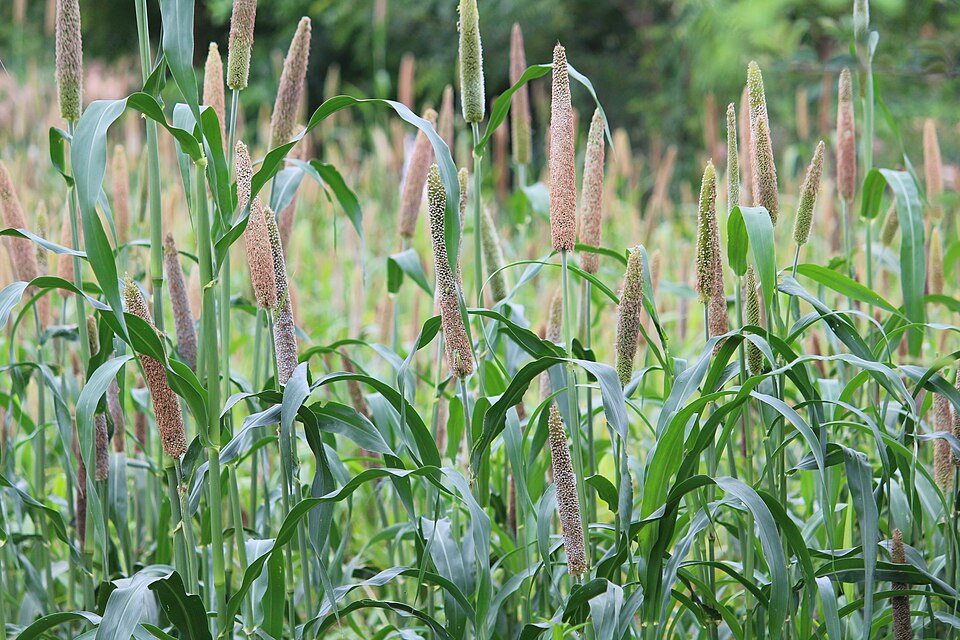
Millets are a group of small-seeded cereals — sorghum, pearl millet, finger millet, foxtail, little, kodo, barnyard and proso millets, along with fonio, teff and Job's tears — grown mostly on marginal, rainfed land. They tolerate heat, drought and poor soils, mature fast, and need far less water than rice or sugarcane, which is why they are treated as a climate-adaptation crop rather than merely a traditional one.
The three statements together describe why millets became a policy priority. Their agronomy suits a warming, water-short future; their nutrition profile suits diets short of micronutrients and fibre; and their tiny share of world trade is presented by FAO not as a weakness but as an opportunity to diversify a grain trade that is dangerously concentrated in wheat, rice and maize. The United Nations General Assembly declared 2023 the International Year of Millets in March 2021 on India's proposal, and FAO led the observance — this paper was set in August 2023, in the middle of that year. India rebranded millets as Shree Anna in the 2023-24 Budget, and the Hindi page of this very booklet prints the word as श्रीअन्न. Since then the International Year has ended, but the crop's promotion has continued through procurement, the public distribution system and export promotion.
- FAO on agronomy: millets 'can grow on arid lands with minimal inputs and are resilient to changes in climate'.
- FAO on nutrition: millets 'are good sources of minerals, dietary fibre, antioxidants and protein'; they are also gluten-free and low on the glycaemic index.
- FAO on trade: millets, including sorghum, account for less than 3% of the global grains trade.
- The UN General Assembly declared 2023 the International Year of Millets in March 2021 on a proposal from India; FAO led the observance.
- India is the world's largest producer of millets; the crop was rebranded Shree Anna in the 2023-24 Union Budget.
- Rejecting the under-3% trade figure because India produces so much — production and trade are different things.
- Assuming any statement quoting a precise percentage must be the planted error.
- Confusing the International Year of Millets (2023) with the International Year of Camelids (2024) or of Glass (2022).
Asked as a three-statement item drawn straight from FAO's campaign material, so a candidate who read the source finds nothing to reject.
Consider the following crops of India : 1. Groundnut 2. Sesamum 3. Pearl millet Which of the above is/are predominantly rainfed crop/crops?
- (a) 1 and 2 only
- (b) 2 and 3 only
- (c) 3 only
- (d) 1, 2 and 3
Answer(d) 1, 2 and 3
The agronomic half of this CAPF item, tested a decade earlier. Pearl millet is grown on marginal land under the monsoon with little or no irrigation, which is exactly the property FAO calls climate resilience.
The resolution adopted by the United Nations General Assembly on 3 March, 2021 decided to celebrate the year 2023 as the International Year of
- (a) Basic Sciences for Sustainable Development
- (b) Glass
- (c) Millets
- (d) Camelids
Answer(c) Millets
The current-affairs anchor behind this whole item, asked in the same year by CDS. Once you know 2023 was the International Year of Millets, you also know where the CAPF statements came from — FAO's campaign pages for that year.
- practice — not a real PYQ
The United Nations General Assembly declared which one of the following years as the International Year of Millets?
- (a)2021
- (b)2022
- (c)2023
- (d)2024
Answer(c) 2023 — declared in March 2021 on India's proposal, with FAO leading the observance.
- practice — not a real PYQ
Which one of the following is not a millet?
- (a)Ragi
- (b)Bajra
- (c)Jowar
- (d)Arhar
Answer(d) Arhar — pigeon pea, a pulse. Ragi (finger millet), bajra (pearl millet) and jowar (sorghum) are all millets.