
The Battle of Rakshasi-Tangadi is popularly known as the
- (a)Battle of Talikota
- (b)Battle of Khanwa
- (c)Battle of Panipat
- (d)Battle of Dharmat
Correct — A, Battle of Talikota. The battle of 23 January 1565 was fought near the villages of Rakkasagi and Tangadigi on the Krishna, which is why Indian scholarship often calls it Rakshasi-Tangadi; the popular name borrows the nearby town of Talikota instead. A coalition of the Deccan sultanates — Ahmadnagar, Bijapur, Golconda and Bidar — beat the Vijayanagara army, and Aliya Rama Raya, the empire's effective ruler, was captured and beheaded on the field.
- (b)Battle of Khanwa — Khanwa was fought in 1527 near Agra, between Babur and Rana Sanga of Mewar — a north Indian battle two generations earlier and unconnected with the Deccan.
- (c)Battle of Panipat — Panipat is in Haryana and gave its name to three battles (1526, 1556 and 1761), all on the route into the Ganga plain rather than on the Krishna.
- (d)Battle of Dharmat — Dharmat, near Ujjain, was fought in 1658 during the Mughal war of succession between Aurangzeb and the army sent by Dara Shukoh.
Talikota is the hinge of Deccan history. Rama Raya had spent two decades playing the successor sultanates of the Bahmani kingdom against one another; when marriage diplomacy brought four of them into one alliance, that strategy collapsed in a single day. The victors then plundered Vijayanagara city, and the imperial centre was never rebuilt.
Battles that carry two names are a favourite one-line item, and the reason is usually geography — armies camp near one place and historians later name the day after another. Here Rakkasagi and Tangadigi are the villages on the ground; Talikota is the town that entered the textbooks. Note also that the empire did not end in 1565: Tirumala, Rama Raya's brother, founded the Aravidu dynasty and ruled from Penukonda, and Vijayanagara's fragments lasted into the seventeenth century.
- Fought on 23 January 1565 near Rakkasagi and Tangadigi, close to Talikota in present-day Karnataka.
- The alliance was Ahmadnagar, Bijapur, Golconda and Bidar under Husain Nizam Shah I, Ali Adil Shah I, Ibrahim Quli Qutb Shah and Ali Barid Shah I.
- Aliya Rama Raya commanded for Vijayanagara and was executed after the defeat.
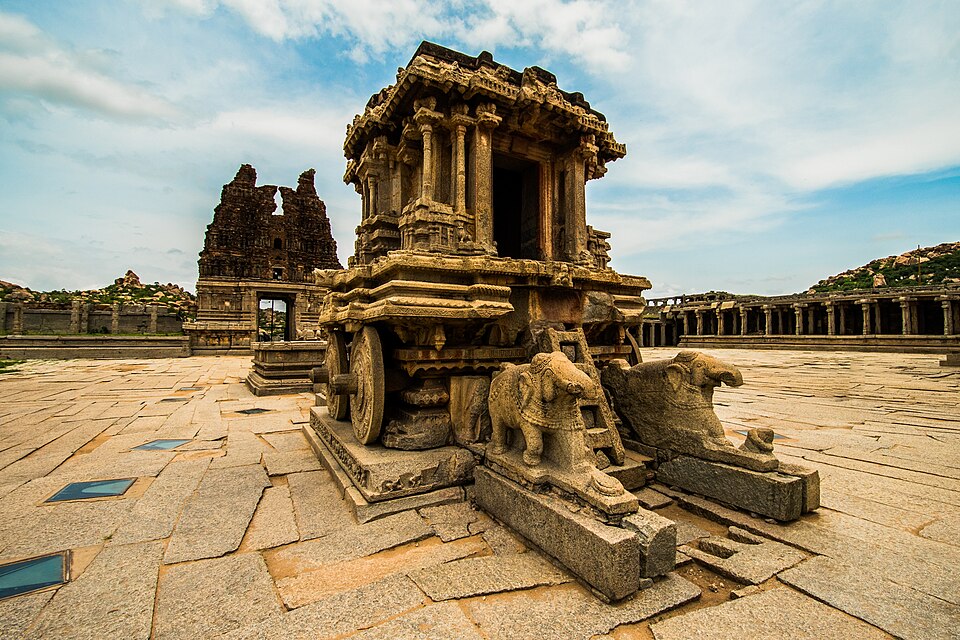
- The victorious armies sacked Vijayanagara; the site is Hampi, a UNESCO World Heritage Site in Karnataka.
- Tirumala moved the surviving state to Penukonda and founded the Aravidu dynasty, the empire's fourth.
- Placing a Deccan battle in the north because Panipat and Khanwa are the better-known names.
- Assuming the empire ended in 1565 rather than shifting its capital.
Alternative-name pairing, or a date-and-participants item on the Deccan alliance.
Domingo Paes, the medieval traveller, has described the city of
- (a) Madurai
- (b) Vijayanagara
- (c) Arikamedu
- (d) Gingee
Answer(b) Vijayanagara
The city that was sacked after this battle, approached through the Portuguese traveller whose account of it survives.
- practice — not a real PYQ
The ruler of Vijayanagara who was defeated and killed in the battle of 1565 was
- (a)Krishnadevaraya
- (b)Aliya Rama Raya
- (c)Achyuta Raya
- (d)Tirumala Deva Raya
Answer(b) Aliya Rama Raya — he was captured and beheaded on the field, and his brother Tirumala regrouped the state at Penukonda.
- practice — not a real PYQ
After the defeat of 1565, the surviving Vijayanagara state was ruled from
- (a)Penukonda
- (b)Warangal
- (c)Madurai
- (d)Bidar
Answer(a) Penukonda — Tirumala shifted there and founded the Aravidu dynasty.