
Ashokan inscriptions in Afghanistan are written in which one of the following scripts?
- (a)Brahmi
- (b)Sharada
- (c)Kharoshthi
- (d)Greek-Aramaic
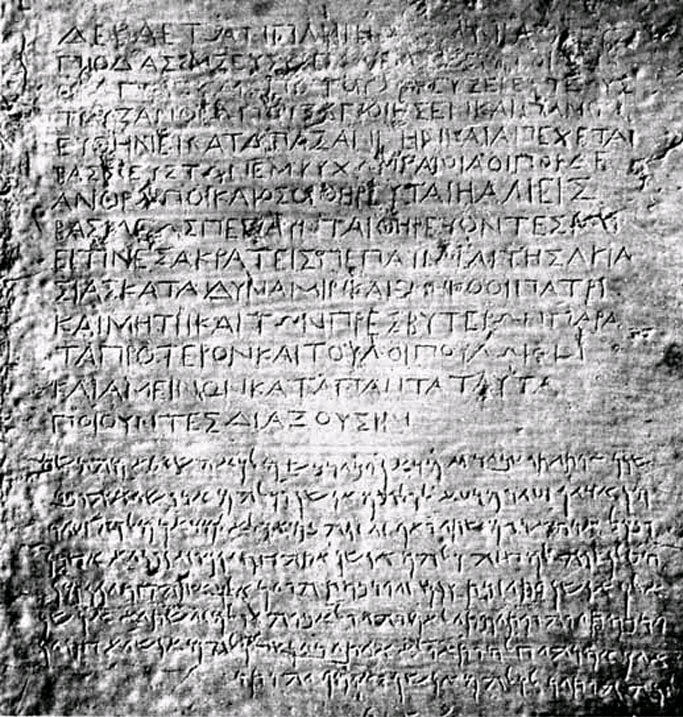
Correct — D, Greek-Aramaic. What Ashoka left in Afghanistan is written in the languages his subjects there actually read. The bilingual rock inscription at Chehel Zina near Kandahar, cut around 260 BCE in the eighth year of his reign, carries the same message in Greek at the top and Aramaic below; a separate Kandahar edict is in Greek alone. Greek came with the Hellenistic settlers of Arachosia and Aramaic was the old chancery language of the Achaemenid empire, so the Mauryan court simply used the scripts already in office there.
- (a)Brahmi — Brahmi carries most of the edicts inside India, from Kalsi to Girnar and Dhauli, but it was not used for the Afghan inscriptions.
- (b)Sharada — Sharada is a much later script of Kashmir and the north-west, from about the eighth century CE — a thousand years after Ashoka.
- (c)Kharoshthi — The best trap in the item. Kharoshthi is the north-western script and Ashoka did use it, but at Shahbazgarhi and Mansehra, which lie in present-day Pakistan, not Afghanistan.
Ashoka's edicts are one message in several writing systems, chosen by region. Brahmi across most of the subcontinent, Kharoshthi in the north-west, and Greek with Aramaic in the far west where the Mauryan frontier met the Hellenistic and former Achaemenid world.
The examiner is testing whether a candidate reads 'Afghanistan' as a place with its own writing history rather than as simply 'the north-west'. Kharoshthi is the reflex answer for anything north-western, so the item is really asking you to place Shahbazgarhi and Mansehra correctly on today's map. The Kandahar edict also matters as evidence: it is among the earliest of Ashoka's inscriptions and it shows the Mauryan state translating dhamma into a Greek philosophical vocabulary for a Greek-reading audience.
- The Kandahar bilingual rock inscription at Chehel Zina, about 260 BCE, is in Greek and Aramaic and is catalogued as KAI 279.
- It was found under about a metre of rubble during excavation near Kandahar in 1958.
- A second Afghan inscription, the Kandahar Greek edict, is in Greek only.
- Kharoshthi versions of the major rock edicts are at Shahbazgarhi and Mansehra in present-day Pakistan.
- James Prinsep deciphered Brahmi in 1837, which is what made the rest of the corpus readable.
- Answering Kharoshthi for anything described as north-western.
- Dating Sharada to the Mauryan period because it sounds ancient.
Script-to-site matching, or a single-line item naming a region and asking for the script.
Which one of the following scripts of ancient India was written from right to left?
- (a) Brahmi
- (b) Nandnagari
- (c) Sharada
- (d) Kharosthi
Answer(d) Kharosthi
Kharoshthi from the other direction — prelims asked which ancient Indian script ran right to left, and the answer is the same north-western script that is the trap here.
Which one of the following statements is correct?
- (a) Brahmi, used for writing many Ashokan inscriptions, shows local variations.
- (b) The system of hieroglyphic writing was developed in ancient Mesopotamia.
- (c) The system of cuneiform writing developed around 3rd millennium BCE in Egypt.
- (d) An ancient script, Kharoshthi was widely used in the southern part of India.
Answer(a) Brahmi, used for writing many Ashokan inscriptions, shows local variations.
CAPF returned to Ashokan writing the next year, that time on how Brahmi varies locally across the edicts and where Kharoshthi was actually used.
- practice — not a real PYQ
Ashokan rock edicts in the Kharoshthi script are found at
- (a)Girnar and Dhauli
- (b)Shahbazgarhi and Mansehra
- (c)Kalsi and Sopara
- (d)Jaugada and Yerragudi
Answer(b) Shahbazgarhi and Mansehra — the two north-western sites, in present-day Pakistan.
- practice — not a real PYQ
Aramaic appears in Ashoka's Afghan inscriptions mainly because it had been
- (a)the language of Buddhist canon
- (b)the chancery language of the Achaemenid empire
- (c)the script of the Indus seals
- (d)the court language of the Satavahanas
Answer(b) the chancery language of the Achaemenid empire — administrative Aramaic outlived Persian rule in the region.