
Consider the following missiles: 1. Agni-I 2. BrahMos 3. Dhanush Which of the above is/are cruise missile/missiles?
- (a)1 and 2
- (b)2 only
- (c)1 and 3
- (d)3 only
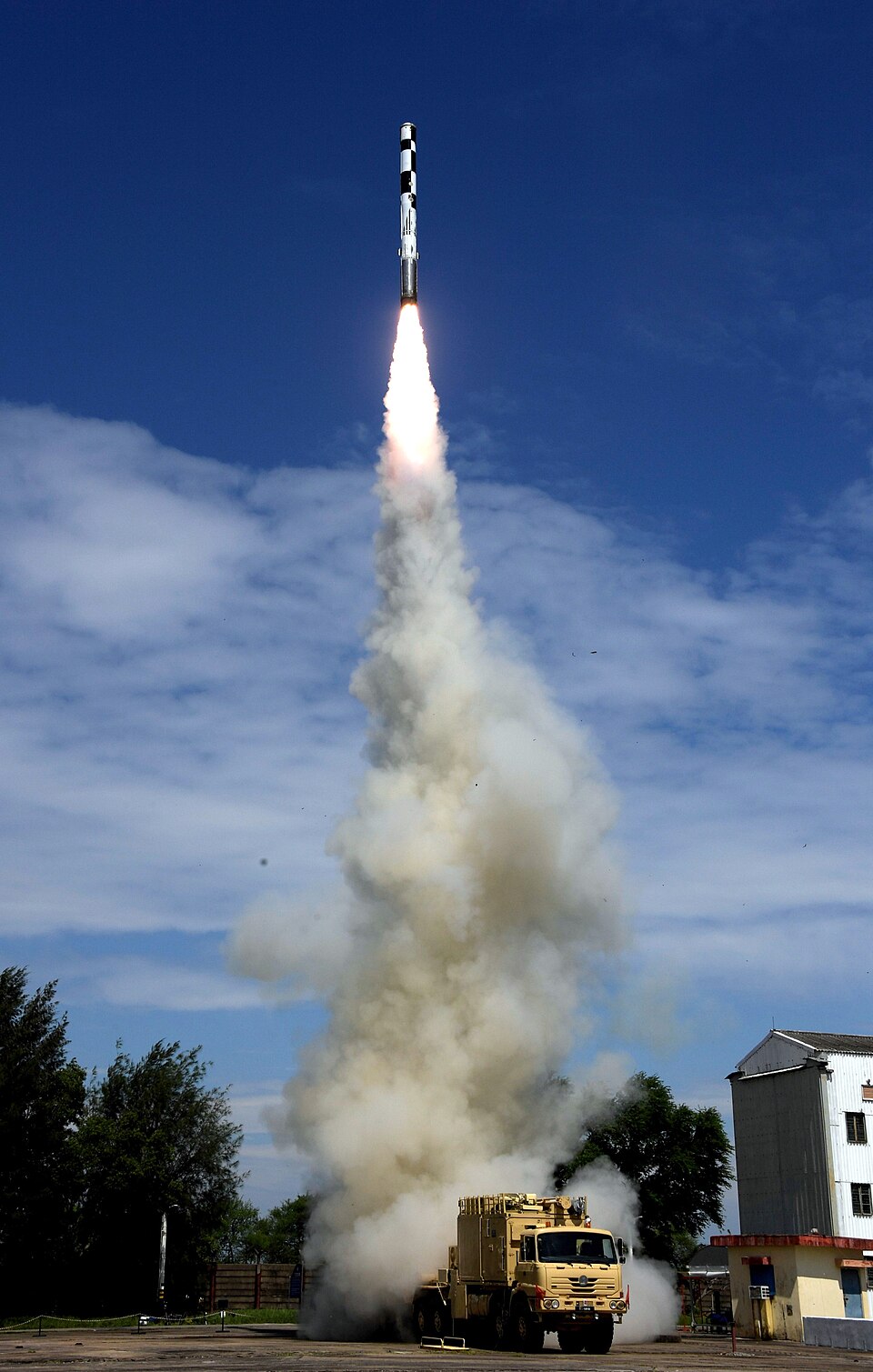
Correct — B, 2 only. BrahMos is the only cruise missile in the list. It is jet-propelled for almost the whole of its flight — a solid rocket booster gets it moving and a liquid-fuelled ramjet then sustains it at roughly Mach 2.8 to 3 on a low, guided, aerodynamically supported path. Agni-I is a surface-to-surface ballistic missile, boosted by a rocket motor and then coasting on an arcing trajectory under gravity. Dhanush is the ship-launched member of the Prithvi family and is also ballistic.
- (a)1 and 2 — Agni-I is the first of the Agni family of ballistic missiles. Its flight is a boost phase followed by a ballistic arc, which is the definition of the class BrahMos does not belong to.
- (c)1 and 3 — This picks out the two ballistic missiles and leaves out the cruise missile, which is the exact reverse of what was asked.
- (d)3 only — Dhanush is a naval variant of the Prithvi short-range ballistic missile, launched from a ship. Being sea-based does not make a missile a cruise missile.
A cruise missile flies like an aircraft — it stays in the atmosphere, is powered for most of its flight by an air-breathing engine, and is guided throughout, so it can hug the terrain or the sea surface. A ballistic missile is powered only in the opening minutes and then follows an unpowered trajectory shaped by gravity, which takes it far higher and much further.
The two classes are the most reliably examined distinction in this part of the syllabus, and the names give little away, so the family has to be learnt: Agni and Prithvi are ballistic, Dhanush is Prithvi at sea, Nirbhay and BrahMos are cruise. As of the 2022 exam BrahMos had just entered the export market — the contract with the Philippines was signed in January 2022, and the first battery was delivered in April 2024. The export version's range is the MTCR-era 290 km; variants in Indian service reach considerably further.
- BrahMos is a two-stage weapon: a solid rocket booster followed by a liquid-fuelled ramjet, cruising at Mach 2.8 to 3.
- It is built by BrahMos Aerospace, a joint venture of India's DRDO and Russia's NPO Mashinostroyeniya; the name joins the Brahmaputra and the Moskva.
- The export range is 290 km, the figure printed in older question papers; Indian-service ship and land variants now reach much further.
- Agni-I is a short-range ballistic missile; Dhanush is the ship-launched variant of the Prithvi.
- Nirbhay is India's subsonic long-range cruise missile, and is the other name worth carrying into the examination hall.
- Treating a sea-launched missile as automatically a cruise missile.
- Assuming supersonic speed marks a cruise missile; ballistic missiles are faster still on re-entry.
- Confusing Dhanush the missile with Dhanush the artillery gun, which is a towed howitzer.
Asked as a sorting item over three or four missile names, or as a statement pair contrasting the flight profiles of the two classes.
Consider the following statements : 1. Ballistic missiles are jet-propelled at subsonic speeds throughout their flights, while cruise missiles are rocket-powered only in the initial phase of flight. 2. Agni-V is a medium-range supersonic cruise missile, while BrahMos is a solid-fuelled intercontinental ballistic missile. Which of the statements given above is/are correct?
- (a) 1 only
- (b) 2 only
- (c) Both 1 and 2
- (d) Neither 1 nor 2
Answer(d) Neither 1 nor 2
The same distinction tested by inverting it — both statements swap the two classes, and the second one specifically calls BrahMos ballistic. A candidate who can sort the CAPF list can dismiss both claims at sight.
With reference to BrahMos missile, consider the following statements : 1. It has a flight range of up to 290 km. 2. It is capable of attaining a speed of 2·8 Mach. 3. Its cruising altitude could be up to 30 km. Which of the statements given above is/are correct ?
- (a) 1 and 2
- (b) 2 only
- (c) 1 and 3
- (d) 3 only
Answer(a) 1 and 2
The same missile examined on its numbers rather than its class — the 290 km export range and the speed of Mach 2.8 are right, while the claimed cruising altitude of 30 km is far too high for a weapon designed to fly low.
- practice — not a real PYQ
Which one of the following is a subsonic long-range cruise missile developed by India?
- (a)Agni-III
- (b)Nirbhay
- (c)Prithvi-II
- (d)Shaurya
Answer(b) Nirbhay — a turbofan-powered cruise missile flying below the speed of sound; the other three are ballistic or quasi-ballistic.
- practice — not a real PYQ
A ballistic missile differs from a cruise missile chiefly in that it
- (a)is powered throughout its flight
- (b)flies at a low altitude hugging the terrain
- (c)is unpowered for most of its flight and follows a gravity-shaped path
- (d)can only be launched from a ship
Answer(c) is unpowered for most of its flight and follows a gravity-shaped path — the engine burns only during the boost phase.