
With reference to India's defence, consider the following helicopters: 1. Cheetah 2. Chetak 3. Rudra Which of the above has/have turret gun, rocket system and air-to-air missile?
- (a)1 and 2
- (b)2 only
- (c)1 and 3
- (d)3 only
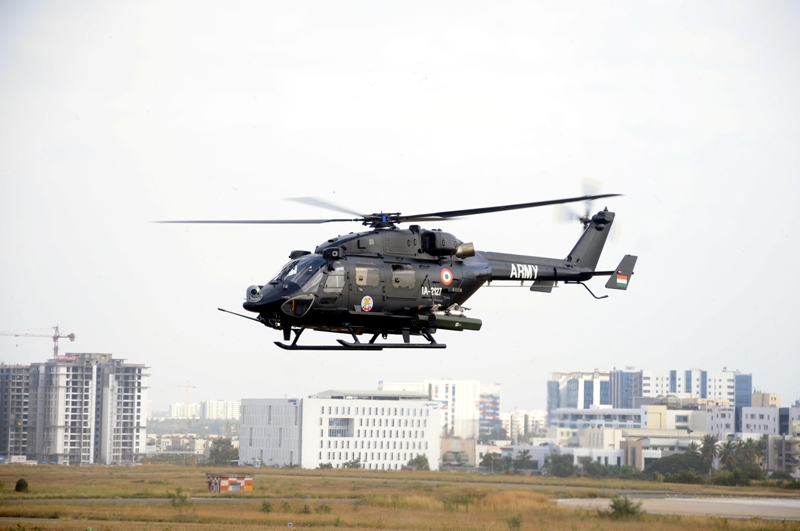
Correct — D, 3 only. Rudra, also called the ALH-WSI, is the weaponised version of HAL's Dhruv advanced light helicopter, and it is the only armed machine on this list. Its armed variant carries a 20 mm turret gun, 70 mm rocket pods, anti-tank guided missiles and air-to-air missiles, along with a forward-looking infrared sensor and day-and-night cameras — which matches the three items named in the stem exactly. Cheetah and Chetak are unarmed light helicopters of an older generation, licence-built from French designs and used for observation, liaison, casualty evacuation and high-altitude supply.
- (a)1 and 2 — Cheetah and Chetak are precisely the two that carry no weapon system of this kind. Their value lies in lifting loads at very high altitude and in reaching posts other helicopters cannot.
- (b)2 only — Chetak is a utility helicopter derived from the Alouette III, flown by all three services for liaison and training rather than for attack.
- (c)1 and 3 — Rudra belongs, but Cheetah does not. The Cheetah is a high-altitude workhorse, celebrated for operating over the Siachen glacier, and it is unarmed.
Indian Army Aviation flies three overlapping families: elderly French-designed light helicopters built under licence, the indigenous Dhruv and its armed derivative, and a dedicated attack helicopter line. Only the armed derivatives carry guns, rockets and missiles, and the stem's list of weapons is a description of one specific machine.
The question rewards recognising a family tree rather than memorising specifications. Rudra is the Dhruv with weapons integrated; the same programme produced the Light Combat Helicopter, later named Prachand, which was inducted in October 2022, two months after this paper was written. Cheetah and Chetak date from the 1960s, and their replacement has been a long-standing procurement question — worth noting as a present-day line, because the fleet the exam describes is steadily being retired.
- Rudra is the ALH-WSI, the weapon-systems-integrated version of the HAL Dhruv; development was sanctioned in 1998 and the prototype flew in August 2007.
- Its armament comprises a 20 mm turret gun, 70 mm rocket pods, anti-tank guided missiles and air-to-air missiles.
- Cheetah is the licence-built Aérospatiale Lama and Chetak the licence-built Alouette III; both are unarmed utility types.
- The Cheetah is the type associated with sustaining posts on the Siachen glacier, the highest helicopter operations in the world.
- HAL Prachand, the Light Combat Helicopter developed from the same line, was inducted in October 2022.
- Confusing Cheetah with the armed types because of the predatory name.
- Assuming Dhruv itself is armed; the weapons belong to the Rudra variant.
- Mixing up Prachand, the Light Combat Helicopter, with Rudra, the armed Dhruv.
Asked as a sorting item over three or four platform names, or as a 'which of the following is indigenously developed' item on the same fleet.
In the context of the Indian defence, what is ‘Dhruv’?
- (a) Aircraft-carrying warship
- (b) Missile-carrying submarine
- (c) Advanced light helicopter
- (d) Intercontinental ballistic missile
Answer(c) Advanced light helicopter
The parent airframe of the machine this CAPF question is about. Rudra is the Dhruv with a turret gun, rocket pods and missiles added, so identifying Dhruv correctly is the first half of answering the CAPF item.
- practice — not a real PYQ
HAL Prachand, inducted by the Indian armed forces, is a
- (a)light combat helicopter
- (b)basic trainer aircraft
- (c)unmanned aerial vehicle
- (d)transport aircraft
Answer(a) light combat helicopter — a dedicated attack helicopter developed by HAL from the Dhruv line for high-altitude operations.
- practice — not a real PYQ
The Cheetah helicopter of the Indian armed forces is best known for
- (a)anti-submarine warfare
- (b)operations at extreme high altitude
- (c)long-range troop transport
- (d)airborne early warning
Answer(b) operations at extreme high altitude — it is the type used to sustain posts on the Siachen glacier.