
Which one of the following is a semi-conductor device that is used to increase the power of the incoming signals by preserving the shape of the original signal?
- (a)Register
- (b)Transistor
- (c)Flip-flop
- (d)Diode
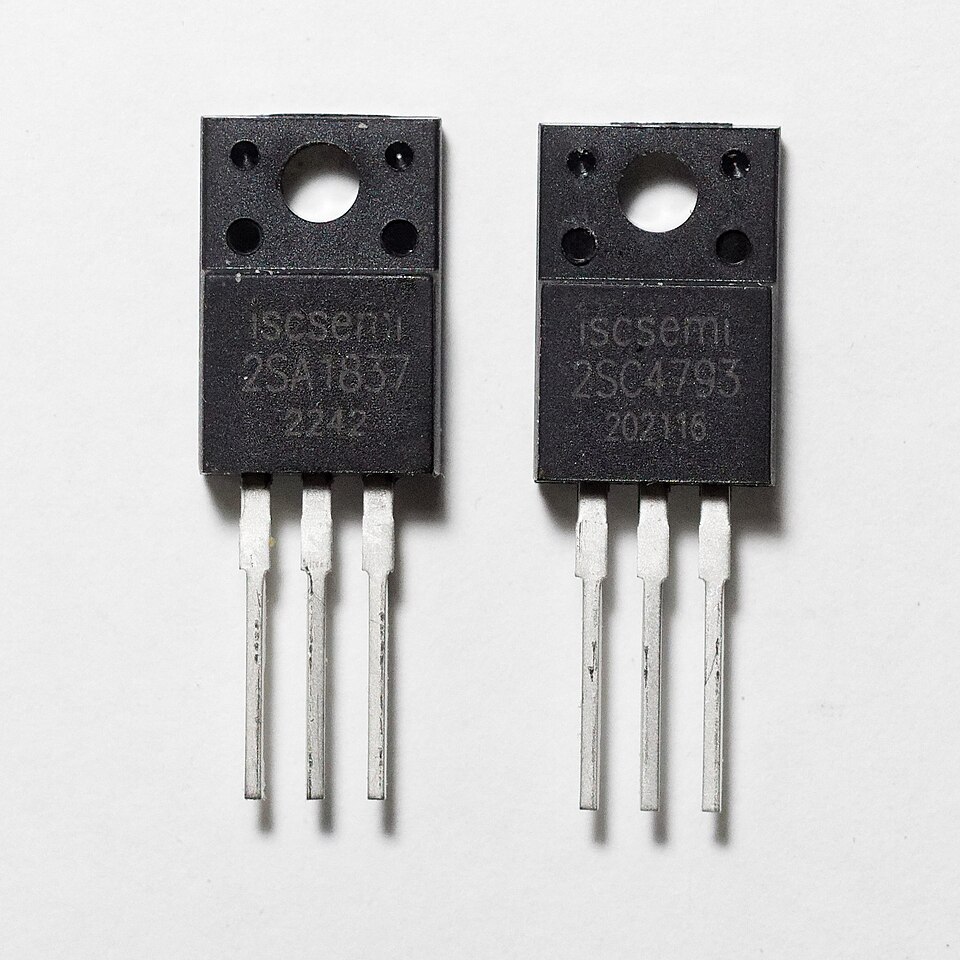
Correct — B, Transistor. A transistor is a three-terminal semiconductor device, and the third terminal is what makes amplification possible. In a bipolar junction transistor a small current fed into the base controls a much larger current flowing from emitter to collector, so the output is a scaled-up copy of the input — bigger in power, unchanged in waveform. That is exactly the description in the stem: the power of the incoming signal is increased while the shape of the original signal is preserved.
- (a)Register — A register is a small, fast storage location inside a processor that holds bits while a computation runs. It stores data and does nothing to a signal's power. It is also easily misread as 'resistor', which is a passive component that opposes current and cannot add power either.
- (c)Flip-flop — A flip-flop is a bistable digital circuit that holds one bit until it is told to change. Transistors are what it is built from, but its purpose is memory, not amplification.
- (d)Diode — A diode is a semiconductor, but it has only two terminals and therefore no control electrode. It lets current pass one way and blocks the other, so it rectifies and clips a signal rather than amplifying it.
A transistor is a semiconductor device with three regions and three terminals — in a bipolar junction transistor the emitter, base and collector, arranged either as npn or as pnp. A small signal applied between base and emitter controls the far larger emitter-to-collector current, which is why the device can amplify. Driven hard between fully on and fully off, the same device works as a switch, and that is the role in which billions of transistors sit inside every processor.
The stem is written to be answered on the word 'preserving'. Amplification means the output is proportional to the input, so the waveform is reproduced at a larger scale rather than reshaped; a device that changed the shape would be distorting or rectifying, not amplifying. Two of the wrong options belong to digital electronics, where information is held rather than magnified, and the third is a two-terminal device that cannot be controlled by a third signal at all. It is worth remembering the invention as well as the function — the transistor was made at Bell Laboratories in 1947 by John Bardeen, Walter Brattain and William Shockley, who shared the Nobel Prize in Physics for it in 1956, and it displaced the bulky, power-hungry vacuum tube that had done the amplifying until then.
- A bipolar junction transistor has three terminals — emitter, base and collector — and comes in npn and pnp forms.
- A small base current controls a much larger collector current, so the device amplifies; the ratio of the two is its current gain.
- The transistor was developed at Bell Laboratories in 1947 by Bardeen, Brattain and Shockley, who shared the 1956 Nobel Prize in Physics.
- A diode has only two terminals, so it can rectify but never amplify.
- Used as a switch rather than an amplifier, the transistor is the building block of every digital logic circuit.
- Reading 'Register' as 'resistor' — neither is an amplifier, but they are different components.
- Choosing the diode because it is the other semiconductor in the list, without noticing that two terminals leave nothing to control the current with.
- Treating a flip-flop as an amplifier because it is made of transistors.
Asked as a functional description rather than by name — the stem defines amplification and expects the device to be identified from it.
Which one of the following devices is non-ohmic ?
- (a) Conducting copper coil
- (b) Electric heating coil
- (c) Semi conductor diode
- (d) Rheostat
Answer(c) Semi conductor diode
The same device family tested through its current-voltage behaviour. A semiconductor junction does not give current in proportion to voltage, and it is that non-linear junction — two of them, back to back — from which a transistor is built.
In which one of the following devices, the light energy is converted into the electrical energy?
- (a) Light-emitting diode
- (b) Laser diode
- (c) Solar cell
- (d) Transistor
Answer(c) Solar cell
A companion item on what each semiconductor device actually does. It carries the transistor as one of its wrong options precisely because the transistor amplifies and switches rather than converting light into current.
- practice — not a real PYQ
The three terminals of a bipolar junction transistor are
- (a)anode, cathode and gate
- (b)emitter, base and collector
- (c)source, drain and grid
- (d)input, output and earth
Answer(b) emitter, base and collector — the base current controls the emitter-to-collector current.
- practice — not a real PYQ
Which one of the following devices is used mainly to convert alternating current into direct current?
- (a)Transistor
- (b)Diode
- (c)Flip-flop
- (d)Capacitor
Answer(b) Diode — it conducts in one direction only, which is what rectification requires.