
Light weight bullet proof helmets and jackets use which of the following fibres for their production ?
- (a)Kevlar
- (b)Terylene
- (c)Nylon
- (d)None of the above
Correct — A, Kevlar. Kevlar is a para-aramid — chemically poly-paraphenylene terephthalamide — a strong, heat-resistant synthetic fibre developed by Stephanie Kwolek at DuPont in 1965 and related to other aramids such as Nomex and Technora. Its usefulness in armour comes from its molecular architecture. The polymer chains are rigid rods rather than the flexible coils of an ordinary plastic, and when spun they line up almost perfectly along the fibre axis, held side by side by dense hydrogen bonding. The result is a fibre roughly five times stronger than steel on a weight-for-weight basis, which is exactly the property the stem's words 'light weight' are pointing at. A bullet striking a woven Kevlar panel is not stopped by hardness but by energy absorption: the fibres at the point of impact stretch and pull on the fibres woven across them, so the projectile's kinetic energy is spread through the whole fabric and dissipated over many layers instead of punching through one. That is also why soft armour is built from many layers of loosely woven cloth rather than from one stiff sheet. Since option (a) names the fibre correctly, the escape option has nothing left to cover. The other two named fibres are real and important, but neither has the tenacity to do this job at a weight a soldier or a police officer can carry all day.
- (b)Terylene — Terylene is a polyester — polyethylene terephthalate — the fibre of ordinary shirting, curtains and blended suiting, and the same polymer family as the plastic drinks bottle. It is durable, crease-resistant and cheap, and it is nowhere near the tenacity or energy absorption needed to stop a projectile. It is on the list because it is the synthetic fibre an Indian candidate is likeliest to have heard of by trade name.
- (c)Nylon — The strongest wrong answer, and one with real history behind it: nylon, a polyamide, was tough enough that wartime flak jackets were made from it, and it is still used in ballistic liners and in the backing of composite armour. But modern light armour moved to aramids and to ultra-high-molecular-weight polyethylene precisely because nylon cannot deliver the same stopping power without becoming heavy — and the stem's qualifier 'light weight' is what rules it out.
- (d)None of the above — This escape needs all three named fibres to fail, and the first one is the standard answer. The only reading that could support it is that modern armour is not made of Kevlar alone — ultra-high-molecular-weight polyethylene and ceramic plates share the field — but naming one correct material is not a claim that it is the only one.
Synthetic fibres are long-chain polymers spun into filaments, and their properties follow from what the chains are made of and how well they line up. Nylon, invented at DuPont in the 1930s, is a polyamide: chains joined by amide links, tough and elastic, the fibre of parachutes, ropes and stockings. Polyester, marketed as Terylene, joins its units by ester links and gives a stiff, hydrophobic, crease-resistant fibre that dominates ordinary clothing. Aramids are aromatic polyamides — the amide links now join benzene rings rather than flexible carbon chains — and that aromatic backbone is what makes them rigid, heat-resistant and enormously strong along the fibre. Kevlar's rods pack in sheets and are exceptionally hard to pull apart; its cousin Nomex is arranged differently and is used for flame-resistant clothing rather than ballistic protection. The same logic of chain alignment explains ultra-high-molecular-weight polyethylene, the other modern armour fibre: an ordinary plastic becomes extraordinary when its very long chains are drawn into near-perfect parallel order. Body armour in practice combines these fibres with ceramic or steel plates, the fabric absorbing energy and the plate breaking up the projectile.
The stem contains its own discriminator, and it is the phrase 'light weight'. Every one of the three named fibres can stop something if you use enough of it; the question is what stops a bullet at a wearable weight, and that is a specific-strength question — strength per unit mass — on which the aramids are in a different class from ordinary textile polymers. So read the qualifier as the test and rank the options by tenacity rather than by familiarity. It is also worth separating two kinds of 'bullet-proof material', because the two are made of different things and both are examined. Flexible armour worn on the body — vests, helmet shells — is built from woven aramid or polyethylene fibre. Transparent armour — a bank window, a vehicle screen, a riot shield — is laminated polycarbonate, which is a rigid engineering plastic and not a fibre at all. UPSC keyed polycarbonate in exactly that sense in 1995; BPSC here asks about fibres for helmets and jackets, which is the aramid answer. Both are right about different products, and the wording of each stem tells you which is meant.
- Kevlar is a para-aramid, poly-paraphenylene terephthalamide, developed by Stephanie Kwolek at DuPont in 1965; related aramids include Nomex and Technora.
- Its rigid, well-aligned, hydrogen-bonded chains make it roughly five times stronger than steel on a weight-for-weight basis — the property behind 'light weight' armour.
- Soft armour works by energy absorption and spreading, not hardness: fibres at the impact point stretch and load the fibres woven across them, so the projectile's energy is distributed across many layers.
- Terylene is a polyester (polyethylene terephthalate), an ordinary clothing fibre; nylon is a polyamide, tough enough for wartime flak jackets but too heavy for modern light armour at equivalent protection.
- Transparent bullet-resistant material is a different technology altogether — laminated polycarbonate, a rigid engineering plastic rather than a woven fibre.
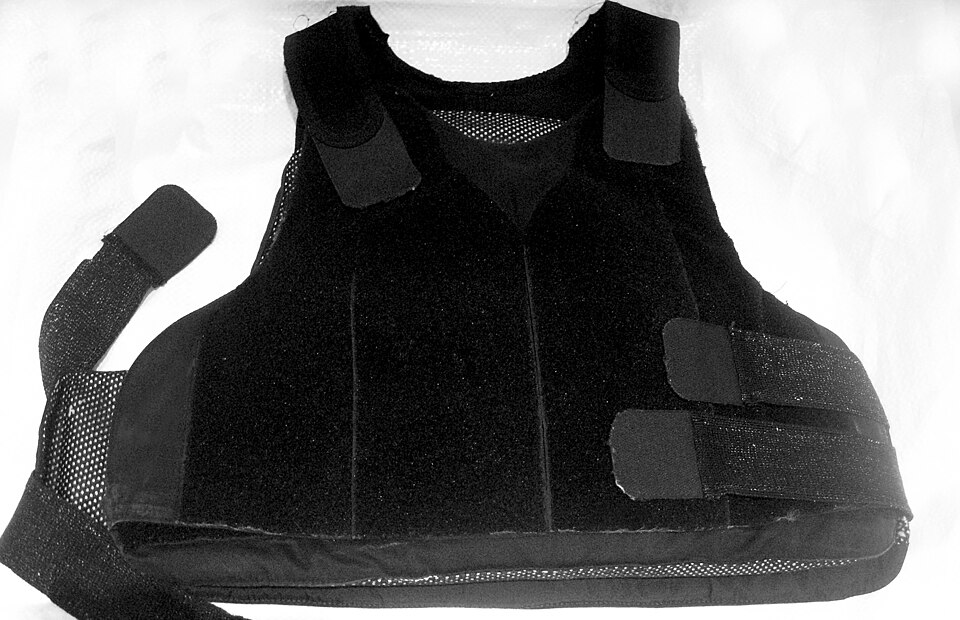
- Reading past 'light weight'. Nylon can be made to stop bullets; it cannot do so at a weight a person can wear all day, which is the whole point of the aramids.
- Treating all bullet-proof material as one thing. Woven aramid is for flexible armour; laminated polycarbonate is for transparent armour, and examiners key each in its own context.
- Assuming a trade name is a polymer class. Kevlar, Terylene and Nomex are brand names — para-aramid, polyester and meta-aramid are what they actually are.
BPSC asks applied materials science by naming a product and asking for the material, with the discriminating condition hidden in an adjective — here 'light weight'. It also likes fibre-to-origin matching, as the 69th CCE did with linen, coir, mohair and down. UPSC asks the same field by polymer class rather than trade name, and expects the candidate to know which polymer suits which kind of protection.
102. Which one of the following polymers is widely used for making bullet-proof material?
- (a) Polyvinyl chloride
- (b) Polyamides
- (c) Polyethylene
- (d) Polycarbonates
Answer(d) Polycarbonates
The same subject with a different product in view, and the pair is worth holding together: UPSC's answer, polycarbonate, is the laminated plastic of transparent armour such as bullet-resistant windows, while a woven aramid like Kevlar is what goes into the helmets and jackets this question names.
Match List–I with List–II : List—I (Cloth) a. Linen b. Coir c. Mohair d. Down List—II (Origin) 1. Coconut plant 2. Flax plant 3. Feathers of duck and geese 4. Angora goat Select the correct answer using the codes given below.
- (a) a b c d 1 3 2 4
- (b) a b c d 4 3 1 2
- (c) a b c d 2 1 4 3
- (d) a b c d 4 1 3 2
Answer(c) a b c d 2 1 4 3
The 69th CCE of September 2023 tested fibres from the natural side — which plant or animal each cloth comes from. Taken with this question, BPSC has now covered both halves of the fibre syllabus, natural origins and synthetic performance.
- practice — not a real PYQ
Kevlar belongs to which class of synthetic polymers ?
- (a)Polyesters
- (b)Para-aramids
- (c)Polycarbonates
- (d)Polyvinyl chlorides
Answer(b) Para-aramids — aromatic polyamides, developed at DuPont in 1965. Nomex is the related meta-aramid used for flame-resistant clothing, and polycarbonate is the rigid plastic used for transparent armour.
- practice — not a real PYQ
Terylene is the trade name of which synthetic fibre ?
- (a)Polyamide
- (b)Polyester
- (c)Acrylic
- (d)Viscose rayon
Answer(b) Polyester — polyethylene terephthalate, the same polymer as the ordinary plastic drinks bottle, widely used in shirting and blended suiting.