
Who among the following is the recipient of Bharat Ratna for 2024 ?
- (a)Chandra Shekhar
- (b)Pranab Mukharjee
- (c)M. S. Swaminathan
- (d)C. N. R. Rao
Correct — C, M. S. Swaminathan. Five Bharat Ratnas were announced for 2024, an unusually large cohort: Karpoori Thakur, Lal Krishna Advani, Chaudhary Charan Singh, P. V. Narasimha Rao and Mankombu Sambasivan Swaminathan — four of the five posthumously. Only one of those names appears among the options, so the question is decided the moment you can recall the cohort. Swaminathan, who lived from 1925 to 2023, was the plant geneticist who made the Green Revolution work in India. Working with Norman Borlaug from the mid-1960s, he led the introduction and Indian adaptation of the semi-dwarf, high-yielding Mexican wheat varieties whose short stiff stems could carry a heavy grain head without lodging under fertiliser and irrigation — the single change that turned India from a food-importing country under the PL-480 arrangements into a self-sufficient one within a decade. He directed the Indian Agricultural Research Institute, served as Director-General of the Indian Council of Agricultural Research, went on to head the International Rice Research Institute at Manila from 1982 to 1988, and was the first recipient of the World Food Prize in 1987, using the money to found the M. S. Swaminathan Research Foundation at Chennai. His second act is the one that still shapes Indian policy debate: he chaired the National Commission on Farmers from 2004, whose reports recommended that the minimum support price be fixed at least fifty per cent above the weighted average cost of production — the formula every subsequent farmers' agitation has cited. There is also a Bihar dimension to this cohort worth carrying: Karpoori Thakur, twice Chief Minister of Bihar, was in the same list, which is why BPSC could reasonably expect its candidates to know the 2024 names.
- (a)Chandra Shekhar — The one name on this list that has never received the Bharat Ratna at all, which makes it the cleanest elimination once you know that. He was Prime Minister of India from November 1990 to June 1991, heading a Samajwadi Janata Party government supported from outside by the Congress, and before that a Young Turk within the Congress and a leader of the Janata Party. Distinguished, but not a Bharat Ratna.
- (b)Pranab Mukharjee — A genuine Bharat Ratna, five years too early. Pranab Mukherjee — President of India from 2012 to 2017, and before that Finance Minister, External Affairs Minister and Defence Minister — received the award in 2019, in a cohort with Nanaji Deshmukh and Bhupen Hazarika. The option works by pairing a real recipient with the wrong year, which is how most award questions are built.
- (d)C. N. R. Rao — The other real recipient with the wrong year, and the trap for a candidate who reasons 'the answer must be a scientist'. Chintamani Nagesa Ramachandra Rao, the solid-state and materials chemist and National Research Professor, received the Bharat Ratna in 2014 along with Sachin Tendulkar. Two scientists on one page is deliberate; only Swaminathan belongs to 2024.
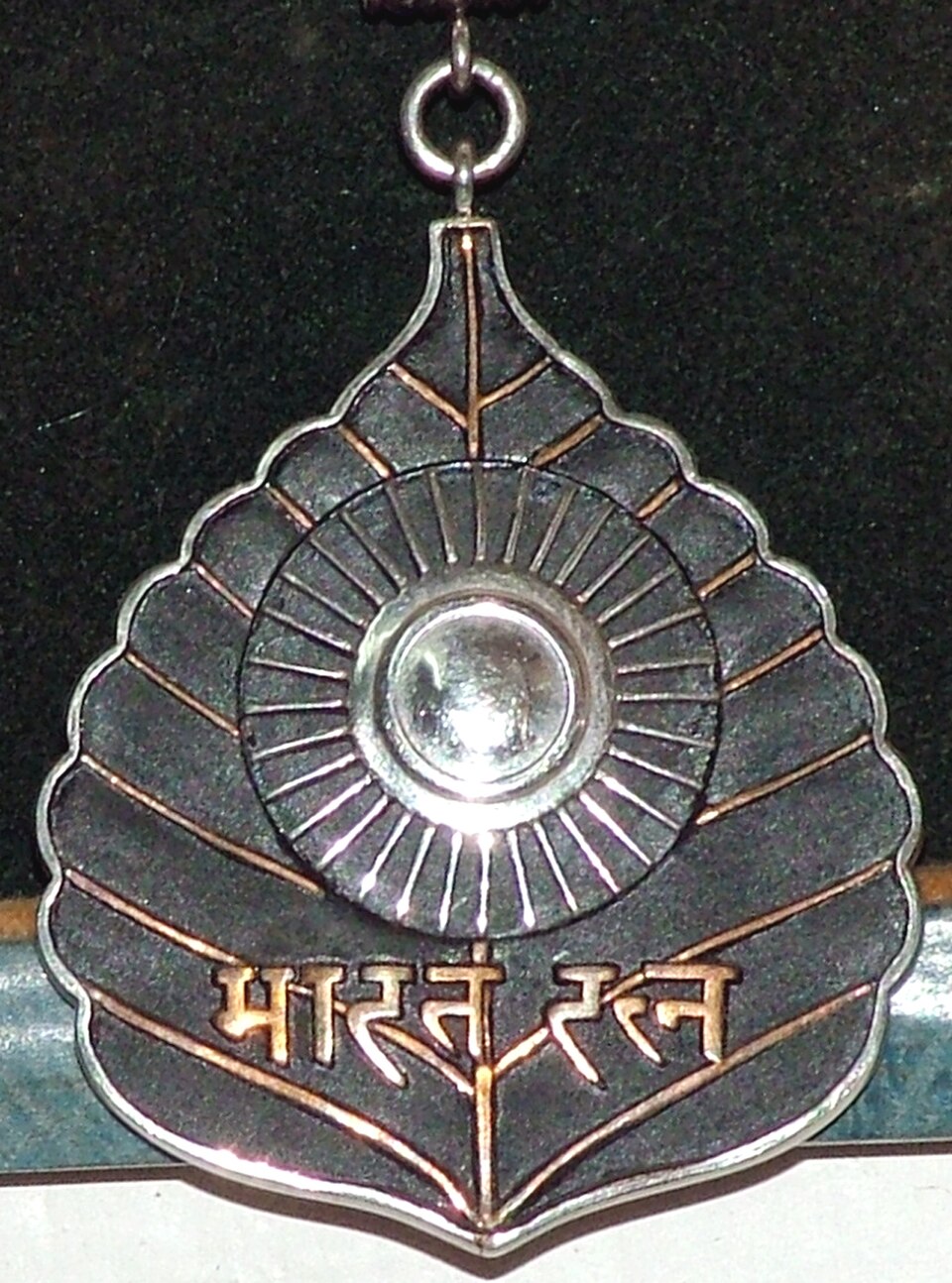
The Bharat Ratna is India's highest civilian honour, instituted on 2 January 1954 for exceptional service or performance of the highest order. It carries no monetary grant. The recipient receives a sanad — a certificate signed by the President — and a medallion shaped like a peepal leaf, rimmed in platinum, with the sun embossed on one face and the words 'Bharat Ratna' on the other. The first three recipients, in 1954, were C. Rajagopalachari, Sarvepalli Radhakrishnan and C. V. Raman. Conferment has been suspended twice, between July 1977 and January 1980 and again from the early 1990s to December 1995. The award confers no title and no precedence: the Supreme Court held in Balaji Raghavan in 1996 that these decorations are not titles within the meaning of Article 18(1) of the Constitution, and recipients may not use 'Bharat Ratna' as a prefix or suffix to their names. It may be awarded posthumously, which it frequently is.
Award questions are pure current affairs and they are won by holding cohorts rather than individuals. The productive way to revise is by year: 2014 — C. N. R. Rao and Sachin Tendulkar; 2015 — Madan Mohan Malaviya and Atal Bihari Vajpayee; 2019 — Pranab Mukherjee, Nanaji Deshmukh and Bhupen Hazarika; 2024 — Karpoori Thakur, L. K. Advani, Chaudhary Charan Singh, P. V. Narasimha Rao and M. S. Swaminathan. Held that way, this question is answered by inspection: three of the four options are in the wrong cohort or in none. The wider point about how these papers are set is that an award question almost never asks a fact you cannot check — it asks whether you have kept a calendar. And when a question names a year, read the year first; two of the three distractors here are people who really did receive the honour, and a candidate who scans for a familiar name rather than for the right year will take one of them.
- Bharat Ratna 2024 went to five people — Karpoori Thakur, L. K. Advani, Chaudhary Charan Singh, P. V. Narasimha Rao and M. S. Swaminathan — four of them posthumously.
- The award was instituted on 2 January 1954, carries no monetary grant, and consists of a sanad signed by the President and a peepal-leaf-shaped medallion rimmed in platinum; the first recipients were C. Rajagopalachari, S. Radhakrishnan and C. V. Raman.
- M. S. Swaminathan (1925–2023) led the introduction of semi-dwarf high-yielding wheat in India with Norman Borlaug, headed IARI and ICAR, directed the International Rice Research Institute at Manila from 1982 to 1988, and was the first World Food Prize laureate in 1987.
- He chaired the National Commission on Farmers from 2004, whose recommendation that minimum support prices be set at least 50 per cent above the weighted average cost of production remains the central demand of farmers' movements.
- Karpoori Thakur, in the same 2024 cohort, was Chief Minister of Bihar twice — 22 December 1970 to 2 June 1971 and 24 June 1977 to 21 April 1979 — as well as Deputy Chief Minister and Education Minister in 1967-68 and Leader of the Opposition in the Bihar Assembly from 1980 to 1988.
- Picking a familiar name without checking the year. Pranab Mukherjee (2019) and C. N. R. Rao (2014) are both genuine recipients, just not of 2024.
- Assuming a former Prime Minister must have the Bharat Ratna. Chandra Shekhar has never received it.
- Treating the award as a title. It is not one, and recipients cannot write it before or after their names.
BPSC asks current-affairs honours as a single name against a single year, and usually picks a cohort with a Bihar connection — 2024 works for it because Karpoori Thakur is in the list. UPSC has moved away from naming recipients and now tests the institution instead: whether these awards are titles under Article 18, how many may be given in a year, whether they have ever been suspended. Learn the cohorts for the State exam and the statute for the central one.
Who among the following is not a recipient of the Bharat Ratna Award?
- (a) Ustad Bismillah Khan
- (b) Satyajit Ray
- (c) Lata Mangeshkar
- (d) Raj Kapoor
Answer(d) Raj Kapoor
The same honour tested in the negative. BPSC asks who received it in a named year; UPSC asks who never received it at all — and both are answered from the same habit of holding the list of recipients by cohort rather than as a vague sense of distinction.
Norman Ernest Borlaug who is regarded as the father of the Green Revolution in India is from which country?
- (a) United States of America
- (b) Mexico
- (c) Australia
- (d) New Zealand
Answer(a) United States of America
The other half of the partnership behind this answer. Borlaug, an American agronomist working in Mexico, bred the semi-dwarf wheats; Swaminathan brought them to India, adapted them to Indian conditions and drove the programme that ended the food imports of the 1960s.
Which of the following individuals or organisations was a recipient of the Ramon Magsaysay Award 2024?
- (a) Phuntsho, Karma
- (b) Rural Doctors Movement
- (c) Miyazaki Hayao
- (d) More than one of the above
Answer(d) More than one of the above
The 71st CCE ran the same drill on a different honour and for the same year — name the award, name the year, identify the recipients. Awards questions recur on every BPSC paper, and the way to prepare is to keep a year-by-year list rather than to recognise names.
- practice — not a real PYQ
Which of the following was NOT among the recipients of the Bharat Ratna announced in 2024 ?
- (a)Chaudhary Charan Singh
- (b)P. V. Narasimha Rao
- (c)Atal Bihari Vajpayee
- (d)Karpoori Thakur
Answer(c) Atal Bihari Vajpayee — he received the Bharat Ratna in 2015. The 2024 cohort was Karpoori Thakur, L. K. Advani, Chaudhary Charan Singh, P. V. Narasimha Rao and M. S. Swaminathan.
- practice — not a real PYQ
M. S. Swaminathan is most closely associated with which of the following ?
- (a)The White Revolution in milk production
- (b)The introduction of high-yielding varieties of wheat in India
- (c)The founding of the Indian Space Research Organisation
- (d)The Blue Revolution in inland fisheries
Answer(b) The introduction of high-yielding varieties of wheat in India — he adapted the semi-dwarf Mexican wheats developed with Norman Borlaug to Indian conditions in the mid-1960s. The White Revolution belongs to Verghese Kurien and Operation Flood.