
One of the properties associated with X-rays is that they can be deflected by
- (a)Magnetic fields only
- (b)Both electric and magnetic fields together
- (c)Electric fields only
- (d)None of the above
Correct — D, None of the above. X-rays are electromagnetic radiation — the same kind of thing as light, radio waves and gamma rays, differing only in wavelength, which for X-rays runs from about 0.01 to 10 nanometres. Electromagnetic radiation is carried by photons, and a photon has no electric charge and no magnetic moment. The force that bends a beam in a field is the Lorentz force, F = q(E + v × B), and every term in it is multiplied by the charge q. Put q = 0 and the force vanishes identically: an X-ray beam passes through an electric field and through a magnetic field without the slightest deviation. So all three of the field options fail, and the escape option is the correct one. This is not a technicality — non-deflection is precisely how X-rays were identified. Wilhelm Conrad Röntgen discovered them in November 1895 and called them X-rays because he did not know what they were; the decisive experiment that separated them from cathode rays was that cathode rays bend sharply in a magnetic field while the new rays did not bend at all. The same test sorts radioactivity into its three classes: alpha particles, carrying charge +2e, curve one way; beta particles, carrying −e, curve the other way and much more sharply because they are far lighter; gamma rays, being photons, go straight through undeviated. X-rays behave exactly like gamma rays in this respect. Note carefully what the answer does NOT claim. X-rays interact with matter in several strong ways — they are absorbed heavily by high atomic-number elements such as calcium and barium, which is what makes a radiograph; they are diffracted by the regular planes of a crystal, which is the basis of X-ray crystallography; and they scatter off electrons with a change of wavelength in the Compton effect. None of that is deflection by an electric or magnetic field, which is what the stem asks about.
- (a)Magnetic fields only — Describes a beam of charged particles, not X-rays. Cathode rays — streams of electrons — are deflected by a magnetic field, and J. J. Thomson used exactly that deflection, balanced against an electric field, to measure the electron's charge-to-mass ratio in 1897. An X-ray beam put through the same apparatus does not move at all.
- (b)Both electric and magnetic fields together — The most confident-sounding wrong answer, and it is the correct description of a charged particle beam, which responds to both fields. Since an X-ray photon carries no charge, doubling the number of fields does not help: zero force from the electric field plus zero force from the magnetic field is still zero.
- (c)Electric fields only — Fails for the same reason. An electric field exerts a force qE on a particle, and q is zero for a photon. Canal rays, or anode rays, which are positive ions, are the beam that this option would correctly describe — and their deflection in electric and magnetic fields is how isotopes were first separated in a mass spectrograph.
The electromagnetic spectrum is a single family of waves ordered by wavelength: radio, microwave, infrared, visible light, ultraviolet, X-rays, gamma rays. Every member travels at the speed of light in vacuum, every member is uncharged, and therefore no member of the family is deflected by an electric or magnetic field. What distinguishes X-rays within that family is photon energy. Their wavelengths are comparable to the spacing between atoms in a solid, which has two consequences that define their uses. First, they are energetic enough to pass through soft tissue while being strongly absorbed by heavier elements, so bone and metal cast shadows — the basis of radiography and of computed tomography. Second, because their wavelength matches the crystal lattice spacing, crystals diffract them according to Bragg's law, nλ = 2d sin θ, which is how the atomic structure of salts, metals, proteins and famously DNA was determined.
This is a question about charge, not about X-rays, and reading it that way makes it instant. Ask one thing of any beam: does it carry charge? If yes, both an electric and a magnetic field will bend it. If no, neither will. That single test sorts everything a syllabus contains — cathode rays and beta particles bend, canal rays and alpha particles bend, protons in an accelerator bend, and light, radio waves, X-rays and gamma rays do not. The trap here is the stem's own phrasing, 'one of the properties associated with X-rays is that they can be deflected by', which presupposes that some deflection occurs and nudges the candidate towards choosing which field does it. Resist the presupposition; the escape option is on the paper because it is needed. One genuine subtlety is worth knowing so it does not cause doubt: X-rays ARE bent by gravity, as all light is, and that bending has been observed around massive objects. But gravitational lensing is not deflection by an electric or magnetic field, and no examination at this level intends it.
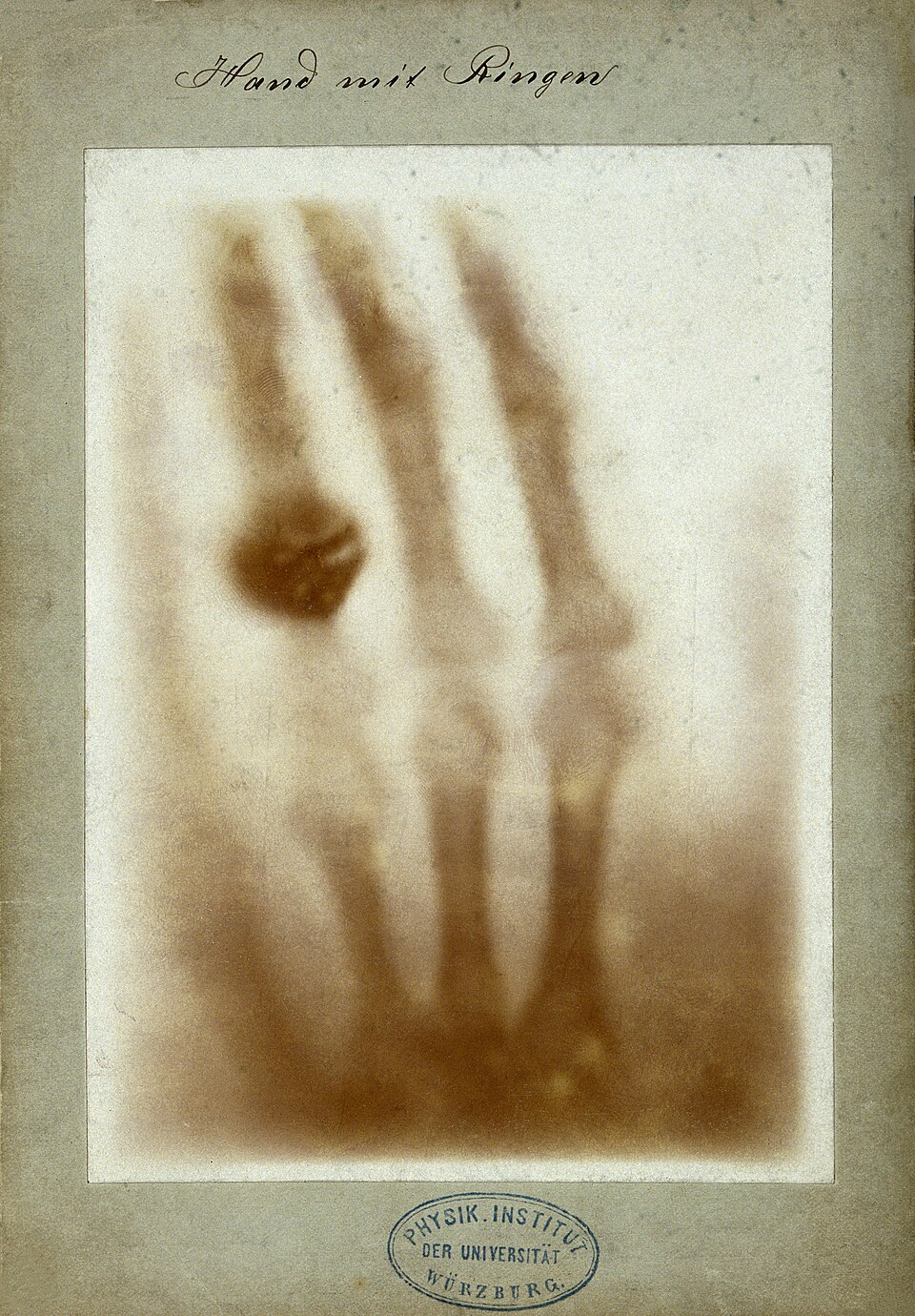
- X-rays were discovered by Wilhelm Conrad Röntgen in November 1895; he received the first Nobel Prize in Physics in 1901 for the discovery.
- X-ray wavelengths run from about 0.01 to 10 nanometres, shorter than ultraviolet and longer than gamma rays.
- The Lorentz force is F = q(E + v × B); since a photon has q = 0, electromagnetic radiation of any wavelength is undeflected by electric and magnetic fields.
- Deflection sorts radioactivity: alpha particles (+2e) and beta particles (−e) curve in opposite directions in a magnetic field, while gamma rays, being photons, pass straight through.
- X-rays are diffracted by crystals according to Bragg's law, nλ = 2d sin θ — the basis of X-ray crystallography and of the structure determination of DNA.
- Reading the stem's phrasing as a guarantee that some deflection occurs. When an escape option is offered, the stem's presupposition may itself be the trap.
- Confusing X-rays with cathode rays. They come out of the same discharge tube in Röntgen's experiment, but only the electrons are charged.
- Mistaking interaction with matter for deflection by a field. X-rays are absorbed, diffracted and scattered, and none of that involves an electric or magnetic field.
BPSC asks physics as a single-property recall — which ray is deflected, which is not, which is used for what — usually with an escape option so that a candidate who half-remembers cannot bluff. UPSC prefers the assertion-and-reason or statement form, as in its 2008 item pairing the claim that radio waves bend in a magnetic field with the true reason that radio waves are electromagnetic — where the whole point is that the reason actually disproves the assertion.
Assertion (A): Radio waves bend in a magnetic field. Reason (R): Radio waves are electromagnetic in nature.
- (a) Both A and R are individually true and R is the correct explanation of A
- (b) Both A and R are individually true but R is not the correct explanation of A
- (c) A is true but R is false
- (d) A is false but R is true
Answer(d) A is false but R is true
Exactly the same physics, with a different member of the same family. Radio waves do not bend in a magnetic field, and the stated reason — that they are electromagnetic in nature — is precisely why they do not. Substitute X-rays for radio waves and this card's answer follows.
Barium in a suitable form is administered to patients before an X-ray examination of the stomach, because
- (a) barium allows X-rays to pass through the stomach on account of its transparency to X-rays
- (b) barium compound, like magnesium sulphate helps in cleaning the stomach before X-ray examination
- (c) barium is a good absorber of X-rays and this helps the stomach to appear clearly in contrast with the other regions in the picture
- (d) barium salts are white in colour and this helps the stomach to appear clearly in contrast with other regions in the picture
Answer(c) barium is a good absorber of X-rays and this helps the stomach to appear clearly in contrast with the other regions in the picture
What X-rays DO interact with, as against what they do not. A barium meal works because a heavy element absorbs the beam strongly — an interaction with matter, not a deflection by a field, and exactly the distinction that decides this BPSC question.
- practice — not a real PYQ
Which one of the following is NOT deflected by a magnetic field ?
- (a)Alpha particles
- (b)Beta particles
- (c)Gamma rays
- (d)Cathode rays
Answer(c) Gamma rays — like X-rays they are electromagnetic radiation, so the photons carry no charge and the Lorentz force on them is zero. Alpha particles, beta particles and cathode rays are all charged and are all deflected.
- practice — not a real PYQ
X-ray crystallography determines the arrangement of atoms in a solid because X-rays
- (a)are deflected by the electric fields between atoms
- (b)have wavelengths comparable to the spacing between atomic planes and are therefore diffracted
- (c)are absorbed completely by every crystal
- (d)carry an electric charge that interacts with the lattice
Answer(b) have wavelengths comparable to the spacing between atomic planes and are therefore diffracted — the condition is Bragg's law, nλ = 2d sin θ. X-rays carry no charge at all, which rules out the first and last options.