
 View answer copy →
Akshat JainAIR 2CSE 2018
Answered a very similar question
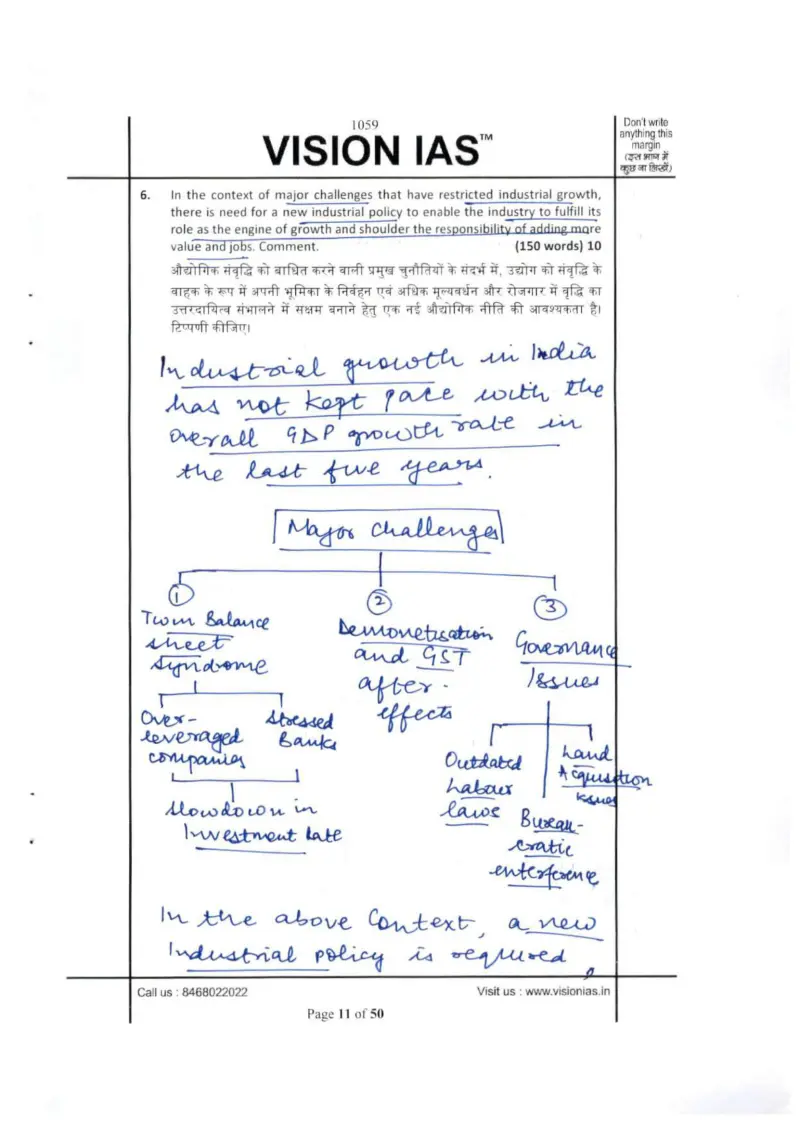
Their question: “Need for a new industrial policy given challenges restricting industrial growth”
Akshat's answer diagnoses the challenges holding back India's industrial growth and argues for a new industrial policy with named reforms, exactly the demand of 2017 Q9.
Key learnings from their answer
- ›He packs multiple named reports into strict 150-word answers, Economic Survey 2016-17 and 2017-18, World Bank EoDB (India 100th, a 30-spot jump), UNEP's definition of inclusive growth, ILO on textiles/footwear automation, and the World Bank '69% of jobs threatened by automation' stat all appear across Q4/Q7. Lesson: attach a specific authority to each claim rather than asserting it yourself; report-density is what separates a topper answer from an opinion essay.
- ›He converts analysis into hand-drawn arrow 'trees' rather than prose, Q1's branching Issues tree (inequitable risk allocation / clearance delays) paired with an HAM Advantages tree, and Q11's flow chain 'NPAs -> Twin Balance Sheet -> over-leveraged companies & stressed banks -> credit slowdown'. Lesson: when a question asks how one thing causes/fixes another, draw the causal chain as a branched arrow diagram, it shows the linkage faster than a paragraph and is more scannable.
- ›He names schemes and provisions with precision rather than gesturing vaguely, Sagarmala and Dedicated Freight Corridors cited as concrete SPV examples (Q8), plus IBC, e-Biz portal, single-window clearance, EPFO/EPS and GST data, and Article 41 (DPSP). Lesson: replace 'various government initiatives' with the exact instrument that fits the demand; one well-placed correct example earns more than three generic ones.
What they cited: e-Biz portal, single-window clearance, Investment Promotion Cell; demonetisation & GST after-effects (Q6/Q7) · World Bank — 69% of jobs in India threatened by automation (Q4); EoDB Index — India ranked 100th, a 30-spot jump (Q7)