
 View answer copy →
Pakshal SecretryRank 8CSE 2025
Answered a very similar question
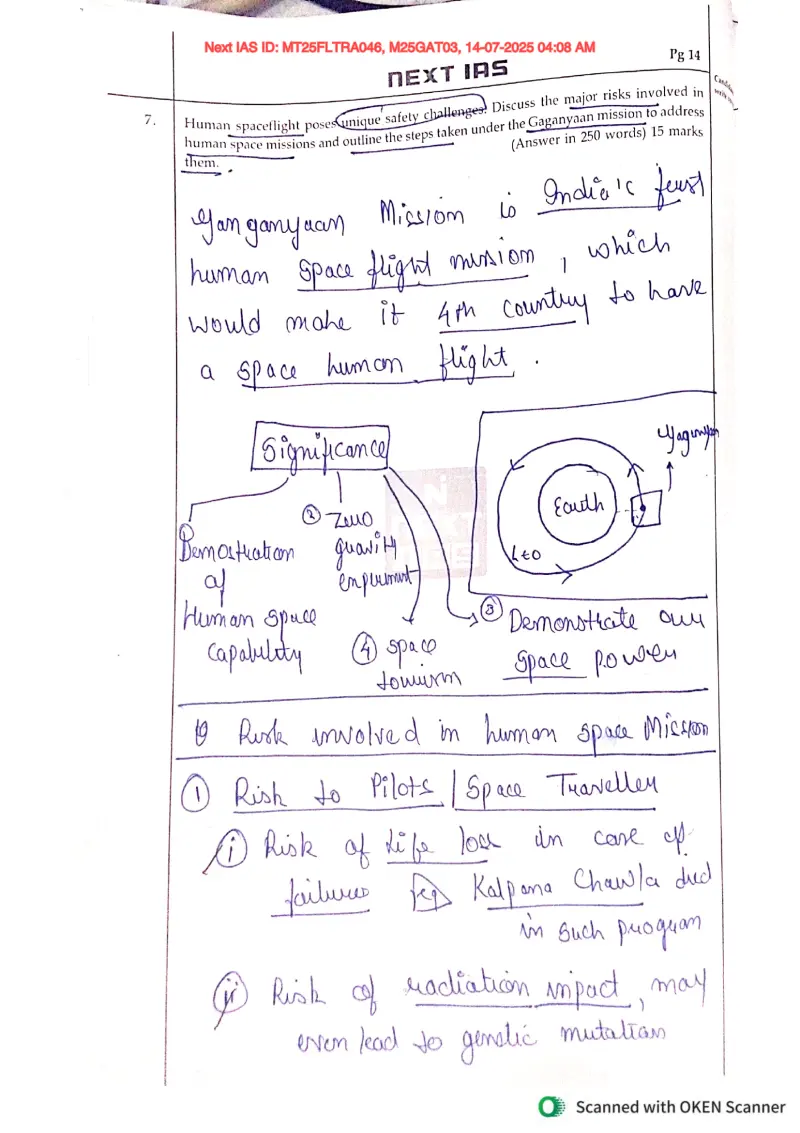
Their question: “Human spaceflight risks and steps under the Gaganyaan mission to address them (250 words)”
The topper lays out the technological and logistical risks of human spaceflight (life-support, escape module, radiation/Kessler, human-rated launcher) and Gaganyaan's mitigations, exactly the obstacles-to-a-manned-mission the PYQ asks to examine.
Key learnings from their answer
- ›Turned abstract S&T concepts into purpose-built diagrams rather than decorative ones: a Sun-Earth Lagrange-point map (L1-L5) to locate Aditya-L1, vertical-vs-horizontal RLV contrast sketches, a Gaganyaan LEO orbit + escape-module sketch, and an mRNA flow (cell/vector -> spike protein -> immune response) paired with a PIR-vs-SIR immune-response-over-time graph -> for any S&T question, draw the actual mechanism/geometry, not a generic box-chart; the diagram should carry information the prose can't, like orbit positions or a response curve over time.
- ›Pulled answers into the present by citing the latest concrete developments - Shubhanshu Shukla's flight and Vyommitra for Gaganyaan, SpaceX's Falcon-9 booster-catch for RLVs, Shukrayaan's 2027 timeline and 'India as 4th country with a dedicated Venus mission', BrahMos strikes dated 10 May 2025 -> tie each static topic to its newest milestone with a date or 'first/4th' framing, which shows the examiner you are current, not textbook-bound.
What they cited: Gaganyaan: Kalpana Chawla, Chandrayaan-2, Kessler Syndrome, Vyommitra robot, escape module, human-rated GSLV by SAC Ahmedabad, Kevlar shielding, AI simulation testbed, NASA collaboration, Shubhanshu Shukla flight