
 View answer copy →
Anudeep DurishettyAIR 1CSE 2017
Answered a very similar question
Their question: “Intellectual Property Rights — types; and Intellectual Property Exchange (benefits/challenges)”
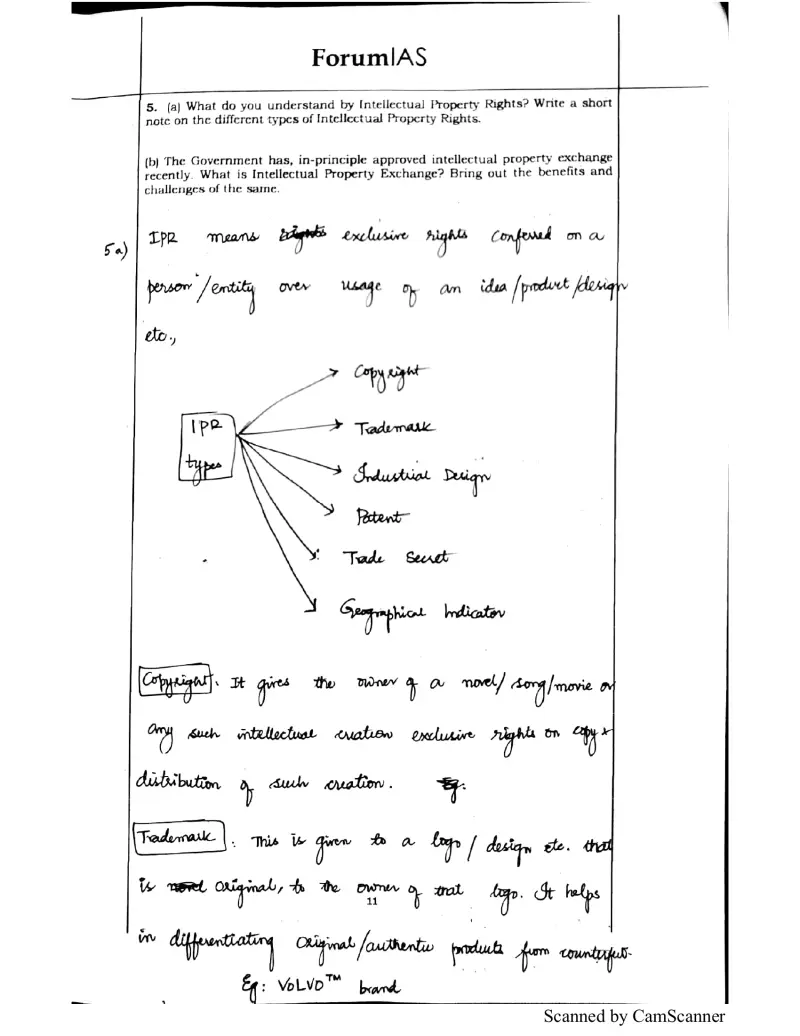
The topper's IPR answer branches out the six IPR types and pins each to a concrete case (Coca-Cola = trade secret, 20-year drug patents = patent, Benaras Sarees = GI), which is exactly the distinction between Copyrights, Patents and Trade Secrets this PYQ demands.
Key learnings from their answer
- ›He converted abstract classifications into tree/cycle diagrams: a tree of the six IPR types (Copyright, Trademark, Industrial Design, Patent, Trade Secret, GI) in Q5, and a cycle diagram of the SHG movement (pooling resources -> lump-sum -> self-employment -> autonomy/empowerment) in Q11. -> When a question asks for 'types of X' or the 'mechanism by which X works', a tree or cycle diagram is a faster, more examiner-legible structure than a bulleted list, use the visual form that matches the logic (branching = types, loop = process).
- ›Each IPR type in Q5 was pinned to a concrete real-world instance, Volvo (trademark), fountain-pen design (industrial design), 20-year drug patents, Coca-Cola recipe (trade secret), Benaras Sarees (GI), rather than abstract definitions. -> Attach one memorable, verifiable example to every concept you define; a single recognisable case (Coca-Cola for trade secret) cements understanding and lifts the answer above a textbook definition.
What they cited: IPR examples — Volvo trademark, fountain-pen industrial design, 20-year drug patents, Coca-Cola recipe (trade secret), Benaras Sarees (GI) (Q5)