
 View answer copy →
Junaid AhmadAIR 3CSE 2018
Answered a closely related question
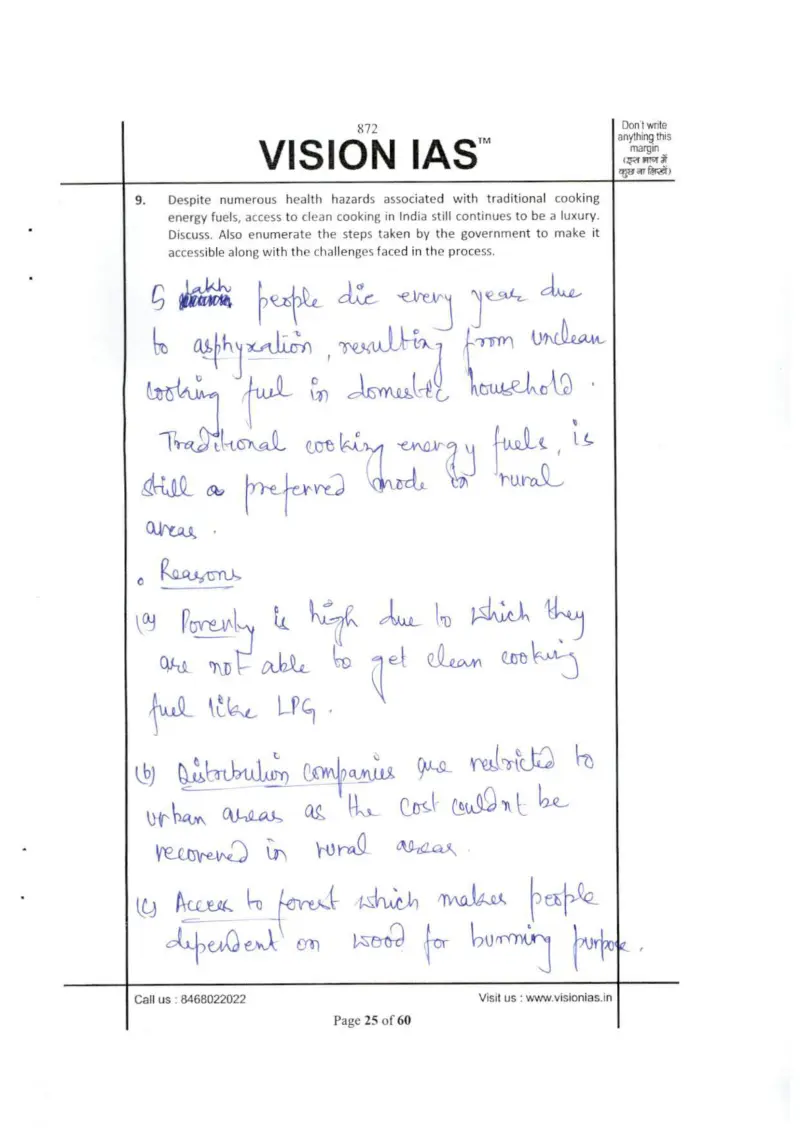
Their question: “Access to clean cooking energy as a luxury — government steps and challenges (Ujjwala)”
Clean cooking energy access via Ujjwala is a flagship progress point for the 'affordable, reliable, sustainable and modern energy' SDG the PYQ asks India's progress on, and the topper supplies its numbers and challenges.
Key learnings from their answer
- ›Junaid opens each answer with a single data-anchored line that both defines the concept and stakes a number, e.g. the NPA answer leads with the RBI Asset Quality Review declaring ~Rs 7 lakh crore NPAs (~10% of bank loans, ~14% in PSBs), and the nuclear answer with coal-based thermal at ~68% of generation. -> Don't waste your intro on textbook definitions; lead with one precise figure that frames the scale of the problem, so the examiner sees command from line one.
- ›He packs dense, accurate scheme-and-committee recall mapped to the right problem: for NPAs, IBC, SARFAESI amendment, S4A, SDR, and PARA (called for by the Economic Survey); for unemployment, PMKVY, DDU-GKY, Skill India; for agri-taxation, the Kelkar committee (2002) finding ~95% of farmers below the tax threshold. -> Build a per-topic 'toolkit' of named acts/schemes/committees so your 'government measures' section reads as a specific inventory, not a generic call for 'policy intervention'.
What they cited: Q9 Clean cooking: ~5 lakh deaths/year from indoor smoke; women spend 4-5 hours collecting fuel; Pradhan Mantri Ujjwala Yojana (5 cr LPG connections, ~Rs 1,600 one-time support; ~2.5 cr already in 2 years); solar cookers