
 View answer copy →
Shakti DubeyAIR 1CSE 2024
Answered a very similar question
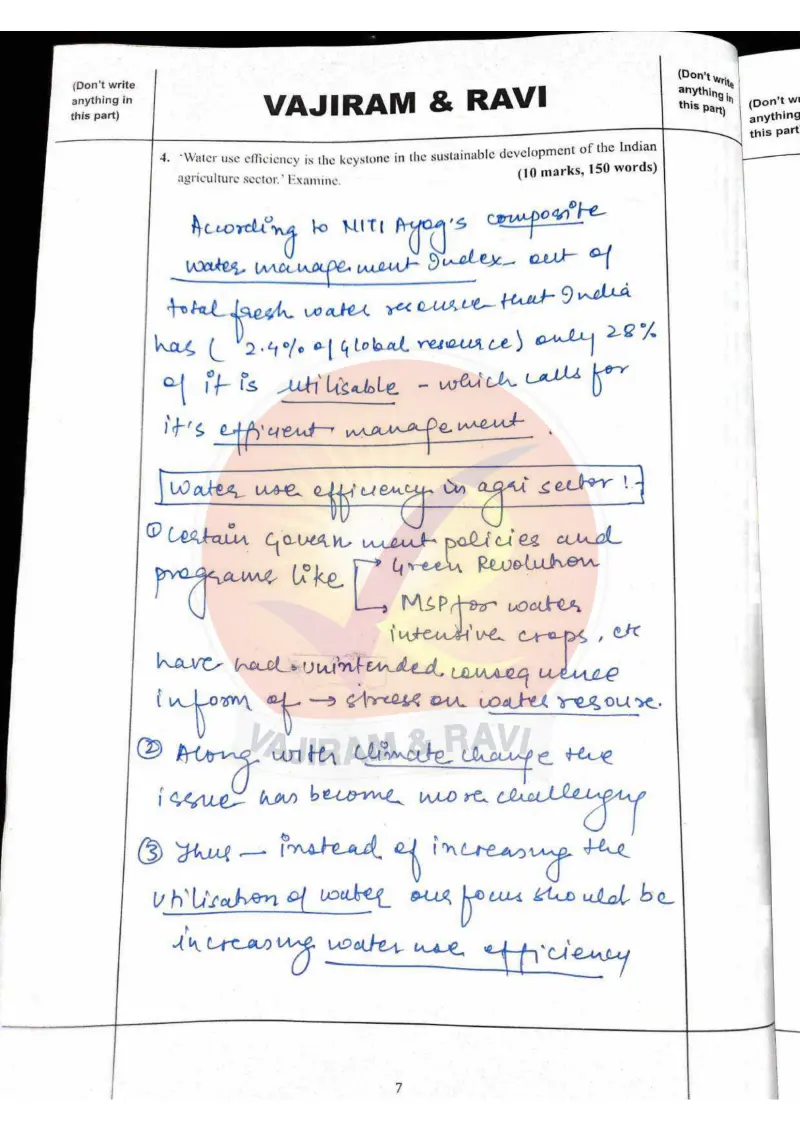
Their question: “Water-use efficiency as keystone of sustainable Indian agriculture (10m)”
Same core concept, water-use efficiency and micro/drip irrigation, with a sourced water-index anchor and Israel's drip-irrigation benchmark the student can lift straight into the PYQ.
Key learnings from their answer
- ›She opens almost every answer with a hard data or report anchor rather than a textbook definition - Q4 leads with the NITI Aayog Composite Water Management Index (India holds 2.4% of global freshwater, only ~28% utilisable), Q9 with World Bank figures (India = 18% of world population but ~4% of freshwater, extracts ~25% of groundwater), and Q2-Q3 with the Dalwai Committee's ~40% food-grain wastage / only ~10% processed -> lead your intro with one precise, sourced number that frames the problem, so the examiner sees command of facts in the first two lines.
- ›She brings in a sharp global best-practice comparison where it sharpens the prescription - Israel's root-zone/drip irrigation as the model for water-use efficiency (Q4) -> when arguing what India should do, name one concrete external benchmark instead of a vague 'learn from other countries', so your recommendation is specific and credible.
- ›She closes with a forward-looking 'Thus...' conclusion that maps the answer onto a national goal - SDG-2, the Panchamrit targets, COP28's tripling-nuclear pledge, Vision 2047 or the $5-trillion-economy goal -> end by tying your specific topic to a recognised national/global commitment, which signals big-picture awareness and gives the answer a deliberate landing point.
What they cited: NITI Aayog Composite Water Management Index — India has 2.4% of global freshwater, only ~28% utilisable (Q4) · Israel's root-zone watering / drip irrigation as best practice (Q4)