
 View answer copy →
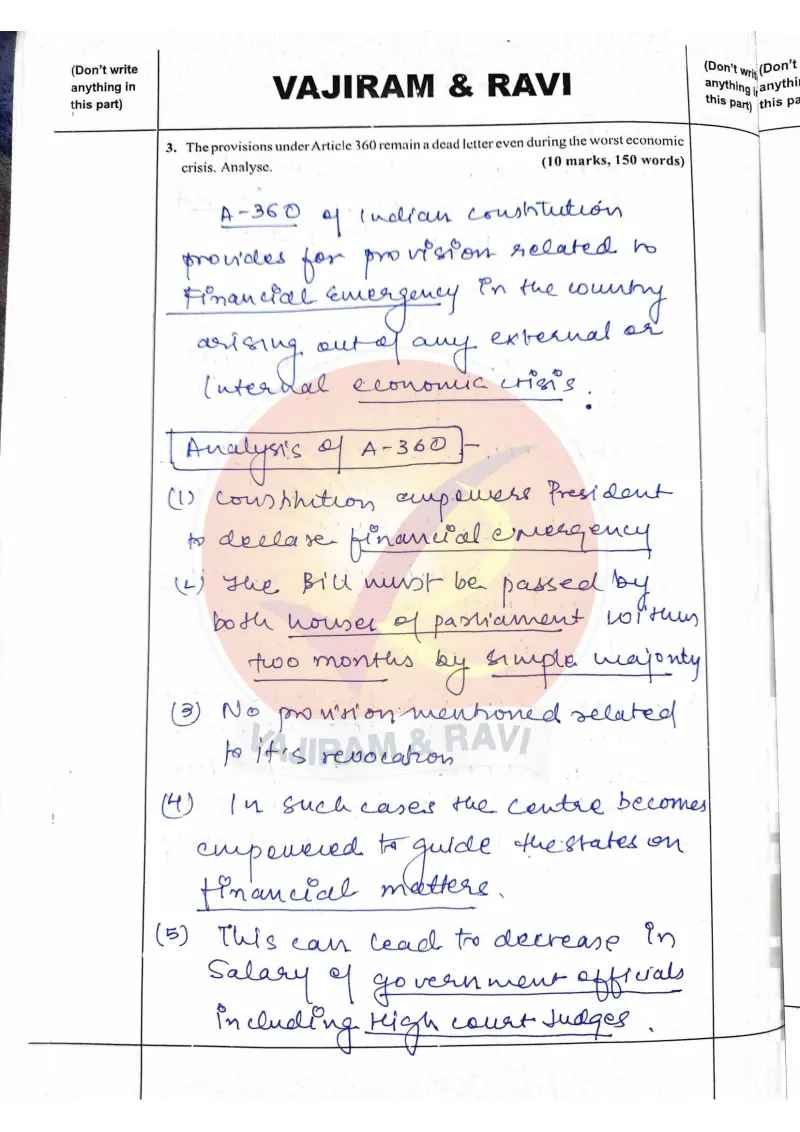
Shakti DubeyAIR 1CSE 2024
Answered a very similar question
Their question: “Article 360 (Financial Emergency) remaining a dead letter even in worst economic crisis (10m)”
To argue Article 360 is a dead letter the topper runs through the very crises (1991, 2008, 2020) in which it could have been proclaimed, the same circumstances-and-consequences material the 2018 PYQ on Financial Emergency asks for.
Key learnings from their answer
- ›Every one of the 20 answers opens with a 2-4 line context-setter pegged to a fresh, specific hook before the first sub-heading, India-PNG MoU for India Stack (Q17), the PM's Good Governance Day for Mission Karmayogi (Q15), the CEC Act 2023 for the EC question (Q14), India's aid to Sri Lanka for the Gujral Doctrine (Q18). -> Don't open with a textbook definition; lead with a current, answer-specific anchor (a recent MoU, Act, or event) so the examiner sees relevance from line one.
- ›Claims are nailed down with exact comparative numbers, not adjectives: PRS data showing bill referral to committees fell from 33% (16th LS) to 16% (17th LS) on the DRSC question, US ~25 amendments in two centuries vs India's 108 in 70 years on the flexibility/rigidity question, Census 2011 elderly at 11% on geriatric health, and 84% informal-sector workers contributing over half of GDP for platform workers. -> Memorise a few precise, contrasting data pairs per theme, a single 33%->16% or 25-vs-108 figure proves a point faster than a paragraph of assertion.
What they cited: Article 360 (Financial Emergency); economic crises cited 1989 (BoP deficit), 1991 (BoP crisis), 2008 (Great Financial Crisis), 2020 (COVID)