
 View answer copy →
Answered a very similar question
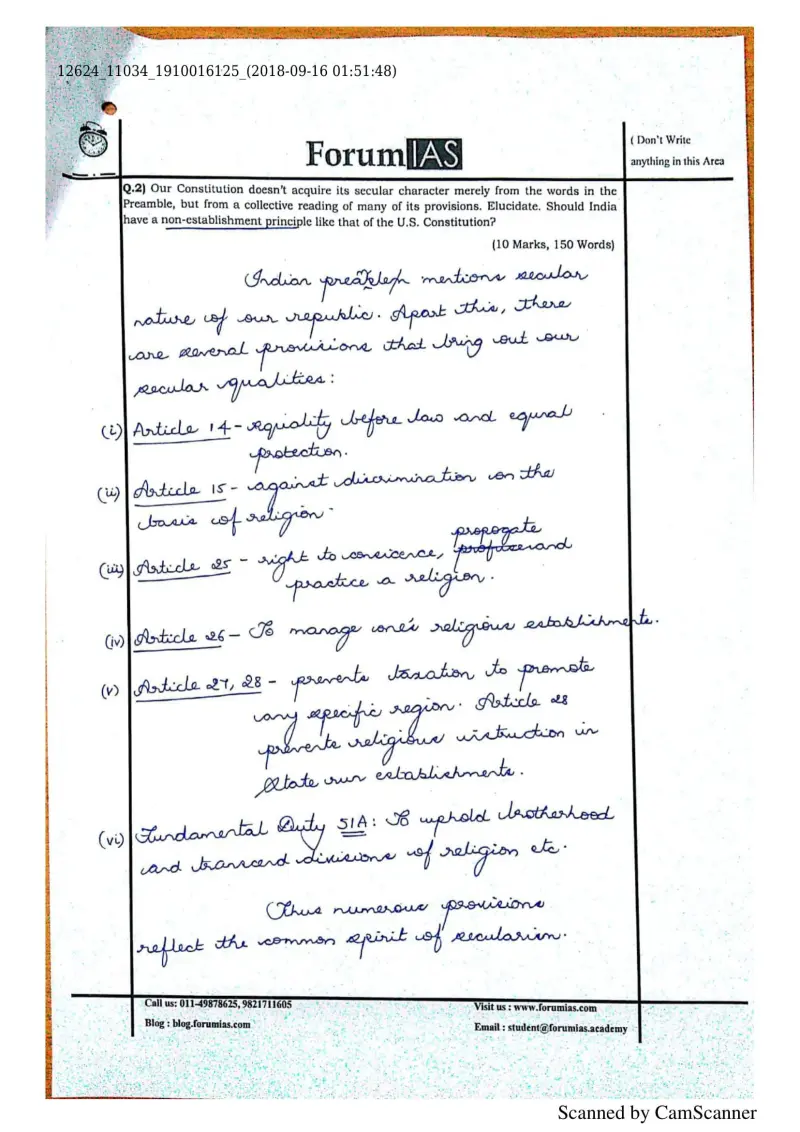
Their question: “Constitution's secular character from collective reading of provisions; should India adopt US-style non-establishment principle (image-verified, p.6)”
The topper's answer directly adjudicates Indian secularism against the US non-establishment model using 'principled distance' in a two-column comparison, exactly the compare-and-contrast the PYQ demands.
Key learnings from their answer
- ›On the secularism question (Q2), Dhatri didn't just describe Indian secularism, she anchored it on the concept of 'principled distance' as the defining contrast with the US non-establishment model, laid the two models side-by-side in a YES/NO comparison table, brought in Gandhiji, and closed with 'Vasudhaiva Kutumbakam'. -> When a question asks 'should India adopt X foreign model', frame the whole answer around one sharp distinguishing concept and adjudicate it in a two-column table rather than writing loose paragraphs.
- ›Even in the strict 150-word limit, her genuine pages run tightly point-wise: a short intro, numbered/roman sub-points under bold-underlined sub-headings ('FACTORS:', 'Socio-economic / Politico-cultural', 'Need for further competition', 'Way Forward'), and an explicit closing line ('Thus...', 'Way Forward:'). -> Pre-decide a skeleton of labelled sub-headings before writing so a short answer still reads as structured analysis with a clear conclusion, never as a wall of text.
What they cited: Gandhiji invoked in the non-establishment debate (Q2, image-verified p.6)
Quotes used: “'Vasudeva Kutumbakam' (Vasudhaiva Kutumbakam) — used to close the secularism answer (Q2, image-verified p.6); no author attributed” “'Principled distance' — invoked as the defining idea of Indian secularism vs the Western model (Q2); a concept/phrase, not an attributed quotation”