
 View answer copy →
Rishabh BhattRank 363CSE 2023
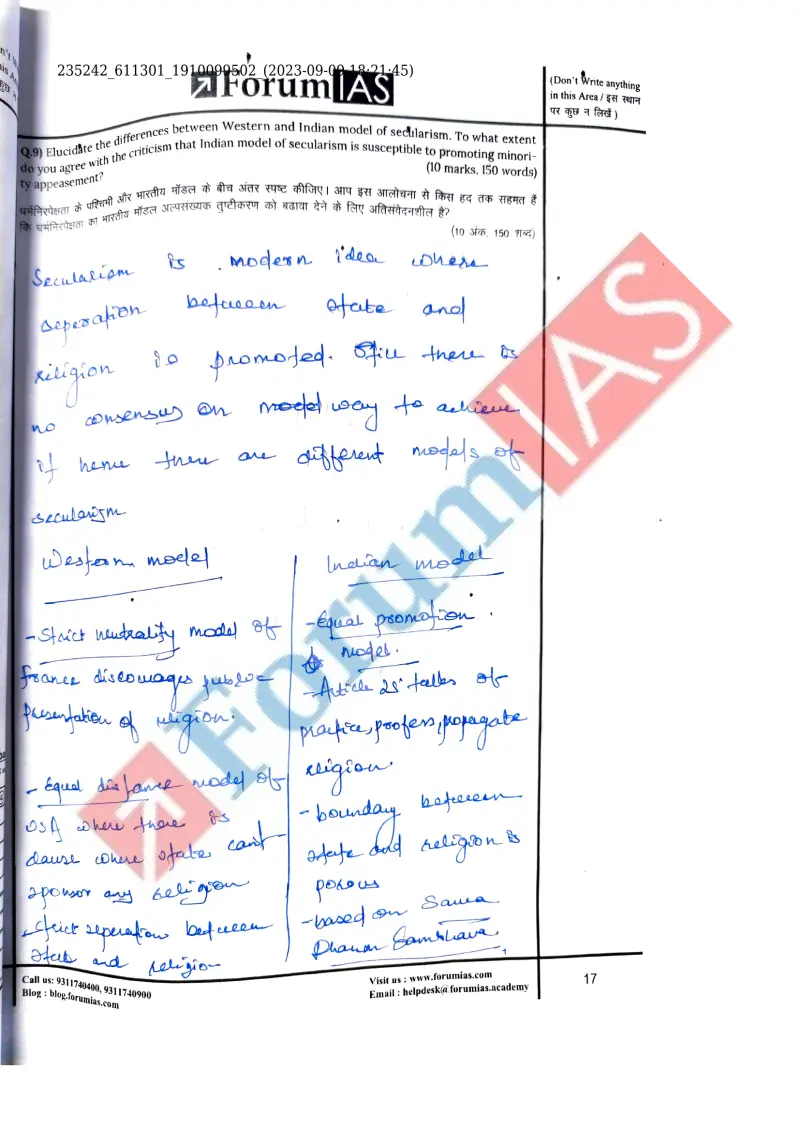
Answered a very similar question
Their question: “Western vs Indian secularism; criticism of minority appeasement”
This is the same Indian-vs-Western secularism question; the topper even sources the minority-appeasement critique (Pratap Bhanu Mehta) and cites the relevant constitutional articles.
Key learnings from their answer
- ›He borrows authority to add weight to value-laden GS1 society/culture answers: Q9 attributes the minority-appeasement critique to scholar Pratap Bhanu Mehta, Q8 backs 'Hinduism as a way of life' to the Supreme Court, and quantified claims like ISRO's '30% land degraded' (Q13) and 'top 10% holds >90% wealth' (Q10) are sourced rather than asserted. -> On opinion-heavy topics, attach a named scholar, court ruling or institutional data point to your stance so it reads as informed analysis instead of personal opinion.
- ›He answers in the question's own direction-words as boxed/underlined sub-headings: Q2 splits into 'Similarities/Differences' (because the demand was 'compare & contrast'), and CSP-type answers run 'Causes/Consequences/Solutions'. -> Lift the directive verb from the question (compare, examine, causes-and-measures) and turn it into your literal headings, so the structure visibly mirrors the demand and you can't drift off-question.
What they cited: Q9: Pratap Bhanu Mehta, France & USA models, Sarva Dharma Sambhava, Articles 25/26/27/30/14, Gandhi, 'salad bowl' model
Quotes used: “Q9: Pratap Bhanu Mehta cited as saying the Indian model of secularism promotes minority appeasement (paraphrase, scholar attributed).”