
 View answer copy →
Rishabh BhattRank 363CSE 2023
Answered a closely related question
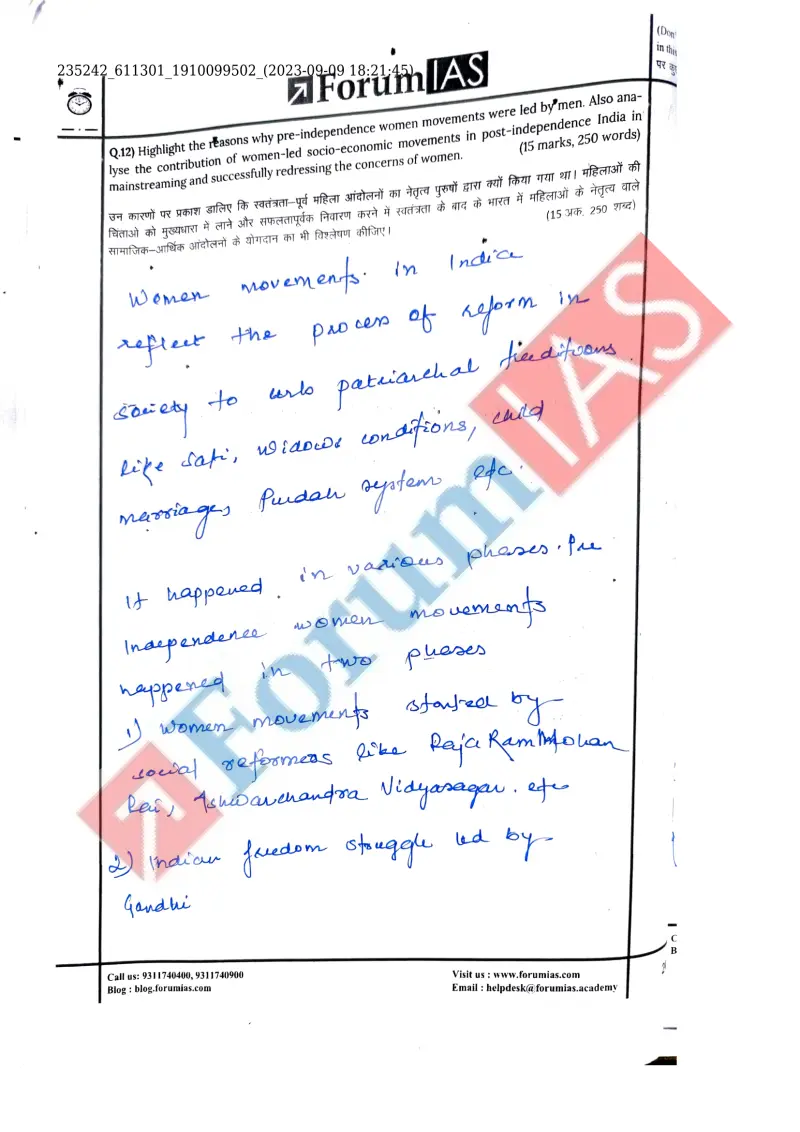
Their question: “Pre-independence women's movements led by men; post-independence women-led movements (15 marks)”
The 19th-century male reformers (Ram Mohan Roy, Vidyasagar, Malabari) and their debates on women map onto the PYQ's demand on the issues and debates concerning women in the social reform movement.
Key learnings from their answer
- ›Almost every sub-point is anchored with a concrete 'eg ->' rather than a generic claim: Q2 names Faraizi, Eka, Indigo, Tebhaga, Pagalpanthis and Mappila movements instead of just saying 'peasant movements'; Q5 cites Joshimath's NTPC tunnel; Q15 cites the Reasi (J&K) lithium reserve and the South American 'lithium triangle'. -> Don't state a point and move on; immediately bolt a specific named instance onto it so the examiner sees you actually know the topic, not just the template.
- ›He borrows authority to add weight to value-laden GS1 society/culture answers: Q9 attributes the minority-appeasement critique to scholar Pratap Bhanu Mehta, Q8 backs 'Hinduism as a way of life' to the Supreme Court, and quantified claims like ISRO's '30% land degraded' (Q13) and 'top 10% holds >90% wealth' (Q10) are sourced rather than asserted. -> On opinion-heavy topics, attach a named scholar, court ruling or institutional data point to your stance so it reads as informed analysis instead of personal opinion.
What they cited: Q12: Raja Ram Mohan Roy, Ishwarchandra Vidyasagar, Derozio, Vishnu Shastri, B.M. Malabari, Annie Besant, Sarojini Naidu, Chipko, 'Towards Equality' report, Dowry Act, Domestic Violence Act, LFPR 33%, NCRB