
Consider the following statements about Mahanavami dibba, a massive platform : 1. It is situated on one of the highest points in the city of Vijayanagara 2. Virupaksha temple is located on it Which of the above statements is/are correct?
- (a)1 only
- (b)2 only
- (c)Both 1 and 2
- (d)Neither 1 nor 2
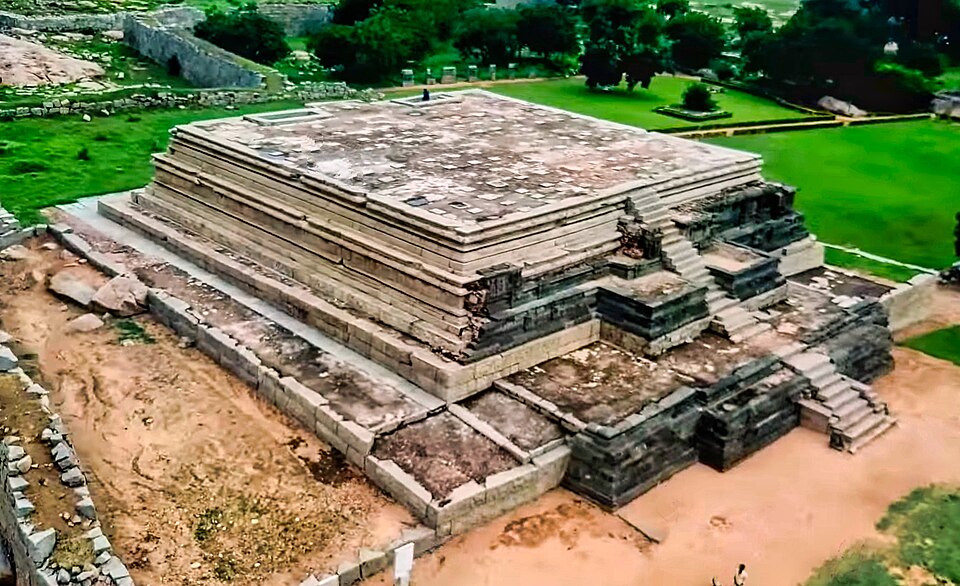
Correct — A, 1 only. The Mahanavami dibba is a massive stone platform in the royal centre of Vijayanagara, raised on one of the highest points in the city, so statement 1 is right. Statement 2 puts the wrong building on it. The Virupaksha temple stands in the sacred centre on the bank of the Tungabhadra, at the northern end of the site near the Hampi bazaar, and it is a working temple with a history older than the empire itself. Nothing stands on the dibba today; the platform carried a wooden structure from which the rulers watched the Mahanavami ceremonies, and its surviving stone base is carved with processions, horses, elephants and dancers.
- (b)2 only — This rejects the one statement that is true. The platform's siting on high ground in the royal centre is among the best-documented facts about it.
- (c)Both 1 and 2 — The two structures belong to different parts of the city. The dibba is in the royal centre; the Virupaksha temple is in the sacred centre by the river.
- (d)Neither 1 nor 2 — Statement 1 stands. The dibba occupies one of the highest points of the site, which is why the rituals staged on it were visible from a distance.
Vijayanagara is read by its zones. The sacred centre lies along the Tungabhadra in the north, where the Virupaksha and Vitthala temples stand among the boulders. The royal centre lies to the south, walled and gated, holding the audience hall, the Mahanavami dibba, the stepped tank and the enclosures known as the zenana. Between and around them run the urban core and the great irrigation works. The Mahanavami festival, from which the platform takes its name, was the state's principal ceremony, at which the ruler received his nayakas and their tribute.
Questions on this site almost always turn on which zone a structure belongs to, so the two centres are worth fixing separately in the memory. The Virupaksha temple is the anchor of the sacred centre and predates the empire, its shrine having drawn worship long before the city was founded in the fourteenth century; the dibba is a secular ceremonial platform in the royal centre. Foreign accounts help here as well, since Domingo Paes described the Mahanavami ceremonies at length.
- The Mahanavami dibba is a stone platform in the royal centre of Vijayanagara, on one of the highest points of the site.
- It carried a wooden structure and was used for the ceremonies of the Mahanavami festival.
- Its stone base is carved with reliefs of processions, horses, elephants, hunters and dancers.
- The Virupaksha temple stands in the sacred centre on the bank of the Tungabhadra and predates the empire.
- The site at Hampi is inscribed on the UNESCO World Heritage list.
- Placing the Virupaksha or Vitthala temple in the royal centre.
- Assuming a platform that big must have carried a stone temple.
- Confusing the Mahanavami dibba with the audience hall, which stands nearby.
A two-statement item on a single monument, where one statement is about siting and the other misattributes a neighbouring structure.
The Amara-Nayaka system was a major political innovation of which Indian imperial rulers?
- (a) Cholas
- (b) Chalukyas
- (c) Guptas
- (d) Vijayanagara
Answer(d) Vijayanagara
The institution the platform was built for. The nayakas held land and troops from the ruler, and the Mahanavami festival staged on this dibba is where they appeared before him with their tribute.
At which one of the following places is the Vitthala temple located?
- (a) Elephanta
- (b) Chidambaram
- (c) Hampi
- (d) Nagarjunakonda
Answer(c) Hampi
Another building of the sacred centre, tested on a keyed CAPF paper. Keeping the Vitthala and Virupaksha temples by the river and the dibba inside the royal enclosure answers both questions at once.
- practice — not a real PYQ
The Virupaksha temple at Hampi is located in
- (a)the royal centre
- (b)the sacred centre by the Tungabhadra
- (c)the zenana enclosure
- (d)the elephant stables
Answer(b) the sacred centre by the Tungabhadra — at the northern end of the site, beside the Hampi bazaar.
- practice — not a real PYQ
The Mahanavami dibba was used chiefly for
- (a)storing the state treasury
- (b)housing the royal elephants
- (c)the ceremonies of the Mahanavami festival
- (d)the coronation of Chola kings
Answer(c) the ceremonies of the Mahanavami festival — the principal state ritual of Vijayanagara.