
Consider the following statements: 1. Black soil is considered suitable for growing rain-fed crops 2. Black soil can retain moisture for a prolonged period, aiding crops to survive even in dry seasons With regard to the statements given above which of the following is/are correct?
- (a)Both the statements are correct and statement 2 is the correct explanation of statement 1
- (b)Both the statements are correct and statement 2 is NOT the correct explanation of statement 1
- (c)Statement 1 is correct but statement 2 is false
- (d)Statement 1 is false but statement 2 is correct
Correct — A, both statements are true and the second explains the first. Black soil is the weathering product of the Deccan lavas, and its dominant clay mineral is montmorillonite, which swells and locks up water when wet. A soil that stores the monsoon's water in its own body can carry a crop through weeks with no further rain, which is precisely what rain-fed farming demands. Cotton, jowar and safflower are grown on regur without irrigation for that reason. So statement 1 is true, statement 2 is true, and statement 2 is the mechanism behind statement 1 rather than an unrelated fact about the same soil.
- (b)Both the statements are correct and statement 2 is NOT the correct explanation of statement 1 — This would be right only if moisture retention were a separate property that had nothing to do with rain-fed cultivation. The link is direct: without stored water there is no rain-fed crop on the Deccan in a dry spell, so the second statement is the reason for the first.
- (c)Statement 1 is correct but statement 2 is false — Moisture retention is the best-known property of regur. Its montmorillonite clay expands on wetting and shrinks on drying, and the deep cracks that open in a black-soil field in summer are the visible sign of how much water the soil had taken up.
- (d)Statement 1 is false but statement 2 is correct — The black-soil tract of Maharashtra, Madhya Pradesh, Gujarat and northern Karnataka is India's classic rain-fed cotton belt. Statement 1 states the standard position and is true.
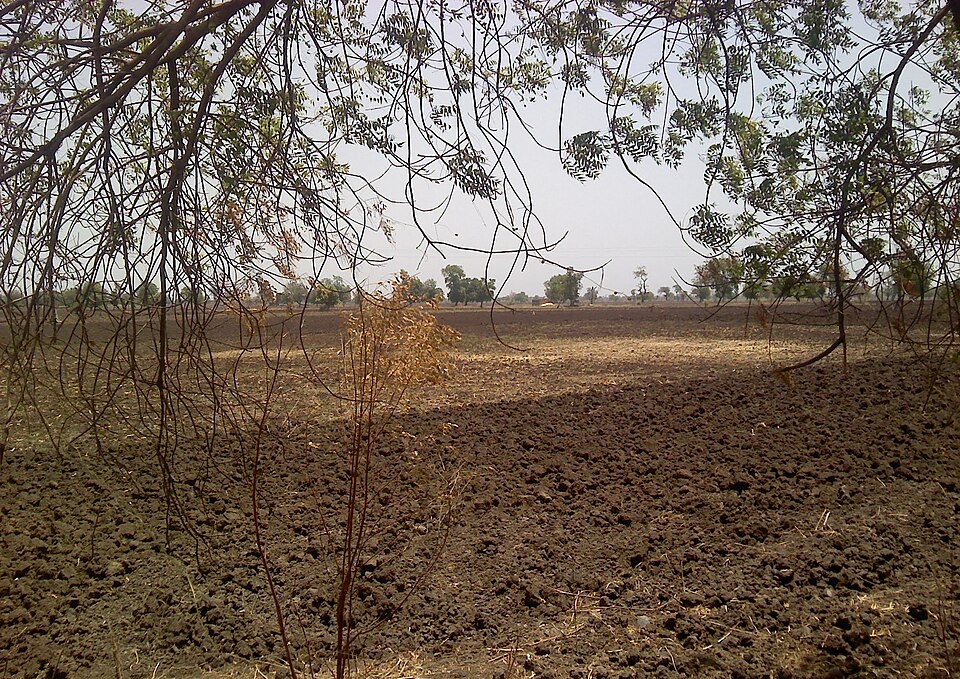
Black soil, called regur or black cotton soil, forms on the Deccan basalt under a semi-arid climate. It is clayey, deep and impermeable, rich in lime, iron, magnesia and alumina, and poor in nitrogen, phosphorus and organic matter. The clay fraction is largely montmorillonite, a mineral whose layers take water between them, so the soil swells when wet and contracts into wide cracks when dry. Those cracks turn over the surface material and give the soil its old nickname, self-ploughing.
The format here is the assertion-reason format in disguise: two true statements, and the marks turn on whether one causes the other. Test it by asking what would happen if statement 2 were false. A soil that shed the monsoon rain instead of holding it could not carry a crop through a dry September, and rain-fed farming on the Deccan would collapse. That counterfactual settles the link. The trap option is (b), which is correct on both facts and wrong on the connection between them.
- Black soil is derived from the weathering of Deccan Trap basalt and covers much of Maharashtra, Madhya Pradesh, Gujarat, northern Karnataka and parts of Telangana and Tamil Nadu.
- Its water-holding capacity comes from montmorillonite clay, which swells on wetting.
- It is rich in lime, iron, magnesia and alumina, and deficient in nitrogen, phosphorus and organic matter.
- Deep cracks in the dry season aerate the soil, which is why regur is described as self-ploughing.
- Cotton, jowar, safflower, tur and groundnut are the standard rain-fed crops of the black-soil tract.
- Marking (b) after verifying both statements and never testing the causal link.
- Confusing black soil's fertility with organic richness — it is chemically rich but low in humus and nitrogen.
- Assuming a moisture-retentive soil must also be well drained; regur is impermeable and waterlogs easily.
Asked in the two-statement plus explanation format, where knowing both facts is not enough — the examiner is testing whether you can say which fact causes the other.
Which one of the following soils is ideal for growing cotton ?
- (a) Regur soil
- (b) Laterite soil
- (c) Desert soil
- (d) Mountainous soil
Answer(a) Regur soil
Regur is black soil under its other name, and cotton is the rain-fed crop this question has in mind. Knowing the pairing settles both papers.
Identify the type of soil on the basis of the given characteristics : 1. They are rich in lime, iron, magnesia and alumina. 2. They are generally clayey, deep and impermeable. 3. They are mainly found in Maharashtra, Madhya Pradesh and Gujarat. Select the correct answer from the given alternatives :
- (a) Laterite soil
- (b) Red and yellow soil
- (c) Saline soil
- (d) Black soil
Answer(d) Black soil
The same soil approached from its properties instead of its uses. Clayey, deep and impermeable is the description that carries the moisture-holding of this question, and the three states named are the rain-fed cotton tract.
- practice — not a real PYQ
The self-ploughing character of black soil is best explained by
- (a)the high sand content of the soil
- (b)the swelling and shrinking of its clay with moisture
- (c)the burrowing activity of soil fauna
- (d)the high organic matter content
Answer(b) the swelling and shrinking of its clay with moisture — wetting expands the montmorillonite and drying opens deep cracks that turn the surface material over.
- practice — not a real PYQ
Black soil is deficient in which one of the following?
- (a)Lime
- (b)Iron
- (c)Nitrogen
- (d)Magnesia
Answer(c) Nitrogen — regur carries lime, iron, magnesia and alumina in plenty but is poor in nitrogen, phosphorus and humus.