
Which one of the following statements with reference to the Nebular Hypothesis for the origin of Solar System is correct?
- (a)The initiation of the nebular hypothesis can be considered as a diffuse, roughly spherical, slowly rotating expanding nebula
- (b)As a result of rotation and expansion, a disk is formed with matter concentrated in the centre
- (c)Expansion continues with the formation of the proto-Sun and the rings of material are left behind
- (d)The material in the rings get condensed and form the planets that revolve in orbits around the Sun
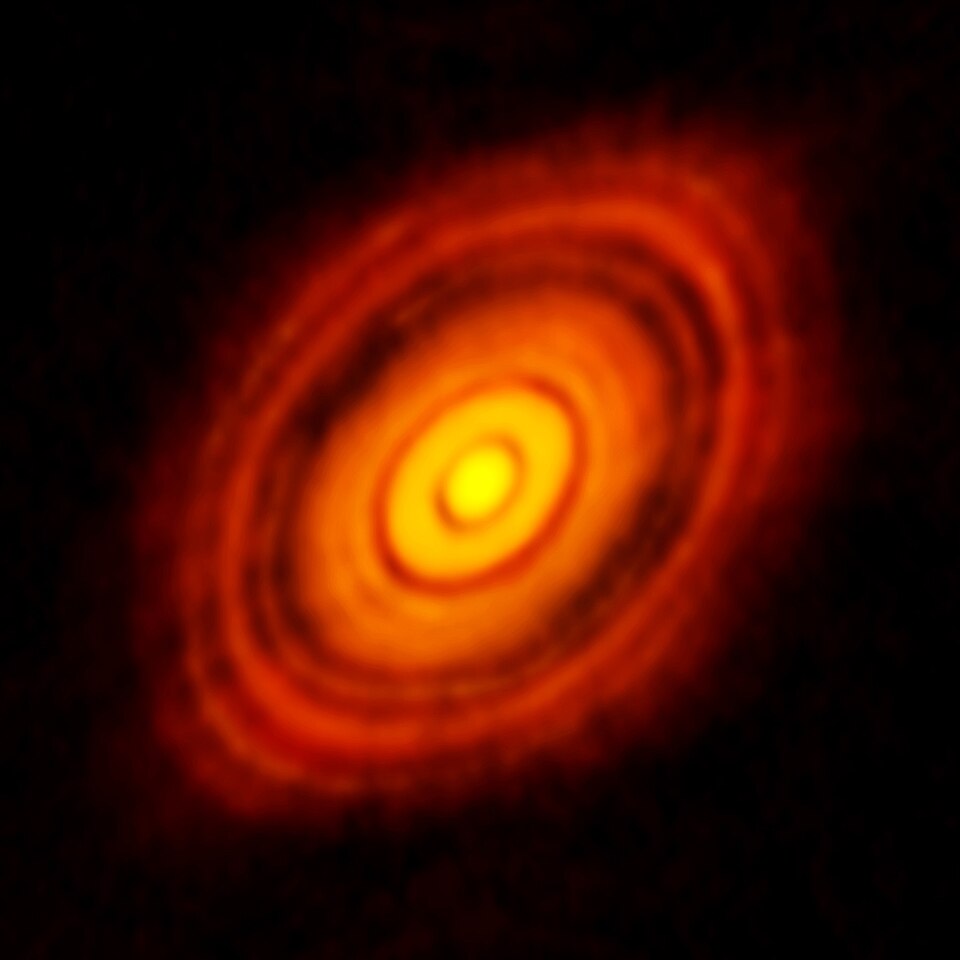
Correct — D, the material in the rings gets condensed and forms the planets that revolve in orbits around the Sun. The nebular hypothesis, in the form Laplace gave it in 1796, begins with a hot, slowly rotating cloud of gas and dust that cools and contracts under its own gravity. As it shrinks, conservation of angular momentum makes it spin faster, and the faster spin flattens it into a disc. From time to time the outer edge sheds a ring of material, and each ring later condenses into a planet while the bulk of the cloud collapses into the Sun at the centre. Only option (d) states a step of that sequence correctly; the other three all describe the cloud as expanding, which reverses the mechanism.
- (a)The initiation of the nebular hypothesis can be considered as a diffuse, roughly spherical, slowly rotating expanding nebula — The nebula contracts, not expands. Gravity draws the cloud inward, and expansion would drive the material apart rather than gather it into a Sun and planets.
- (b)As a result of rotation and expansion, a disk is formed with matter concentrated in the centre — The disc does form with matter concentrating at the centre, but it forms through rotation and contraction. Naming expansion as the cause reverses the physics, since it is contraction that speeds the spin and flattens the cloud.
- (c)Expansion continues with the formation of the proto-Sun and the rings of material are left behind — The proto-Sun does form and rings are left behind, but again by continued contraction rather than expansion. The word makes the statement false as printed.
Ideas about the origin of the solar system fall into two families. Monistic theories derive the Sun and planets from one body of material — the nebular hypothesis of Kant and Laplace, and the modern solar nebular disc model. Dualistic theories require a second star: Chamberlin and Moulton's planetesimal hypothesis, Jeans and Jeffreys's tidal theory, and Hoyle's supernova idea all invoke an encounter. Laplace's version fails to explain why the Sun holds 99.8 per cent of the mass but only a small share of the angular momentum, which is why the modern disc model, not the eighteenth-century one, is accepted today.
All four options are near-identical sentences differing in a single word, and three of them share the same error. That is the pattern to exploit: scan for the repeated word rather than reading each option whole. The repeated word here is 'expansion', and the moment you know the cloud contracts, three options fall together. Do not confuse this with the origin of the universe, which is a different question answered by the Big Bang; the nebular hypothesis addresses only the solar system.
- The nebular hypothesis was proposed by Immanuel Kant in 1755 and developed mathematically by Pierre-Simon Laplace in 1796.
- A contracting cloud spins faster by conservation of angular momentum and flattens into a disc.
- Rings shed from the disc condense into planets while the centre becomes the Sun.
- Laplace's version cannot explain why the Sun holds 99.8 per cent of the mass but little of the angular momentum.
- Planetesimal and tidal hypotheses are dualistic, requiring a passing star; the nebular hypothesis is monistic.
- Missing that three options share the same wrong word, which is what makes them all fail.
- Confusing the origin of the solar system with the origin of the universe.
- Treating the nebular hypothesis as requiring a second star, which is the dualistic family.
A four-statement item where three options carry the same reversal. Finding the repeated error is faster than evaluating each sentence separately.
Which one of the following hypothesis/theory explains the origin of the universe?
- (a) Nebular hypothesis
- (b) Binary theory
- (c) Big Bang theory
- (d) Planetesimal hypothesis
Answer(c) Big Bang theory
The distinction this question depends on, tested directly. The nebular hypothesis appears there as a wrong option precisely because it explains the solar system and not the universe.
- practice — not a real PYQ
The nebular hypothesis of the origin of the solar system was developed mathematically by
- (a)Pierre-Simon Laplace
- (b)James Jeans
- (c)Fred Hoyle
- (d)Edwin Hubble
Answer(a) Pierre-Simon Laplace — in 1796, building on Kant's earlier proposal.
- practice — not a real PYQ
A contracting cloud of gas spins faster as it shrinks because of the conservation of
- (a)mass
- (b)linear momentum
- (c)angular momentum
- (d)charge
Answer(c) angular momentum — the same reason a spinning skater speeds up on drawing in the arms.