
Where does podsolization take place?
- (a)Regions in high middle latitudes
- (b)Coastal regions in lower latitudes
- (c)Regions with hot and humid climate
- (d)Regions having arid climate
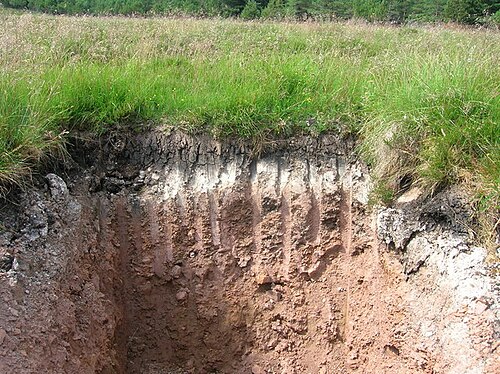
Correct — A, Regions in high middle latitudes. Podsolisation is the soil-forming process of the cool, humid belt where coniferous forest grows — roughly 50 to 70 degrees of latitude, the taiga of Canada, Scandinavia and Siberia. Three conditions have to hold together. Precipitation must exceed evaporation, so water moves downward through the soil. Temperatures must be low enough that organic matter decomposes slowly and accumulates. And the litter must be acidic, which pine and spruce needles are. The percolating acid water strips iron and aluminium oxides and humus from the upper horizon, leaving a bleached, ash-grey layer of almost pure silica, and redeposits them lower down. The Russian word podzol means 'under ash', which describes that bleached horizon exactly.
- (b)Coastal regions in lower latitudes — Coastal regions in lower latitudes are warm and their vegetation gives a much less acidic litter. Where rainfall is heavy in the tropics the characteristic process is laterisation, which leaves iron and aluminium behind rather than washing them down.
- (c)Regions with hot and humid climate — A hot and humid climate produces laterisation. Intense leaching there removes silica and bases and concentrates iron and aluminium oxides at the surface, giving the red lateritic soils of Kerala, coastal Karnataka and the Chhotanagpur plateau — the opposite of a podsol's bleached upper layer.
- (d)Regions having arid climate — In an arid climate evaporation exceeds precipitation, so water moves upward through the soil and salts accumulate at the surface. That process is calcification or salinisation, and it needs the downward percolation that a dry climate does not supply.
Climate decides which soil-forming process dominates. Where precipitation exceeds evaporation, water moves down and leaches material out of the upper horizons; where evaporation exceeds precipitation, water moves up and salts accumulate at the top. Podsolisation is leaching under cool, acidic, coniferous conditions and removes iron, aluminium and humus from the surface layer. Laterisation is leaching under hot, humid conditions and removes silica while leaving iron and aluminium behind. Calcification and salinisation belong to dry climates where the movement is upward.
The item can be settled by pairing each option with the process that actually belongs to it. Hot and humid goes with laterisation, arid goes with calcification, and the cool humid coniferous belt is left for podsolisation. The name itself is the best mnemonic: podzol is Russian for 'under ash', and the ash-grey horizon it names forms only where slow decomposition and acidic needle litter come together, which is a high-latitude condition. Podsols are poor agricultural soils, strongly acidic and low in bases, which is why the taiga is forested rather than farmed.
- Podsolisation occurs in cool, humid, coniferous regions of high middle latitudes, roughly the taiga belt.
- Acidic percolating water removes iron, aluminium and humus from the upper horizon and deposits them below.
- The name podzol is Russian for 'under ash', after the bleached grey horizon left behind.
- Laterisation is the hot, humid counterpart and leaves iron and aluminium oxides at the surface.
- Calcification and salinisation belong to arid regions, where water moves upward and salts collect at the top.
- Confusing podsolisation with laterisation, which is the hot-climate leaching process.
- Assuming any heavy-rainfall region podsolises, when acidic litter and slow decomposition are also required.
- Placing the process in the tropics because leaching is associated with high rainfall.
A process-to-region item best solved by pairing each of the four climates with the process that genuinely belongs to it.
The process of Podsolization is predominantly found in :
- (a) Equatorial forest
- (b) Monsoon forest
- (c) Taiga forest
- (d) Mediterranean forest
Answer(c) Taiga forest
The same process located by vegetation rather than by latitude. The taiga is exactly the high middle latitude coniferous belt named here, so the two items are two labels for one answer.
- practice — not a real PYQ
Laterite soils in India are typically formed under which climatic condition?
- (a)Cool and humid
- (b)Hot and humid with alternating wet and dry seasons
- (c)Cold and arid
- (d)Hot and arid
Answer(b) Hot and humid with alternating wet and dry seasons — intense leaching leaves iron and aluminium behind.
- practice — not a real PYQ
The bleached, ash-grey horizon characteristic of a podzol lies
- (a)at the very bottom of the profile
- (b)in the upper part of the profile
- (c)below the parent rock
- (d)only in waterlogged soils
Answer(b) in the upper part of the profile — the layer from which material has been washed down.