
Which among the following are the main ingredients for manufacturing of glass?
- (a)Silica, sodium carbonate, borax, alumina and cullets
- (b)Iron oxide, lead, sodium bicarbonate, alumina and cullets
- (c)Magnesium carbonate, alumina, silica and cullets
- (d)Iron oxide, sodium, alumina, silica and cullets
Correct — A, Silica, sodium carbonate, borax, alumina and cullets. Glass making starts from a network former, and for ordinary glass that is silica, silicon dioxide, supplied as clean sand. Silica alone melts near 1,700 degrees Celsius, so a flux is added to bring the melting temperature down, and the standard flux is sodium carbonate, called soda ash. Alumina is added as a stabiliser to improve chemical durability, borax gives thermal-shock resistance in the borosilicate grades, and cullets are crushed waste glass recycled into the batch to save fuel and help the melt start. Only option (a) contains a network former and an alkali flux together; the other three each leave out one of the two essentials.
- (b)Iron oxide, lead, sodium bicarbonate, alumina and cullets — Iron oxide and lead are not the base of a glass batch. Iron oxide is a colouring impurity that makes glass green and is deliberately kept low, and lead oxide is used only in the special lead crystal grades. This option also omits silica, without which there is no glass network at all.
- (c)Magnesium carbonate, alumina, silica and cullets — This has silica and alumina but no alkali flux. Magnesium carbonate is a minor stabiliser, not a substitute for soda ash, and without a flux the batch would need furnace temperatures that no commercial plant runs.
- (d)Iron oxide, sodium, alumina, silica and cullets — Iron oxide again heads a list where it does not belong, and elemental sodium is not a raw material anywhere in glass making — the sodium is charged as sodium carbonate. The list has silica but no usable flux.
Glass is an amorphous solid: it has the disordered structure of a liquid but the rigidity of a solid, because it is cooled too fast for crystals to form. A glass batch has three functional groups of ingredients. The former builds the random network, and silica is the usual one. The flux lowers the melting point, and sodium carbonate is the usual one. The stabiliser makes the product durable and insoluble, and limestone and alumina do that work. Cullet, recycled glass, is added to every batch for economy.
The way through is to check each option for the two essentials rather than to memorise a list. A glass batch must have a network former and it must have a flux. Silica appears in three of the four options, so the flux is the discriminator, and sodium carbonate appears in only one. It is worth knowing that ordinary window and bottle glass is soda-lime glass — silica, soda and lime — while borax belongs properly to borosilicate glass of the laboratory and cookware kind, which resists sudden temperature change because it expands very little on heating.
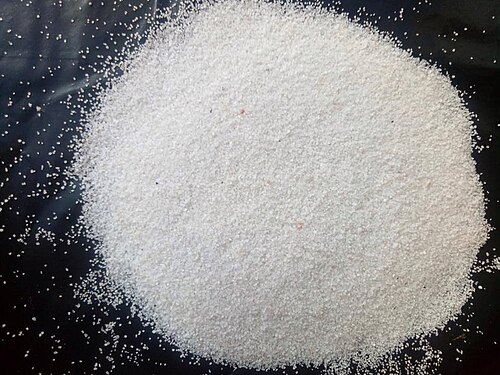
- Silica, silicon dioxide, is the network former of ordinary glass and comes into the batch as sand.
- Sodium carbonate, soda ash, is the flux that brings the melting temperature down from about 1,700 degrees Celsius.
- Limestone and alumina are stabilisers that make the glass insoluble and durable.
- Cullet is crushed recycled glass added to the batch to save fuel and speed the melt.
- Borosilicate glass contains borax and resists thermal shock; ordinary window glass is soda-lime glass.
- Choosing an option that has silica but no flux.
- Treating iron oxide as an ingredient rather than as an impurity that colours glass green.
- Assuming borax is essential to all glass rather than characteristic of borosilicate grades.
A composition item best solved by elimination — check every option for a network former and a flux, and only one survives.
Consider the following statements: I. Glass can be etched or scratched by diamond. II. Glass can be etched or scratched by hydrofluoric acid. III. Glass can be etched or scratched by aqua regia. IV. Glass can be etched or scratched by concentrated sulphuric acid. Which of these statements are correct?
- (a) I and IV
- (b) II and III
- (c) I and II
- (d) II and IV
Answer(c) I and II
The chemistry of the same material from the other side. Hydrofluoric acid attacks glass precisely because glass is a silica network, which is the ingredient this question is really about.
- practice — not a real PYQ
The main constituent of ordinary glass is
- (a)calcium oxide
- (b)silicon dioxide
- (c)aluminium oxide
- (d)sodium chloride
Answer(b) silicon dioxide — the network former, supplied as sand.
- practice — not a real PYQ
Laboratory glassware that withstands sudden heating is usually made of
- (a)lead glass
- (b)borosilicate glass
- (c)soda-lime glass
- (d)quartz-free glass
Answer(b) borosilicate glass — the boron oxide gives it a very low coefficient of thermal expansion.