
Which among the following is correct with respect to bond formation in an ethyne molecule?
- (a)Carbon-Carbon single bond
- (b)Carbon–Carbon double bond
- (c)Carbon–Carbon triple bond
- (d)Carbon–Hydrogen double bond
Correct — C, Carbon-Carbon triple bond. Ethyne has the formula C2H2, and each carbon can form four bonds. One of each carbon's bonds goes to a hydrogen, which leaves three bonds on each carbon to be shared with the other carbon — a triple bond, written H-C三C-H. The naming rule confirms it independently: in the systematic names for open-chain hydrocarbons the ending -ane means only single bonds, -ene means a double bond and -yne means a triple bond. Ethyne ends in -yne, so it has a triple bond, just as ethane has a single one and ethene a double one. The triple bond consists of one sigma bond and two pi bonds, the two carbons are sp hybridised, and the molecule is linear.
- (a)Carbon-Carbon single bond — A carbon-carbon single bond is what ethane, C2H6, has. Ethane's six hydrogens use up three bonds on each carbon, leaving only one for the carbon-carbon link.
- (b)Carbon–Carbon double bond — A carbon-carbon double bond belongs to ethene, C2H4, whose name ends in -ene. Ethene is planar with bond angles near 120 degrees, while ethyne is linear.
- (d)Carbon–Hydrogen double bond — Carbon and hydrogen cannot form a double bond. Hydrogen has only one electron to share and can therefore form exactly one covalent bond, so every C-H link in any hydrocarbon is a single bond.
Hydrocarbons are named by their carbon count and their bond order. The stem of the name gives the number of carbons — meth, eth, prop, but — and the ending gives the bonding: -ane for saturated, -ene for a double bond, -yne for a triple bond. Bond order also fixes the geometry. A single bond leaves the carbon sp3 hybridised and tetrahedral at about 109.5 degrees, a double bond makes it sp2 and planar at about 120 degrees, and a triple bond makes it sp and linear at 180 degrees. Bond length falls and bond strength rises as the order goes up.
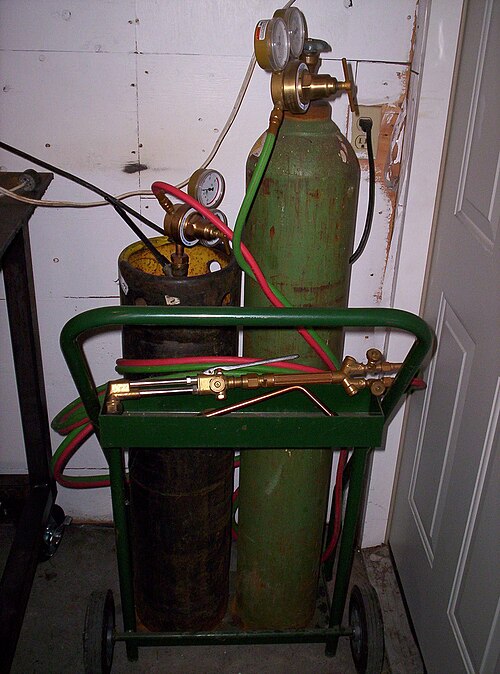
This item can be answered from the name alone without drawing anything, which is why the -ane, -ene, -yne rule is worth over-learning. The fourth option is the one that tests understanding rather than memory: a carbon-hydrogen double bond is impossible, because hydrogen has a single valence electron. Ethyne is better known industrially as acetylene, the fuel of the oxy-acetylene welding torch, whose flame reaches around 3,300 degrees Celsius because the triple bond releases so much energy on combustion.
- Ethyne is C2H2, with one sigma bond and two pi bonds between the carbons.
- The name endings run -ane for single, -ene for double and -yne for triple bonds.
- Ethyne is linear at 180 degrees because both carbons are sp hybridised.
- Carbon-carbon bond length falls from about 154 picometres in ethane to 134 in ethene and 120 in ethyne.
- Ethyne is industrially made from calcium carbide and water, and is the acetylene of the welding torch.
- Reading the formula C2H2 as a double bond because the subscripts are both 2.
- Accepting a carbon-hydrogen double bond as chemically possible.
- Confusing ethene with ethane when the names differ by a single letter.
A one-line structure item answerable straight from the name ending, with one option that is chemically impossible thrown in as a check on understanding.
Consider the following statements about acetylene: I. It is used in welding industry. II. It is raw material for preparing plastics. III. It is easily obtained by mixing silicon carbide and water. Of these statements:
- (a) I and II are correct
- (b) I and III are correct
- (c) II and III are correct
- (d) I, II and III are correct
Answer(a) I and II are correct
The same compound under its common name. Acetylene is ethyne, and that item tests where it is used and how it is made — the practical half of the fact whose structural half is asked here.
- practice — not a real PYQ
Which one of the following hydrocarbons contains a carbon-carbon double bond?
- (a)Ethane
- (b)Ethene
- (c)Ethyne
- (d)Methane
Answer(b) Ethene — the ending -ene marks a double bond, and its formula is C2H4.
- practice — not a real PYQ
Acetylene is prepared industrially by the action of water on
- (a)calcium carbide
- (b)silicon carbide
- (c)sodium carbonate
- (d)calcium carbonate
Answer(a) calcium carbide — CaC2 with water gives C2H2 and calcium hydroxide.