
Which of the following is/are important markers for the archaeologists to identify an archaeological site as a 'center of craft production'? 1. Evidence of raw materials such as stone nodules, whole shells, etc. 2. Geographical expanse of the site 3. Evidence of unfinished objects, rejects and waste material 4. Evidence of variety of pottery Select the correct answer using the code given below:
- (a)1 only
- (b)1 and 3 only
- (c)2 and 4 only
- (d)3 only
Correct — B, 1 and 3 only. Statements 1 and 3 are lifted almost word for word from the standard account of the method: to identify centres of craft production, archaeologists look for raw material such as stone nodules, whole shells and copper ore, for tools, for unfinished objects, and for rejects and waste material — and waste is described as one of the best indicators of craft work, because cutting shell or stone leaves discarded pieces exactly where the cutting was done. Statement 2 fails because size measures nothing about manufacture. Chanhudaro covers less than seven hectares against Mohenjodaro's hundred and twenty-five and was almost entirely given over to craft, so if anything the expanse of a site points the other way. Statement 4 fails because pottery turns up at essentially every settlement as ordinary domestic material; its variety tells you about use and exchange, not about where the pots were made, unless kilns and spoilt vessels are found alongside.
- (a)1 only — Raw material on its own is ambiguous — stone nodules or shell could have been brought in for storage or for onward trade. It is the waste and the unfinished pieces that prove work was actually done on the spot.
- (c)2 and 4 only — Chooses the two markers that do not work. A large site need not have made anything, and pottery is found everywhere people lived.
- (d)3 only — Rejects and waste are indeed the strongest single indicator, but the standard list opens with raw material, and statement 1 names precisely the examples given — stone nodules and whole shells.
Archaeology infers activity from what an activity leaves behind, and manufacture leaves a distinctive signature: material that came in, tools that worked it, objects abandoned part-finished, and debris that nobody bothered to carry away. Finished goods travel, so their presence at a site proves consumption rather than production. Waste does not travel, which is why it is the most reliable evidence of all.
Two of the offered markers describe a settlement rather than a workshop, and separating those two categories is the skill being tested. Size and pottery variety are both facts about a place; nodules, rejects and half-made objects are facts about a process. Reading the question that way settles it without recalling any particular excavation. The examples in the Harappan case are worth carrying: Chanhudaro, a tiny settlement almost wholly devoted to bead-making, shell-cutting, metal-working, seal-making and weight-making, and Nageshwar and Balakot on the coast, where the shell was.
- The markers used to identify a centre of craft production are raw material such as stone nodules, whole shells and copper ore; tools; unfinished objects; and rejects and waste material.
- Waste is treated as the single best indicator, because cutting shell or stone leaves discarded pieces at the place of work.
- Chanhudaro, under seven hectares against Mohenjodaro's hundred and twenty-five, was almost exclusively devoted to craft production.
- Nageshwar and Balakot, both near the coast, specialised in shell objects — bangles, ladles and inlay — which were taken to other settlements.
- Specialised drills for bead-making have been found at Chanhudaro, Lothal and Dholavira.
- Craft was not confined to small specialist settlements; the traces show it was carried on in the large cities of Mohenjodaro and Harappa as well.
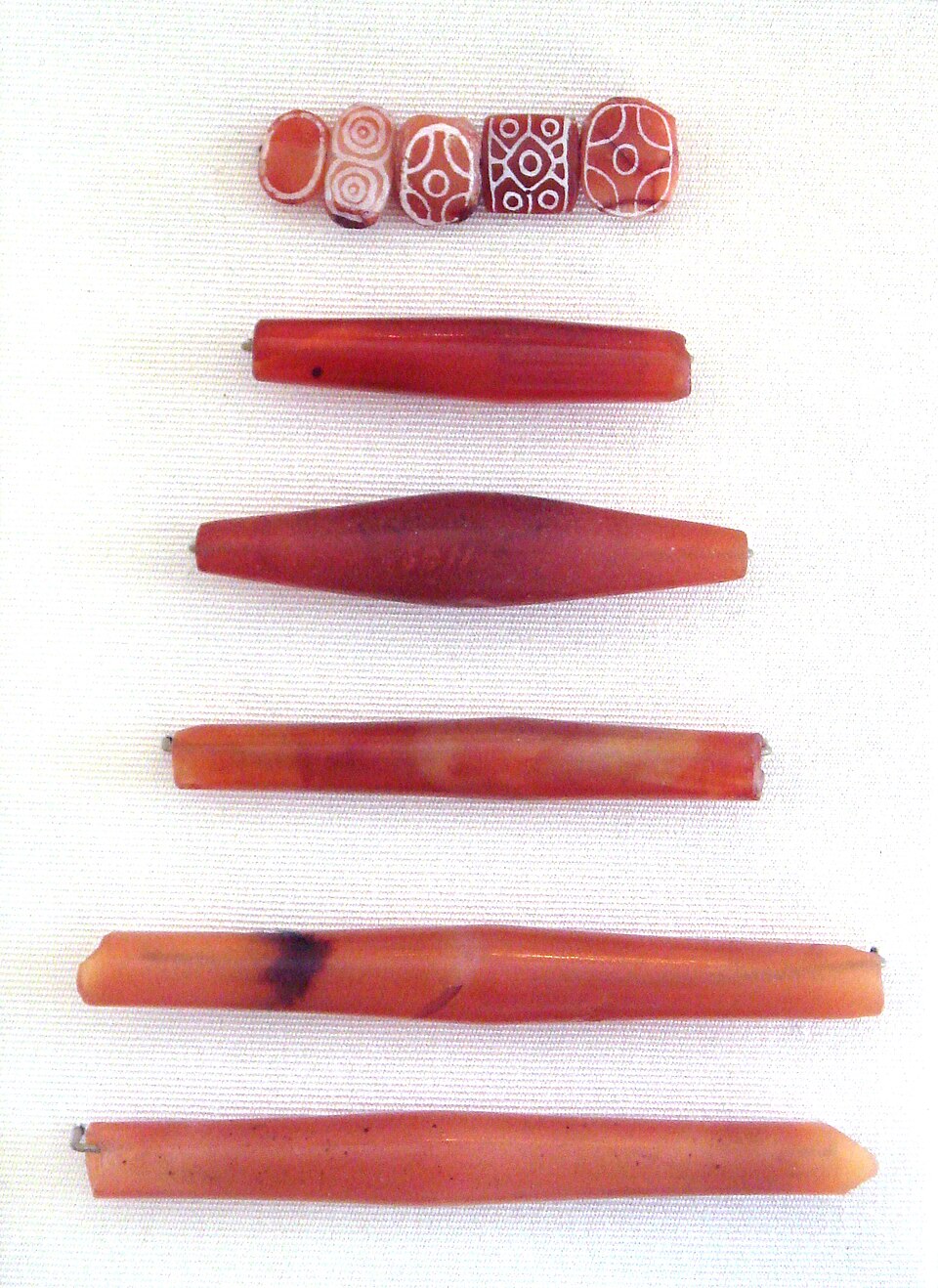
- Treating the size of a site as evidence of what happened there.
- Reading a variety of pottery as proof of local manufacture rather than of use or exchange.
- Assuming the presence of raw material alone settles the matter, when it could have been stored or traded onward.
A statement-selection item drawn straight from the textbook account of archaeological method, so the true statements are close to verbatim and the false ones are plausible-sounding additions.
From which one of the following factory sites were limestone and chert blades mass produced and sent to various Harappan settlements in Sindh?
- (a) Sukkur and Rohri Hills
- (b) Khetri in Rajasthan
- (c) Chagai Hills
- (d) Hills of Baluchistan
Answer(a) Sukkur and Rohri Hills
A worked example of the principle. The blades were made at the stone source and distributed from there, which is why the debris of manufacture lies in the hills and the finished blades lie in the settlements of Sindh.
Which of the following is/are the most distinctive artefacts of the Harappan Civilisation? 1. Steatite seal 2. Bricks of a standardised ratio 3. Gold bangles 4. Silver spittoon Select the correct answer using the code given below:
- (a) 1 only
- (b) 1 and 2 only
- (c) 2, 3 and 4
- (d) 1, 2 and 3
Answer(b) 1 and 2 only
The same reasoning applied to objects rather than to sites. Seals and standardised bricks were made to a Harappan pattern everywhere; gold and silver items are rare and concentrated in the large settlements, so they distinguish wealth rather than the civilisation.
- practice — not a real PYQ
Which Harappan settlement, covering less than seven hectares, was almost entirely devoted to craft production?
- (a)Kalibangan
- (b)Chanhudaro
- (c)Banawali
- (d)Ropar
Answer(b) Chanhudaro — a tiny site by comparison with Mohenjodaro's hundred and twenty-five hectares, given over to bead-making, shell-cutting, metal-working, seal-making and weight-making.
- practice — not a real PYQ
In identifying a centre of craft production, archaeologists treat which of the following as the strongest single indicator?
- (a)The number of burials at the site
- (b)Rejects and waste material
- (c)The thickness of the surrounding wall
- (d)The presence of finished ornaments
Answer(b) Rejects and waste material — finished ornaments travel and prove only that someone owned them, while waste stays where the work was done.