
Which of the following is/are the most distinctive artefacts of the Harappan Civilisation? 1. Steatite seal 2. Bricks of a standardised ratio 3. Gold bangles 4. Silver spittoon Select the correct answer using the code given below:
- (a)1 only
- (b)1 and 2 only
- (c)2, 3 and 4
- (d)1, 2 and 3
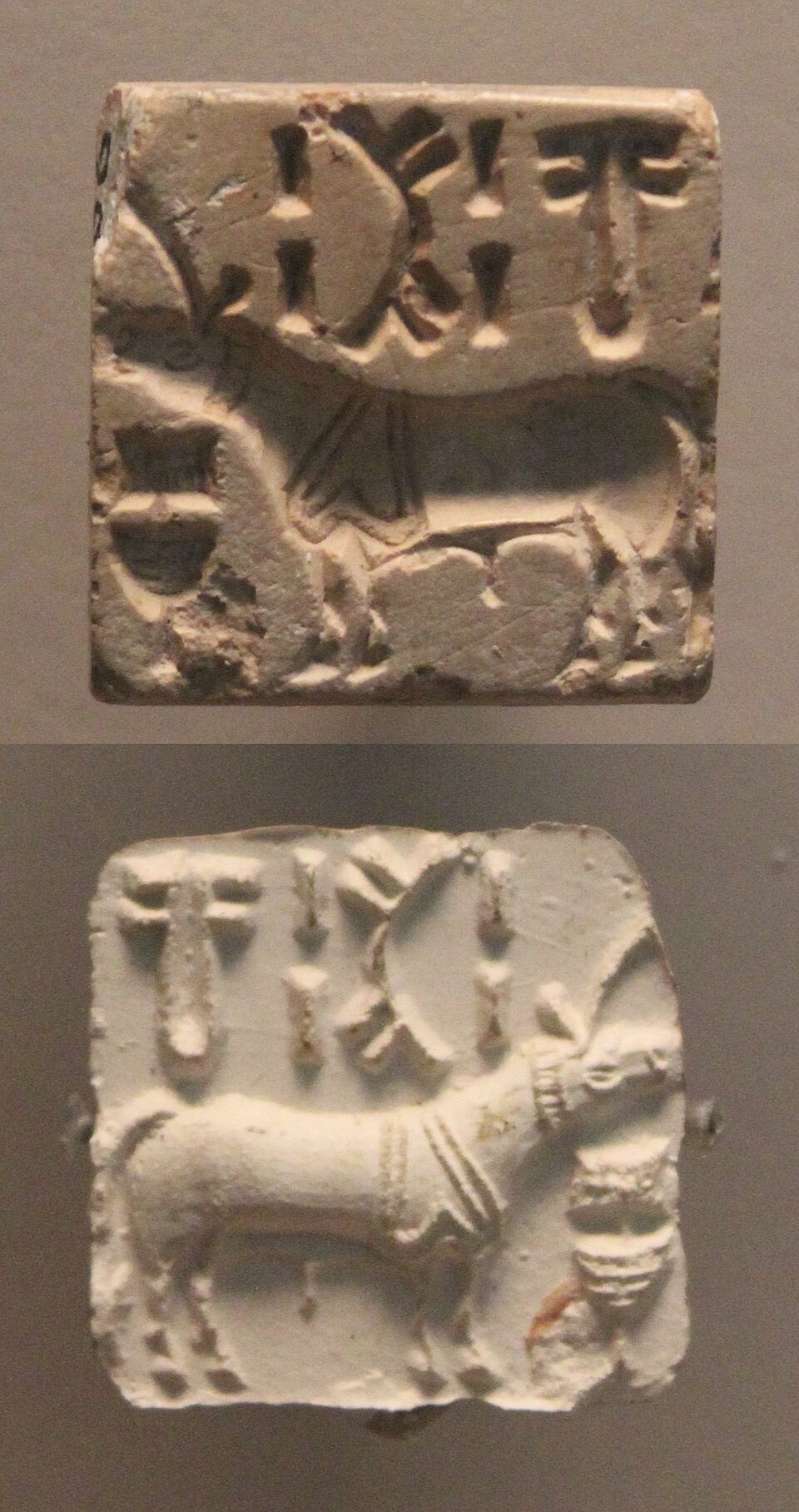
Correct — B, 1 and 2 only. Distinctive means diagnostic — an object that lets an archaeologist call a site Harappan rather than something else. The steatite seal, square, small and carved with an animal and a line of the undeciphered script, is the signature artefact of the civilisation and is found nowhere outside its orbit. The baked brick made to a fixed ratio of one to two to four in thickness, width and length is the other, because the same ratio recurs from Sindh to Gujarat to Haryana and implies a shared standard rather than local habit. Gold bangles are not diagnostic; goldwork appears in many ancient cultures and Harappan gold is modest in quantity. A silver spittoon is not a Harappan object at all.
- (a)1 only — Keeps the seal and drops the brick. The standardised brick ratio is as much a marker of the civilisation as the seal, and it is the one that shows the standardisation running across sites hundreds of kilometres apart.
- (c)2, 3 and 4 — Loses the seal, which is the single most recognisable Harappan artefact, and admits the spittoon, which belongs to a much later material culture.
- (d)1, 2 and 3 — Adds gold bangles to the two correct items. Gold ornaments are found at Harappan sites, but they are not distinctive — almost every literate Bronze Age culture left gold jewellery behind.
Archaeologists identify a culture by the objects that recur across its sites and do not occur outside them. For the Harappan civilisation that set is small and famous — seals of steatite, standardised baked bricks, cubical chert weights in a binary series, long carnelian beads, chert blades and a distinctive red-and-black painted pottery. The word distinctive in the stem is doing real work; it asks which objects mark the culture out, not which objects the culture happened to possess.
The standardisation is the deeper point. Bricks of a fixed proportion, weights in a fixed series and seals of a fixed form all point to conventions enforced over a very large area, which is why the civilisation is described as unusually uniform for the Bronze Age. The seals are mostly of steatite, a soft stone that is easy to carve and hardens when heated, and the commonest motif is the one-horned animal usually called the unicorn. The spittoon in option (d) is worth recognising as a deliberate anachronism — it is an object of much later, medieval Indian courtly life, and it is placed there to see whether a candidate will accept any object that sounds old.
- Steatite seals carrying an animal motif and a short line of the undeciphered Indus script are the signature Harappan artefact.
- Harappan baked bricks keep a ratio of about 1 to 2 to 4 in thickness, width and length across widely separated sites.
- Chert weights in a binary series, long barrel-shaped carnelian beads and chert blades are the other diagnostic objects.
- The Indus script remains undeciphered, so the seals are read as objects rather than as texts.
- Gold and silver were both worked by the Harappans, but neither the metal nor its ornaments distinguish the culture from its contemporaries.
- Reading distinctive as merely present — gold was present, but it distinguishes nothing.
- Accepting any object that sounds ancient; the spittoon is a much later form.
- Forgetting that the standardised brick is itself an artefact, and a diagnostic one.
Material-culture items ask what marks a civilisation out, so test each object against the question of whether its absence would make you doubt the identification.
Regarding the Indus Valley Civilization, consider the following statements : 1. It was predominantly a secular civilization and the religious element, though present, did not dominate the scene. 2. During this period, cotton was used for manufacturing textiles in India. Which of the statements given above is/are correct?
- (a) 1 only
- (b) 2 only
- (c) Both 1 and 2
- (d) Neither 1 nor 2
Answer(c) Both 1 and 2
The same civilisation judged by what it left behind. Its buildings are civic rather than temple-like and its textile evidence is cotton — both conclusions drawn, as here, from the objects rather than from any readable text.
Match List-I with List-II and select the correct answer using the code given below the Lists: List-I (Harappan Site) A. Nageshwar B. Alamgirpur C. Kalibangan D. Rakhigarhi List-II (Location) 1. Uttar Pradesh 2. Rajasthan 3. Saurashtra 4. Haryana Code:
- (a) A-3, B-1, C-2, D-4
- (b) A-4, B-2, C-1, D-3
- (c) A-4, B-1, C-2, D-3
- (d) A-3, B-2, C-1, D-4
Answer(a) A-3, B-1, C-2, D-4
The geography behind the standardisation. Those four sites lie in four different modern states, which is what makes a common brick ratio and a common seal form across all of them worth calling distinctive.
- practice — not a real PYQ
Harappan seals were most commonly made of which material?
- (a)Terracotta
- (b)Steatite
- (c)Ivory
- (d)Copper
Answer(b) Steatite — a soft stone that carves easily and hardens on heating, which suited the fine incised work.
- practice — not a real PYQ
The cubical weights of the Harappan civilisation were usually made of
- (a)chert
- (b)lead
- (c)baked clay
- (d)bronze
Answer(a) chert — the weights follow a binary series and are found across the Harappan area.