
The method used in separating a mixture of two miscible liquids having sufficient difference in their boiling points is:
- (a)Filtration
- (b)Solvent Extraction
- (c)Centrifugation
- (d)Simple Distillation
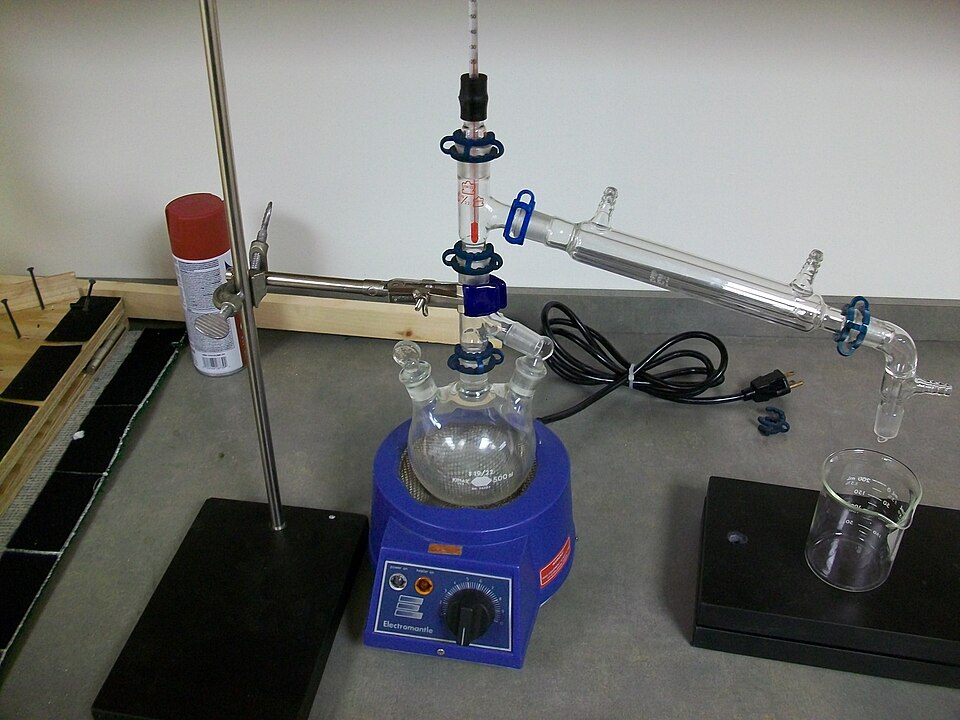
Correct — D, Simple Distillation. Two liquids that mix in all proportions cannot be separated by any method that relies on a physical boundary between them, so the separation has to exploit a property in which they differ — and the stem tells you which one, by specifying a sufficient difference in boiling points. Heat the mixture and the lower-boiling liquid vaporises first; lead that vapour through a condenser and it returns as a liquid in the receiver, leaving the higher-boiling component behind in the flask. The working rule taught with this technique is that a gap of roughly 25 K or more between the two boiling points is enough for a single distillation to do the job. Acetone, boiling at 56 °C, is separated from water this way. Where the gap is narrower, as with petrol and kerosene in crude oil, a fractionating column is added and the process becomes fractional distillation.
- (a)Filtration — Filtration needs a solid that will not pass through the pores of the paper. Two miscible liquids form a single phase with nothing to trap, so the whole mixture runs straight through.
- (b)Solvent Extraction — Extraction works by shaking a mixture with a second solvent that dissolves one component and not the other, which needs the two solvents to be immiscible. It is the method for pulling a solute out of a solution, not for splitting two liquids that already dissolve in each other.
- (c)Centrifugation — Spinning separates components of different density that are suspended rather than dissolved — cream from milk, blood cells from plasma. A genuine solution of one liquid in another stays uniform however fast it is spun.
Every separation technique in school chemistry keys on one physical difference between the components. Miscible liquids share a single phase, so density, particle size and solubility are all unavailable, and boiling point is what remains. Distillation converts that difference into a separation by turning one component into vapour and the other not, then condensing the vapour somewhere else.
Read the stem for the property it hands you. 'Miscible' rules out everything that needs two phases — filtration, a separating funnel, decantation, centrifugation. 'Difference in their boiling points' then names the property being exploited, which leaves distillation. The one refinement the examiner may test next is where the line falls between simple and fractional distillation: the word 'sufficient' in this stem is doing that work, and had it read 'a small difference' the answer would have been fractional distillation instead.
- Simple distillation separates two miscible liquids whose boiling points differ by about 25 K or more.
- A narrower gap calls for fractional distillation, where a packed column gives the vapour repeated cycles of evaporation and condensation — the method used on crude oil.
- Filtration separates an insoluble solid from a liquid; a separating funnel separates two immiscible liquids such as kerosene and water.
- Centrifugation exploits differences in density among suspended particles, as in a cream separator or a blood-test tube.
- Sublimation is the route for a solid that passes straight to vapour — ammonium chloride, camphor or naphthalene mixed with common salt.
- Chromatography separates dissolved substances that move at different rates over an adsorbent, such as the dyes in ink.
- Choosing fractional distillation when the stem has already said the boiling points differ sufficiently.
- Reaching for a separating funnel, which needs two immiscible liquids and not two miscible ones.
- Treating solvent extraction as a general-purpose liquid-liquid method when it depends on immiscibility.
Set as a technique-matching item where the stem names the physical property in play, so the marks go to whoever links 'miscible' and 'boiling point' to the right apparatus.
A homogeneous mixture contains two liquids. How are they separated ?
- (a) By filtration
- (b) By evaporation
- (c) By distillation
- (d) By condensation
Answer(c) By distillation
The same question with 'homogeneous' standing in for 'miscible'. Both words say there is a single phase, and both lead to the same apparatus.
Kerosene and petrol mixture can be best separated by
- (a) Sublimation
- (b) Separating funnel
- (c) Fractional distillation
- (d) Compressing and cooling
Answer(c) Fractional distillation
The other half of the same rule, asked in the same year. Petrol and kerosene are miscible but close in boiling range, so a fractionating column is needed where a plain still would not do.
- practice — not a real PYQ
A mixture of two miscible liquids whose boiling points differ by only 5 K is best separated by
- (a)simple distillation
- (b)fractional distillation
- (c)a separating funnel
- (d)filtration
Answer(b) fractional distillation — a fractionating column gives the vapour many rounds of evaporation and condensation, which a single distillation cannot manage across so narrow a gap.
- practice — not a real PYQ
Kerosene and water can be separated by
- (a)a separating funnel
- (b)simple distillation
- (c)sublimation
- (d)chromatography
Answer(a) a separating funnel — the two are immiscible and settle into layers by density, so the lower layer is simply run off through the stopcock.