
The depletion in atmospheric ozone layer in last century was due to:
- (a)chlorofluorocarbon
- (b)carbon monoxide
- (c)methane
- (d)pesticides
Correct — A, chlorofluorocarbon. CFCs were adopted precisely because they are unreactive — non-toxic, non-flammable and stable, which made them ideal refrigerants, foam-blowing agents, aerosol propellants and solvents for cleaning electronics. That same stability means nothing in the lower atmosphere destroys them, so they survive for decades and drift up into the stratosphere. There short-wave ultraviolet light finally breaks them apart and frees chlorine atoms. A chlorine atom strips an oxygen from an ozone molecule to give chlorine monoxide, the chlorine monoxide then reacts with a free oxygen atom and hands the chlorine back, and the cycle starts again — one atom destroying many thousands of ozone molecules before it is locked away in a reservoir compound. Mario Molina and Sherwood Rowland set out this chemistry in 1974 and shared the 1995 Nobel Prize in Chemistry with Paul Crutzen.
- (b)carbon monoxide — A toxic product of incomplete combustion and a serious pollutant at ground level, but a short-lived one that is oxidised in the lower atmosphere. It carries no halogen atom, and it is halogens that run the catalytic cycle which destroys ozone.
- (c)methane — Methane is a powerful greenhouse gas, which is why it feels like a plausible villain. Its stratospheric effect on ozone runs the other way: it converts reactive chlorine into hydrogen chloride, a reservoir form that does not attack ozone.
- (d)pesticides — Pesticides as a class are not ozone-depleting substances. One halogenated fumigant, methyl bromide, genuinely is, and the Montreal Protocol controls it — but the depletion of the last century was overwhelmingly a chlorofluorocarbon story, not a pesticide one.
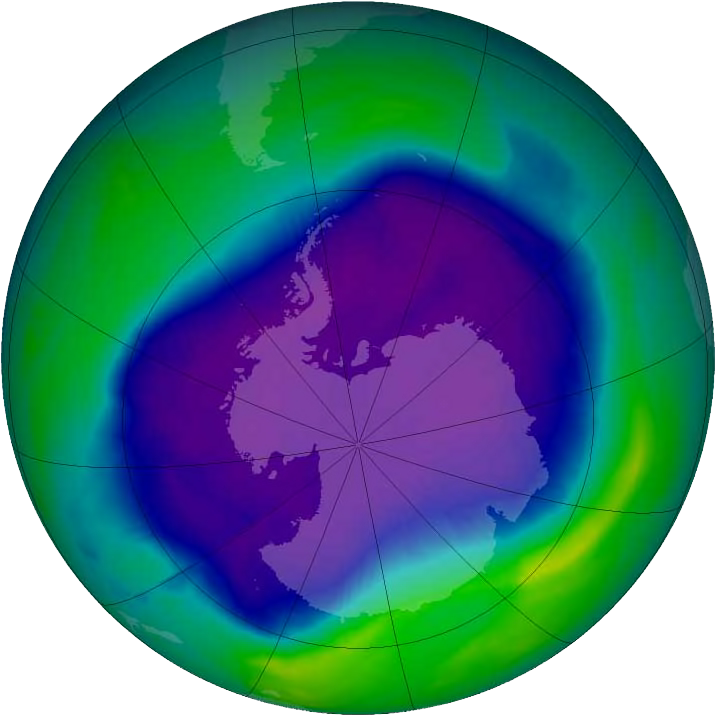
The ozone layer is a band of enhanced ozone concentration in the stratosphere, roughly 15 to 35 km up, which absorbs essentially all incoming UV-C and most UV-B. Column ozone is measured in Dobson Units. The seasonal Antarctic thinning that gave the world the phrase ozone hole was reported by the British Antarctic Survey in 1985; it is severe there because the winter polar vortex traps very cold air in which polar stratospheric clouds form, and reactions on the surface of those cloud particles convert stored chlorine into the reactive form that attacks ozone the moment spring sunlight returns.
The stem's phrase in the last century is a dating clue as much as a chemistry one, because CFC production peaked in the 1980s and was then wound down. The Montreal Protocol was adopted on 16 September 1987 — the reason that date is now International Ozone Day — and it is generally regarded as the most effective environmental treaty yet negotiated. Keep it separate from the climate regime: the Montreal Protocol is about ozone, while the UNFCCC, Kyoto Protocol and Paris Agreement are about greenhouse gases. The 2016 Kigali Amendment straddles the two, since it brings hydrofluorocarbons under Montreal even though HFCs do not deplete ozone at all and are controlled purely as potent warming agents. Scientific assessments since have reported the layer on a recovery path, with the Antarctic hole projected to close around the middle of this century.
- The ozone layer lies in the stratosphere at roughly 15 to 35 km and absorbs most incoming ultraviolet radiation.
- Chlorine released from CFCs destroys ozone catalytically, so a single atom accounts for thousands of ozone molecules.
- Molina and Rowland published the CFC-ozone link in 1974 and shared the 1995 Nobel Prize in Chemistry with Paul Crutzen.
- The Antarctic ozone hole was reported by the British Antarctic Survey in 1985 and is worsened by polar stratospheric clouds inside the winter vortex.
- The Montreal Protocol was adopted on 16 September 1987; its 2016 Kigali Amendment covers hydrofluorocarbons, which warm the planet without depleting ozone.
- Mixing up ozone depletion with the greenhouse effect; the gases, the layer and the treaties are all different.
- Assuming ozone is always beneficial — in the troposphere it is a health hazard and a smog component.
- Treating hydrofluorocarbons as ozone depleters because they are regulated under the Montreal Protocol.
Asked as a single-cause recall item, often with the era or the region supplied in the stem to point at the CFC period.
Consider the following statements: Chlorofluorocarbons, known as ozone-depleting substances, are used 1. In the production of plastic foams 2. In the production of tubeless tyres 3. In cleaning certain electronic components 4. As pressurizing agents in aerosol cans Which of the statements given above is/are correct?
- (a) 1, 2 and 3 only
- (b) 4 only
- (c) 1, 3 and 4 only
- (d) 1, 2, 3 and 4
Answer(c) 1, 3 and 4 only
The uses that made CFCs ubiquitous, tested one by one. Foam blowing, electronics cleaning and aerosol propulsion all exploited the same chemical inertness that later let the molecules survive long enough to reach the stratosphere.
The formation of ozone hole in the Antarctic region has been a cause of concern. What could be the reason for the formation of this hole?
- (a) Presence of prominent tropospheric turbulence; and inflow of chlorofluorocarbons
- (b) Presence of prominent polar front and stratospheric clouds; and inflow of chlorofluorocarbons
- (c) Absence of polar front and stratospheric clouds; and inflow of methane and chlorofluorocarbons
- (d) Increased temperature at polar region due to global warming
Answer(b) Presence of prominent polar front and stratospheric clouds; and inflow of chlorofluorocarbons
The same chemistry taken one level deeper, into why the thinning is worst over Antarctica. It pairs the chlorofluorocarbon supply with the polar stratospheric clouds that activate the chlorine, and it rejects the option blaming methane.
- practice — not a real PYQ
The ozone layer that absorbs most of the incoming ultraviolet radiation lies in which one of the following layers of the atmosphere?
- (a)Troposphere
- (b)Stratosphere
- (c)Mesosphere
- (d)Ionosphere
Answer(b) Stratosphere — the ozone maximum sits roughly 15 to 35 km up; ozone found in the troposphere is a pollutant rather than a shield.
- practice — not a real PYQ
Hydrofluorocarbons were brought under the Montreal Protocol by the Kigali Amendment mainly because they
- (a)destroy stratospheric ozone faster than CFCs do
- (b)are potent greenhouse gases even though they do not deplete ozone
- (c)produce acid rain when they decompose
- (d)are toxic to human beings at low concentrations
Answer(b) are potent greenhouse gases even though they do not deplete ozone — HFCs were adopted as CFC substitutes precisely because they carry no chlorine, and were later controlled for their warming effect.