
In some viral infections, number of platelets are reduced quickly. Platelets are essential because:
- (a)they along with red blood cells carry oxygen.
- (b)platelets are important to carry food to cells through blood.
- (c)platelets remove carbon dioxide from blood.
- (d)platelets have a role in blood clotting.
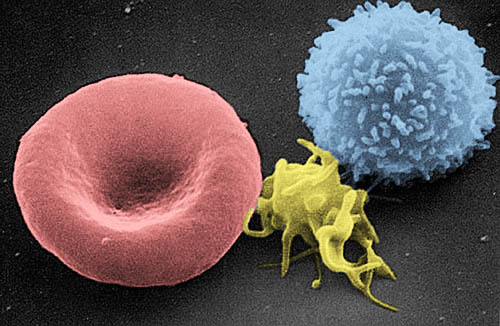
Correct — D, platelets have a role in blood clotting. Platelets are not whole cells at all — they are fragments shed from giant bone-marrow cells called megakaryocytes, they carry no nucleus, and they survive about seven to ten days in circulation. When a vessel is cut, collagen in the torn wall is exposed; platelets stick to it through von Willebrand factor, change shape, and clump into a temporary plug. In doing so they release the contents of their granules, which recruits more platelets and helps set off the coagulation cascade that converts soluble fibrinogen into insoluble fibrin. The fibrin mesh traps red cells and turns the soft plug into a firm clot. Strip out the platelets and the first step never happens, which is why a fall in their number shows up as bleeding from the gums and nose and as pinpoint bleeding into the skin. Dengue is the infection the stem has in mind — thrombocytopenia is one of its warning signs.
- (a)they along with red blood cells carry oxygen. — Oxygen transport is the work of haemoglobin inside red blood cells. Platelets carry no haemoglobin and take no part in it.
- (b)platelets are important to carry food to cells through blood. — Absorbed nutrients travel dissolved in the plasma — glucose, amino acids, salts — not aboard any cell. Lipids move as lipoproteins, which are also plasma particles.
- (c)platelets remove carbon dioxide from blood. — Carbon dioxide is carried mostly as bicarbonate ions in the plasma, with a smaller share bound to haemoglobin, and it leaves the body at the lungs. No part of that route involves platelets.
Blood has three formed elements and a fluid. Red cells carry oxygen, white cells defend against infection, and platelets begin the sealing of damaged vessels; plasma carries everything dissolved, including the clotting factors themselves. Haemostasis proceeds in three steps — the cut vessel narrows, platelets form a plug, and the coagulation cascade lays fibrin over it. A normal platelet count runs from about 150,000 to 450,000 per microlitre, which is why blood contains far more platelets than white cells.
Several viral infections lower the platelet count, and dengue is the one Indian candidates meet most often. The fall comes from more than one direction — the virus suppresses production in the marrow, and antibodies raised against it destroy platelets in circulation — and it is one of the things clinicians watch during the critical phase of the illness. The examinable point, though, is the physiology rather than the clinical management: the reason a low count is dangerous is that the very first step of sealing a vessel depends on platelets, so the body's other defences cannot compensate for their absence. Vitamin K sits behind the later step, since several clotting factors cannot be made without it, which is why questions sometimes pair the two.
- Platelets are cell fragments from megakaryocytes in the bone marrow and have no nucleus.
- A normal count is roughly 150,000 to 450,000 per microlitre, against about 4,000 to 11,000 white cells.
- They adhere to exposed collagen through von Willebrand factor, aggregate, and release granules that amplify the response.
- The coagulation cascade converts fibrinogen to fibrin, and the fibrin mesh is what makes the clot firm.
- Vitamin K is needed to make several clotting factors, and haemophilia is a genetic deficiency of factor VIII or IX.
- Assigning oxygen transport to platelets because they travel in the same fluid as red cells.
- Assuming nutrients are carried by cells; they move dissolved in plasma.
- Mixing up the platelet count with the white cell count when a question asks which is more numerous.
Asked through a clinical hook — a named infection lowers the count and the candidate has to supply the function that is being lost.
Haemophilia is a genetic disorder which leads to
- (a) decrease in haemoglobin level
- (b) rheumatic heart disease
- (c) decrease in WBC
- (d) non-clotting of blood
Answer(d) non-clotting of blood
The same failure reached from the other side. Here the platelets are missing; in haemophilia they are present but a clotting factor is not, and either way the blood will not seal a wound.
With reference to the blood in a normal person, which one of the following statements is correct?
- (a) Compared to arteries, veins are less numerous and hold less of the body’s blood at any given time
- (b) Blood cells constitute about 70 % of the total volume of the blood
- (c) White Blood Cells (WBC) are made by lymph nodes only
- (d) The blood has more platelets than WBC
Answer(d) The blood has more platelets than WBC
Fixes the numbers behind this item. Platelets outnumber white cells many times over, which is what makes a sharp fall in their count measurable and clinically useful.
Dengue virus causes high fever, rashes and reduces the number of a particular type of blood cells. Those blood cells are
- (a) Monocytes
- (b) Platelets
- (c) Eosinophils
- (d) Neutrophils
Answer(b) Platelets
The unnamed infection in this stem, named. The NDA paper asks which count dengue lowers; CAPF assumes you know that and asks why it matters.
From which among the following are blood clotting factors released?
- (a) RBCs
- (b) Eosinophils
- (c) Platelets
- (d) Monocytes
Answer(c) Platelets
One step deeper into the mechanism — not merely that platelets matter to clotting, but that the release of their granule contents is how they set the cascade going.
Which one of the following is the major function of platelets?
- (a) Clotting of blood
- (b) O2 transport
- (c) Immunity
- (d) Phagocytosis
Answer(a) Clotting of blood
The bare version of the same question three years earlier in this very examination, with oxygen transport again offered as the leading decoy.
- practice — not a real PYQ
Platelets are formed in the bone marrow from
- (a)lymphocytes
- (b)megakaryocytes
- (c)erythroblasts
- (d)monocytes
Answer(b) megakaryocytes — large marrow cells whose cytoplasm fragments into thousands of platelets.
- practice — not a real PYQ
The conversion of fibrinogen to fibrin during blood clotting is brought about by
- (a)thrombin
- (b)pepsin
- (c)amylase
- (d)renin
Answer(a) thrombin — the cascade activates thrombin, which cleaves soluble fibrinogen into fibrin strands that mesh over the platelet plug.