
Which organelle other than nucleus in eukaryotic cells has its own DNA, ribosomes and proteins?
- (a)Golgi
- (b)Mitochondria
- (c)Lysosomes
- (d)Nucleosomes
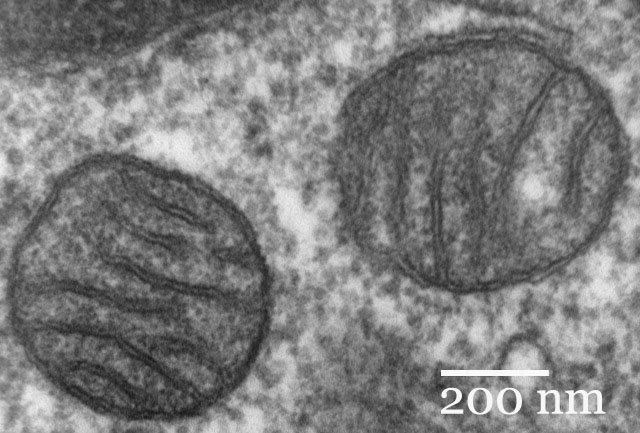
Correct — B, Mitochondria. A mitochondrion carries a small circular genome of its own, ribosomes of its own, and it uses them to make a handful of its own proteins on the spot. Human mitochondrial DNA runs to about 16,600 base pairs and codes for thirty-seven genes — thirteen proteins of the respiratory chain, two ribosomal RNAs and twenty-two transfer RNAs. The ribosomes that read those genes are of the 70S bacterial type, not the 80S type in the surrounding cytoplasm, and that difference is the strongest single piece of evidence for the endosymbiotic account of where mitochondria came from: an aerobic bacterium taken inside an early cell and never released. Most mitochondrial proteins are now coded by the nucleus and imported, which is why the organelle cannot live alone, but the residual genome and its machinery are still there.
- (a)Golgi — The Golgi apparatus has no genome and no ribosomes. It is a stack of membrane cisternae that receives proteins already made elsewhere, then sorts, modifies and dispatches them.
- (c)Lysosomes — A lysosome is a membrane sac of hydrolytic enzymes for breaking material down. Those enzymes are made on the rough endoplasmic reticulum and delivered through the Golgi; the lysosome makes nothing itself and holds no DNA.
- (d)Nucleosomes — This one is a false friend. A nucleosome does contain DNA — about 147 base pairs wound around a core of eight histone proteins — but it is not an organelle at all, and it sits inside the nucleus, which the question has already set aside.
Two organelles in eukaryotic cells keep their own genetic apparatus: mitochondria in all of them, and plastids, including chloroplasts, in plants and algae. Both are bounded by a double membrane, both divide by fission rather than being built from scratch, and both read their genomes on bacterial-type ribosomes. The endosymbiotic theory explains the pattern by descent — each began as a free-living bacterium engulfed by a host cell — and the shrinking of their genomes over evolutionary time explains why almost all of their proteins now arrive from the nucleus.
In an option list, this question is usually decided by elimination rather than by recall. Anything that is purely a packaging or digestion compartment — Golgi, lysosome, vacuole, peroxisome — has no genome. The moment a paper offers chloroplast alongside mitochondrion, both are right and the paper is asking for the pair, as the CDS version below does. Mitochondrial DNA carries a second payoff worth remembering: it is inherited almost entirely from the mother, since sperm mitochondria are destroyed after fertilisation, which is why it is used to trace maternal lineages and why mitochondrial disorders pass down the female line.
- Human mitochondrial DNA is a circular molecule of roughly 16,600 base pairs carrying thirty-seven genes.
- Mitochondrial ribosomes are of the 70S bacterial type; cytoplasmic ribosomes of the same cell are 80S.
- Mitochondria and plastids are both double-membraned and both divide by fission.
- Mitochondrial DNA is maternally inherited, which makes it a tool for tracing descent and for dating population splits.
- A nucleosome is DNA wrapped around a histone octamer — a unit of chromatin packaging, not an organelle.
- Reading nucleosome as a kind of organelle because the word ends the same way as ribosome and lysosome.
- Forgetting the chloroplast when a question asks which organelles, in the plural, hold DNA.
- Assuming an organelle with its own genome is self-sufficient — the great majority of mitochondrial proteins are coded by nuclear genes.
Asked almost every year in some form: name the organelle with its own DNA, or the pair, with Golgi and lysosome standing in as decoys.
Which organelle in the cell, other than nucleus, contains DNA?
- (a) Centriole
- (b) Golgi apparatus
- (c) Lysosome
- (d) Mitochondrion
Answer(d) Mitochondrion
The same question with the same answer, twenty-two years earlier, and with the Golgi and the lysosome again standing as decoys. CAPF has only added ribosomes and proteins to the description.
Which cell organelles have their own DNA and Ribosomes?
- (a) Golgi body and Endoplasmic Reticulum
- (b) Mitochondria and Plastids
- (c) Lysosome and Golgi body
- (d) Vacuole and Plastids
Answer(b) Mitochondria and Plastids
The fuller answer. Asked in the plural, the response has to include plastids as well, so a candidate who has learnt only the mitochondrion loses the mark.
Which one of the following cell organelles contains DNA?
- (a) Golgi apparatus
- (b) Mitochondrion
- (c) Lysosome
- (d) Endoplasmic reticulum
Answer(b) Mitochondrion
The single-answer version, where the endoplasmic reticulum replaces the nucleosome as the fourth decoy.
- practice — not a real PYQ
Mitochondrial DNA in humans is inherited
- (a)equally from both parents
- (b)from the mother only
- (c)from the father only
- (d)only in male offspring
Answer(b) from the mother only — the sperm's mitochondria are destroyed after fertilisation, so the zygote's mitochondria all come from the egg.
- practice — not a real PYQ
The ribosomes found inside mitochondria resemble those of
- (a)the eukaryotic cytoplasm
- (b)bacteria
- (c)the nucleolus
- (d)viruses
Answer(b) bacteria — mitochondrial ribosomes are of the 70S type, one of the strongest arguments for the endosymbiotic origin of the organelle.