
The annual Kheer Bhawani Mela is organized at:
- (a)Kabaw Valley
- (b)Kashmir Valley
- (c)Dah Hanu Valley
- (d)Upper Dibang Valley
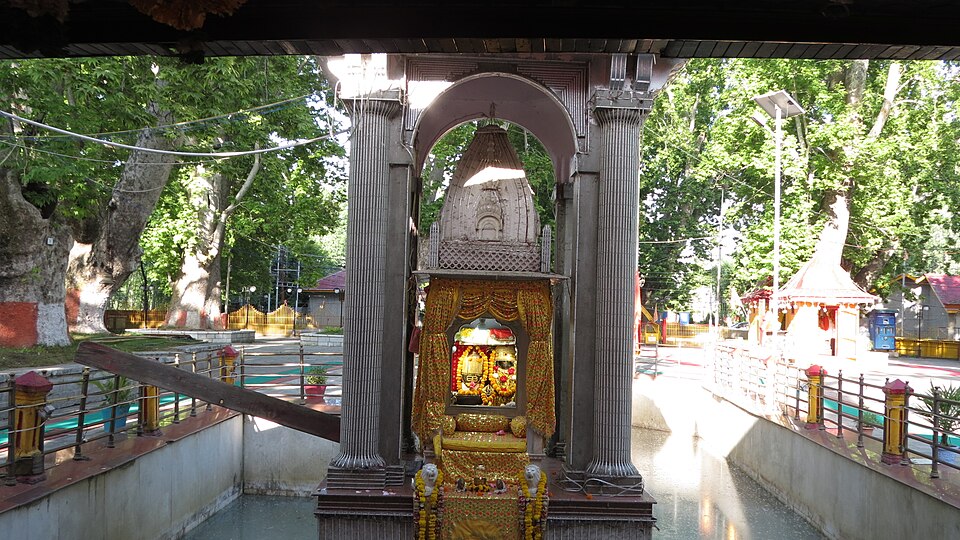
Correct — B, Kashmir Valley. The Kheer Bhawani mela is held at the temple of Ragnya Devi at Tulmulla in Ganderbal district of the Kashmir valley, on Jyeshtha Ashtami, which falls in late May or June. The goddess is worshipped at a spring within the temple compound, and devotees pour kheer, the milk-and-rice pudding from which the shrine takes its popular name, into the water as an offering. It is the principal annual festival of the Kashmiri Pandit community, and each year large numbers who left the valley return for it, which is why the mela is reported so widely.
- (a)Kabaw Valley — The Kabaw valley lies east of Manipur across the international boundary, in Myanmar, and features in discussions of the India and Myanmar border rather than in Kashmiri religious geography.
- (c)Dah Hanu Valley — The Dah Hanu valley is in Ladakh, along the Indus below Khaltse, and is known for the Brokpa communities who live in its villages.
- (d)Upper Dibang Valley — The Upper Dibang valley is in Arunachal Pradesh and is the home of the Idu Mishmi; it lies at the opposite end of the Himalaya from Kashmir.
Kheer Bhawani is a form of the goddess Ragnya, worshipped at a sacred spring rather than through an image alone, and the shrine at Tulmulla is the most important Hindu pilgrimage centre in the Kashmir valley outside Amarnath. Tradition holds that the water of the spring changes colour, and that a darkening of it is an ill omen for the valley — a belief that has attached itself to several episodes in the region's modern history.
This is a placement question, and the three wrong options are all valleys from very different parts of the Himalayan and north-eastern frontier. That structure is common in these papers and it rewards a candidate who has a rough map of India's border regions in mind: Kabaw in Myanmar beyond Manipur, Dah Hanu in Ladakh, Upper Dibang in Arunachal Pradesh. Any of the three would be a plausible-sounding answer to somebody who recognised none of them, which is exactly the point of setting them together.
- The Kheer Bhawani temple is at Tulmulla in Ganderbal district of the Kashmir valley and is dedicated to the goddess Ragnya Devi.
- The mela is held on Jyeshtha Ashtami, in late May or June, and is the principal festival of the Kashmiri Pandit community.
- Devotees offer kheer and milk to the sacred spring in the temple compound, which is where the popular name comes from.
- The Kabaw valley lies in Myanmar adjoining Manipur; Dah Hanu is in Ladakh; the Upper Dibang valley is in Arunachal Pradesh.
- Amarnath and Kheer Bhawani are the two best-known Hindu pilgrimages of the Kashmir valley.
- Guessing among unfamiliar valley names instead of eliminating the three that are far from Kashmir.
- Confusing Kheer Bhawani with the Amarnath yatra, which is a cave pilgrimage in a different part of the valley and a different season.
- Assuming Dah Hanu is in Kashmir because it is in the same Union Territory grouping historically; it is in Ladakh.
As a festival-to-place item in which the distractors are valleys drawn from opposite ends of the country, so a mental map does most of the work.
No directly related past PYQ was found.
- practice — not a real PYQ
The Kheer Bhawani temple is dedicated to
- (a)Ragnya Devi
- (b)Vaishno Devi
- (c)Sharada
- (d)Chandi
Answer(a) Ragnya Devi — worshipped at the sacred spring at Tulmulla.
- practice — not a real PYQ
The Brokpa communities are associated with which region?
- (a)The Dah Hanu area of Ladakh
- (b)The Kashmir valley
- (c)The Kumaon hills
- (d)The Nilgiris
Answer(a) The Dah Hanu area of Ladakh, along the Indus.