
The ruler Vindhyashakti during the period preceding the Gupta Age is associated with which one of the following dynasties?
- (a)Vakatakas
- (b)Chalukyas
- (c)Kalachuris
- (d)Sungas
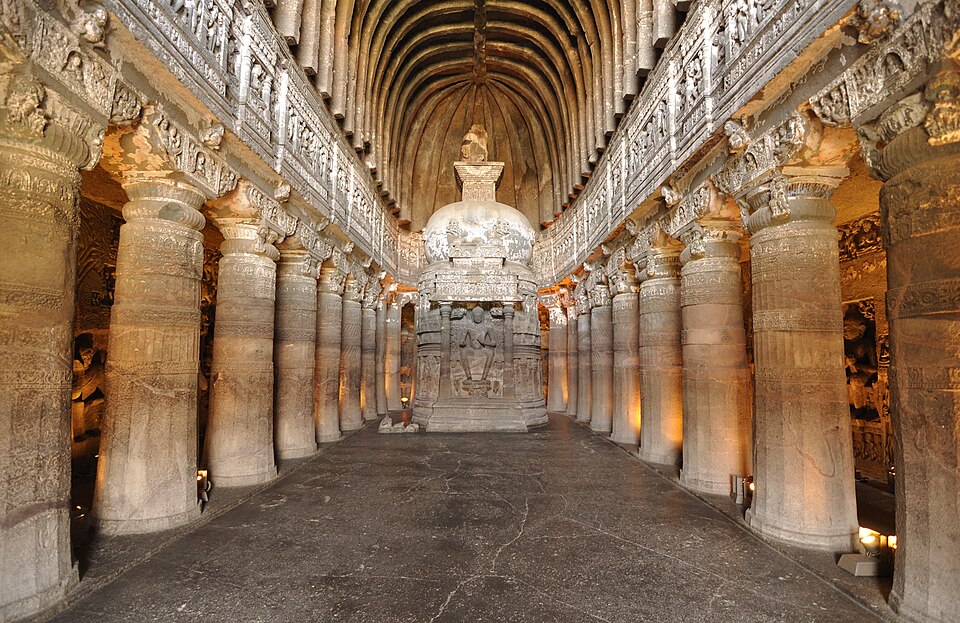
Correct — A, Vakatakas. Vindhyashakti is the founder of the Vakataka dynasty, which rose in the Deccan in the middle of the third century, in the interval between the collapse of Satavahana power and the expansion of the Guptas. His name is known chiefly from an inscription in Cave XVI at Ajanta, which describes him as the banner of the Vakataka family, and from the Puranic lists. His son Pravarasena I took the imperial title samrat and is credited with four horse sacrifices, and it was under the Vakatakas that some of the finest Ajanta caves were excavated. Vakataka power and Gupta power were linked by marriage, since Prabhavatigupta, the daughter of Chandragupta II, married the Vakataka king Rudrasena II and governed as regent for her sons after his death.
- (b)Chalukyas — The Chalukyas of Badami begin with Pulakeshin I in the sixth century, well after the Gupta age had begun rather than before it.
- (c)Kalachuris — The Kalachuris emerge in central India from about the sixth century, with centres at Mahishmati and later Tripuri; they are a post-Gupta rather than a pre-Gupta power.
- (d)Sungas — The Sungas were founded by Pushyamitra in the second century before the common era, immediately after the Mauryas and several centuries before the Guptas, and they had no connection with Vindhyashakti.
The Vakatakas ruled the Deccan from roughly the middle of the third century to the end of the fifth, and their importance is that they occupy exactly the period and the territory that the Guptas did not. The dynasty split into two branches, the main line based at Nandivardhana and Pravarapura in the Vidarbha region and the Vatsagulma branch to its south. Vakataka rule is remembered less for conquest than for what it paid for: the second great phase of excavation and painting at Ajanta belongs to it.
The four options can be separated on chronology alone if the reign of the founder of each is known even approximately. The stem's phrase 'during the period preceding the Gupta Age' places the ruler in the third century, which rules out the Sungas at once for being far too early and the Chalukyas and Kalachuris for being too late. The Ajanta connection is worth carrying as well, because the caves are frequently asked about and the patronage runs through this dynasty — the finest of the later caves are associated with Harishena, the last of the great Vakataka rulers.
- Vindhyashakti founded the Vakataka dynasty in the Deccan in about the middle of the third century.
- His son Pravarasena I assumed the title samrat and is credited with performing four horse sacrifices.
- Prabhavatigupta, daughter of the Gupta emperor Chandragupta II, married Rudrasena II and acted as regent for her sons.
- The second major phase of excavation and painting at Ajanta was carried out under Vakataka patronage.
- The dynasty divided into the main Nandivardhana-Pravarapura line and the Vatsagulma branch.
- Placing the Chalukyas before the Guptas; Pulakeshin I belongs to the sixth century.
- Assuming that a Deccan dynasty of this period must be Satavahana; the Satavahanas had already ended.
- Confusing Vindhyashakti with Vindhyavarman or with the later Kalachuri rulers of central India.
As a founder-to-dynasty match, so the surest route is to date the founder of each option even roughly and discard whatever does not fit the period named in the stem.
No directly related past PYQ was found.
- practice — not a real PYQ
Prabhavatigupta, who acted as regent in the Vakataka kingdom, was the daughter of
- (a)Samudragupta
- (b)Chandragupta II
- (c)Skandagupta
- (d)Kumaragupta I
Answer(b) Chandragupta II — the marriage linked the Gupta and Vakataka houses.
- practice — not a real PYQ
The later phase of excavation and painting at the Ajanta caves is associated with the patronage of the
- (a)Satavahanas
- (b)Vakatakas
- (c)Rashtrakutas
- (d)Chalukyas of Kalyani
Answer(b) Vakatakas — the earlier Hinayana phase is Satavahana-era.