
Which one of the following animals does not come under the category of four noble animals (Maha-Ajaneya Pasu) carved on the round drum (Anda-Phalaka) of the lion capital at Sarnath?
- (a)Deer
- (b)Lion
- (c)Bull
- (d)Horse
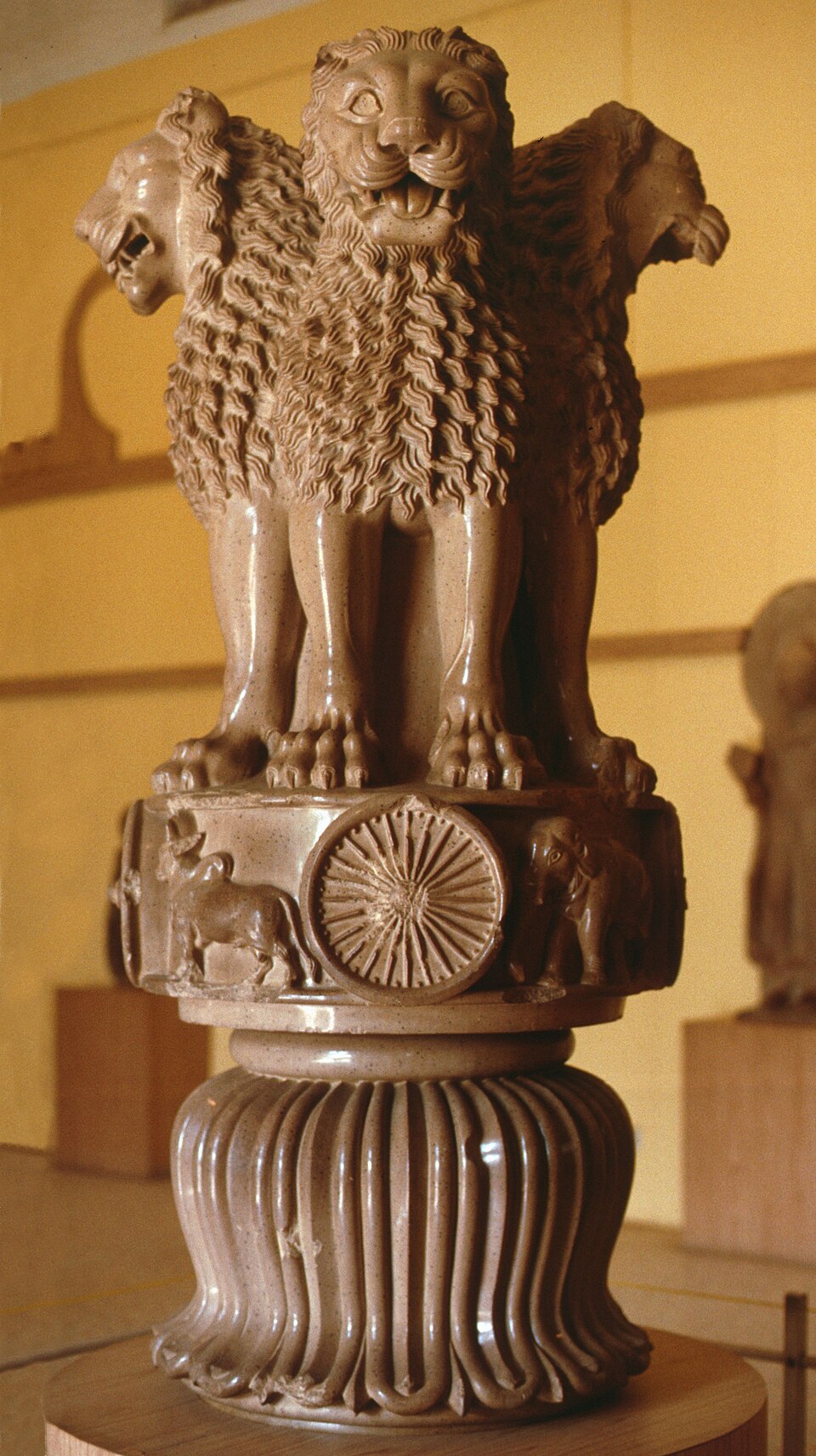
Correct — A, Deer. The abacus of the Sarnath capital, the round drum on which the four lions stand, carries four animals in relief separated by four wheels: an elephant, a bull, a horse and a lion, moving in procession around the drum. The deer is not one of them. It is on the paper because Sarnath itself is the deer park where the Buddha preached his first sermon, so the animal is inseparably associated with the place and a candidate who reasons from the site rather than from the sculpture will pick it. The other three options are all carved there, and the lion appears twice over, once among the four on the drum and again as the four addorsed animals above it.
- (b)Lion — The lion is carved on the drum and also crowns the capital as the four addorsed lions that became the State Emblem, so it cannot be the exception.
- (c)Bull — The bull is one of the four animals on the abacus, and it faces west in the standard description of the arrangement.
- (d)Horse — The horse is one of the four, and it is the animal directly below the front-facing lion in the version reproduced on the State Emblem.
The Lion Capital was set up by Ashoka at Sarnath, where the Buddha delivered his first sermon, and it once crowned a polished sandstone pillar. From the bottom the capital consists of an inverted bell-shaped lotus, then the drum or abacus carrying four animals alternating with four twenty-four-spoked wheels, and above it four lions standing back to back. A large stone wheel originally surmounted the lions and has survived only in fragments. The whole piece is now in the Sarnath Museum.
The four animals are usually explained as guardians of the four quarters and as symbols of the stages of the Buddha's life, and the wheels between them are dharmachakras. What the examination cares about is which four they are, because that is what the State Emblem of India, adopted on 26 January 1950, reproduces — and the emblem shows only three lions with the fourth hidden behind, the wheel in the centre of the abacus, a bull to its right and a horse to its left, above the motto Satyameva Jayate from the Mundaka Upanishad. The bell-shaped lotus is left out of the emblem. Fixing the emblem in the mind therefore fixes most of the capital as well, and it makes plain that no deer is anywhere on it.
- The four animals on the abacus of the Sarnath capital are the elephant, the bull, the horse and the lion, separated by four twenty-four-spoked wheels.
- The State Emblem of India, adopted on 26 January 1950, is taken from this capital and shows three lions, a wheel, a bull and a horse, with the bell-shaped lotus omitted.
- The motto Satyameva Jayate below the emblem comes from the Mundaka Upanishad.
- The twenty-four-spoked wheel of the capital is the Ashoka Chakra at the centre of the national flag.
- Sarnath, near Varanasi, is where the Buddha delivered his first sermon, the Dhammachakkappavattana, in the deer park — which is why the deer is such a natural wrong answer here.
- Answering from the location rather than from the sculpture; the deer belongs to Sarnath but not to the capital.
- Assuming the State Emblem shows all four lions; only three are visible.
- Including the inverted lotus in the emblem, which was deliberately left out.
As a 'which one does not belong' item on a single monument, answerable by anyone who can picture the State Emblem accurately.
Which of the following pairs are correctly matched? I. Lothal: Ancient dockyard II. Sarnath: First Sermon of Buddha III. Rajgir: Lion capital of Asoka IV. Nalanda: Great seat of Buddhist learning Select the correct answer using the codes given below: Codes:
- (a) I, II, III and IV
- (b) III and IV
- (c) I, II and IV
- (d) I and II
Answer(c) I, II and IV
The mirror image of this item. There the trap is to move the Lion Capital away from Sarnath; here it is to import the deer into the capital because Sarnath is the deer park. Both are answered by keeping the monument and the site distinct in the mind.
- practice — not a real PYQ
The State Emblem of India, adapted from the Sarnath capital, shows
- (a)four lions, all visible
- (b)three lions visible, the fourth hidden from view
- (c)two lions and two elephants
- (d)a single lion above a wheel
Answer(b) three lions visible, the fourth hidden from view.
- practice — not a real PYQ
The motto Satyameva Jayate is taken from
- (a)the Rigveda
- (b)the Mundaka Upanishad
- (c)the Bhagavad Gita
- (d)the Arthashastra
Answer(b) the Mundaka Upanishad.