
The organisms that prefer high salt concentration habitats refer to as
- (a)alkaliphiles
- (b)calcifuges
- (c)halophiles
- (d)nitrophiles
Correct — C, halophiles. The word is built from the Greek halos, salt, and philos, loving, so a halophile is an organism whose growth optimum lies in salty surroundings. Extreme halophiles need concentrations well above the roughly three and a half per cent salinity of ordinary seawater, and they are found in places such as the Dead Sea, inland salt lakes and the evaporation pans of solar salt works. Many of them are archaea rather than bacteria, and among flowering plants the equivalent group is the halophytes, which include mangroves.
- (a)alkaliphiles — Alkaliphiles are defined by pH, not by salt — they grow best in strongly alkaline surroundings, around pH nine and above. Soda lakes can be both alkaline and saline, but the two preferences are separate things.
- (b)calcifuges — A calcifuge is a plant that avoids lime — the name means lime-fleeing. Such plants grow on acidic soils and do badly on calcareous ones, which is a soil chemistry preference and has nothing to do with salinity.
- (d)nitrophiles — Nitrophiles favour ground rich in nitrogen, such as disturbed or manured soil where the stinging nettle thrives. The suffix is the same but the substance named is nitrogen, not salt.
Organisms are often named for the condition in which they grow best, using a Greek or Latin root for the condition and the suffix -phile for a preference. Halophiles prefer high salt, alkaliphiles high pH, acidophiles low pH, thermophiles high temperature, psychrophiles cold and barophiles high pressure. Together the ones that thrive at the edges of these ranges are called extremophiles.
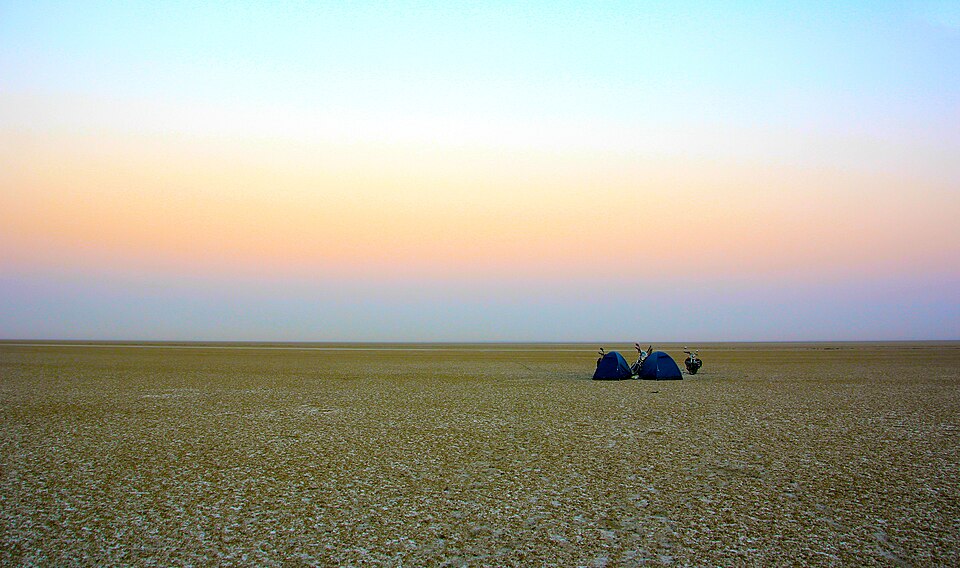
This item can be answered from the roots alone, without any biology, which is exactly why it is worth learning them. Halos gives us halite for rock salt and halogen for the salt-formers of group 17, so 'halophile' can only be about salt. The trap is that all four options end in the same way and three of them are genuine ecological terms, so a candidate who is guessing has no obvious anchor. Note also that high salt is a hostile environment for most life because it draws water out of cells osmotically; halophiles survive it either by accumulating potassium ions inside the cell or by making compatible solutes that balance the outside concentration. Sambhar Lake in Rajasthan, India's largest inland saline lake and a Ramsar site, is a local example of such a habitat.
- Halophile comes from Greek halos, salt, and philos, loving — an organism that thrives in high salt concentrations.
- Extreme halophiles grow in water saltier than the sea, in places such as the Dead Sea, inland salt lakes and solar salt pans; many belong to the archaea.
- Alkaliphiles are defined by high pH, acidophiles by low pH, thermophiles by high temperature and psychrophiles by cold.
- Calcifuge means lime-fleeing — a plant that will not grow on calcareous soil and prefers acidic ground.
- Salt-tolerant flowering plants are called halophytes, and mangroves are the best-known Indian example.
- Reading all four options as interchangeable because they share the -phile ending.
- Confusing salinity with alkalinity — soda lakes are often both, but the two terms name different preferences.
- Assuming a calcifuge is an organism, when the term belongs to plant ecology and describes avoidance of lime.
Asked as a vocabulary item on ecological terminology, answerable from the Greek root even without knowing the organisms.
No directly related past PYQ was found.
- practice — not a real PYQ
Organisms that grow best at very high temperatures are called
- (a)psychrophiles
- (b)thermophiles
- (c)acidophiles
- (d)barophiles
Answer(b) thermophiles — from thermos, heat; psychrophiles are the cold-loving group.
- practice — not a real PYQ
Plants that are adapted to grow in saline soils are known as
- (a)xerophytes
- (b)hydrophytes
- (c)halophytes
- (d)mesophytes
Answer(c) halophytes — mangroves are the familiar Indian example; xerophytes are adapted to dryness.