
The boundary layer of the forest at which the energy exchange occurs and some insolation is returned directly to space is
- (a)forest floor
- (b)forest soil
- (c)forest canopy
- (d)forest litter
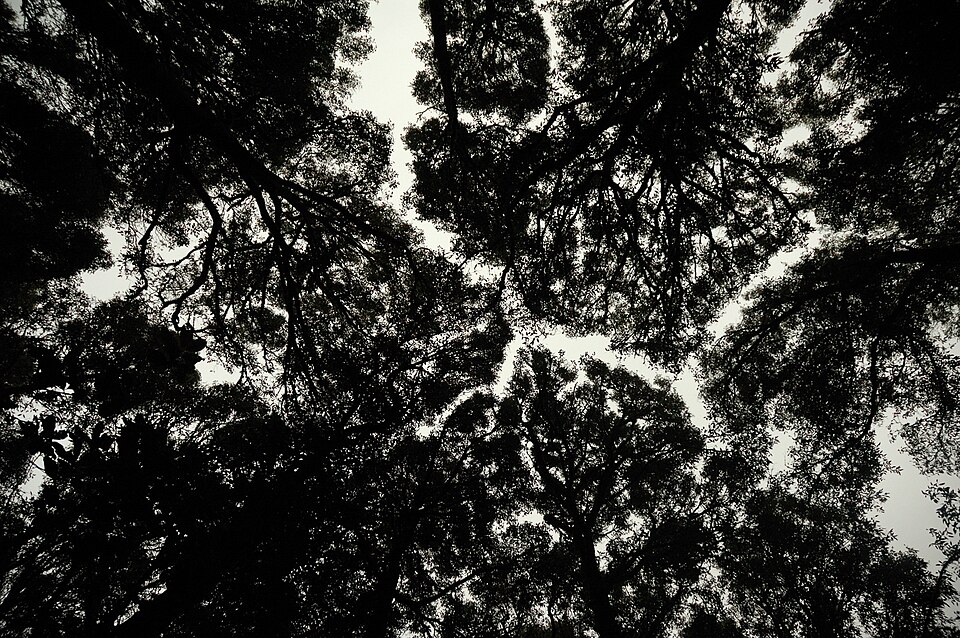
Correct — C, forest canopy. The canopy is the continuous roof formed by the crowns of the tall trees, and it is the surface at which the forest meets the atmosphere. Sunlight arriving at a forest strikes the canopy first: part of it is reflected straight back towards space, part is absorbed for photosynthesis and for heating the leaves, and only a small remainder filters down to the layers below. The exchanges of heat, water vapour and carbon dioxide between the forest and the air above it are concentrated at this level too, which is why the canopy and not the floor is described as the forest's boundary layer.
- (a)forest floor — The floor lies at the bottom of the profile and receives only a small fraction of the sunlight that reached the canopy. Whatever it reflects is intercepted on the way back up, so almost nothing returns from there to space.
- (b)forest soil — The soil is below the surface altogether. It exchanges heat and moisture with the roots and the litter above it, not with the open atmosphere.
- (d)forest litter — Litter is the layer of fallen leaves and twigs lying on the floor. It matters for nutrient cycling and for keeping the soil moist and cool, but it sits in deep shade and intercepts almost no incoming sunlight.
A forest is layered in a vertical profile. Emergent trees rise above a continuous canopy of interlocking crowns; below that come the understorey and the shrub layer, then the forest floor with its litter, and beneath that the soil. Each layer receives what the layer above it has not already absorbed or reflected, so light, temperature and humidity all change sharply with height.
The question is really about where a forest ends and the atmosphere begins. In the energy balance of any surface, the boundary layer is where incoming radiation is intercepted and where turbulent exchange with the air takes place, and for a closed forest that surface is the top of the canopy rather than the ground. A dense forest is one of the darker natural surfaces, so most of the incoming shortwave radiation is absorbed rather than reflected, which is one reason that clearing forest for bare soil or cropland changes the local heat budget. Very little light penetrates to the floor of a closed tropical forest, which is why its ground layer is often sparse and why a gap opened by a fallen tree triggers a rush of new growth.
- The canopy is the more or less continuous layer formed by the crowns of the taller trees, with emergents standing above it.
- Incoming solar radiation meets the canopy first — part is reflected back towards space, part absorbed for photosynthesis and heating.
- The exchange of heat, water vapour and carbon dioxide between forest and atmosphere is concentrated at canopy level.
- Forest is a dark surface with a low albedo, reflecting less of the incoming radiation than grassland, bare soil or snow.
- Only a small fraction of the light striking the canopy reaches the floor of a closed tropical forest, which keeps the ground layer sparse.
- Choosing the forest floor because it is the layer a person walking through a forest actually sees.
- Confusing litter, which lies on the floor, with the canopy far above it.
- Treating soil as part of the forest's exchange surface with the atmosphere.
Asked as a single-term identification where all four options are genuine parts of a forest profile, so the answer turns on which of them faces the sky.
Which of the following is/are unique characteristic/characteristics of equatorial forests? 1. Presence of tall, closely set trees with crowns forming a continuous canopy 2. Coexistence of a large number of species 3. Presence of numerous varieties of epiphytes
- (a) 1 only
- (b) 2 and 3 only
- (c) 1 and 3 only
- (d) 1, 2 and 3
Answer(d) 1, 2 and 3
The same structure from the ecology side. Its first statement — tall, closely set trees whose crowns form a continuous canopy — is exactly the feature that makes the canopy, rather than the ground, the forest's working surface with the atmosphere.
- practice — not a real PYQ
In a dense tropical rainforest, which layer receives the least sunlight?
- (a)Emergent layer
- (b)Canopy
- (c)Understorey
- (d)Forest floor
Answer(d) Forest floor — the layers above absorb or reflect nearly all the incoming light before it gets there.
- practice — not a real PYQ
Which one of the following natural surfaces has the highest albedo?
- (a)Dense forest
- (b)Grassland
- (c)Fresh snow
- (d)Ocean water
Answer(c) Fresh snow — it reflects the greater part of the incoming shortwave radiation, while a dense forest reflects very little.