
The technology known as 'Electromagnetic Air Lift System' is sometimes talked about in reference to
- (a)launching guided missiles from silos
- (b)launching aircraft from warships
- (c)navigation of nuclear-powered submarines
- (d)development of reusable rockets
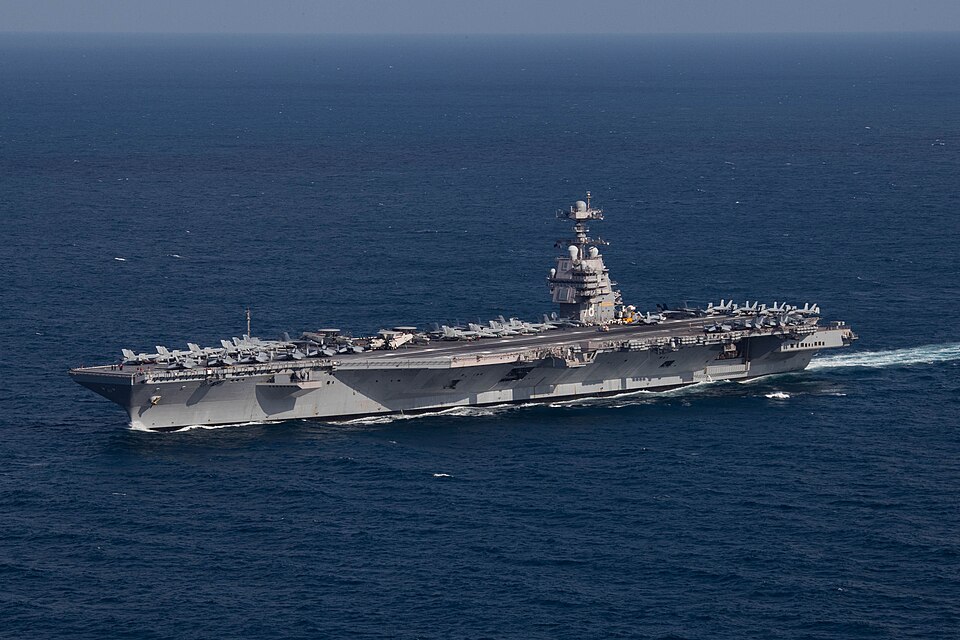
Correct — B, launching aircraft from warships. The technology is the electromagnetic catapult fitted to modern aircraft carriers, developed by General Atomics for the United States Navy and usually written as the Electromagnetic Aircraft Launch System. It replaces the steam catapult with a linear induction motor: a shuttle riding a track down the flight deck is accelerated by a travelling magnetic field, taking an aircraft from a standstill to flying speed in the length of the deck. The gain over steam is control — the acceleration can be tailored to the aircraft, which stresses airframes less and allows both heavier and much lighter machines, drones included, to be launched from the same track.
- (a)launching guided missiles from silos — A silo ejects its missile either on its own rocket motor or on a gas generator that pops it clear before ignition. Neither method is electromagnetic, and no operational silo uses a catapult.
- (c)navigation of nuclear-powered submarines — Submarines navigate submerged by inertial navigation systems backed by charts and periodic satellite fixes. Nothing in that chain launches anything.
- (d)development of reusable rockets — Reusable boosters are recovered by flying themselves back to a pad or a barge, or by parachute. Electromagnetic launch assist for space vehicles remains experimental and is not what this term denotes.
A carrier's deck is far shorter than a runway, so an aircraft must be given most of its take-off speed by the ship. Three solutions exist: a steam catapult, an electromagnetic catapult, and a ski-jump ramp that trades payload for simplicity. The electromagnetic version uses a linear induction motor, the same principle as a maglev train laid flat along the deck.
The stem prints the name as 'Electromagnetic Air Lift System', which is not the form the system is usually catalogued under; the technology it points to is unmistakable from the options. As of the 2022 exam the only carrier in service with it was USS Gerald R. Ford, commissioned in 2017, and China's Fujian, launched in June 2022, was being fitted with electromagnetic catapults of its own. India's INS Vikrant, commissioned the month after this paper was written, launches its aircraft from a ski-jump instead, an arrangement known as STOBAR.
- The electromagnetic catapult uses a linear induction motor; the steam catapult it replaces uses a piston driven by steam bled from the ship's boilers.
- USS Gerald R. Ford, commissioned in 2017, was the first carrier to enter service with the system.
- Advantages claimed over steam are gentler and adjustable acceleration, lower weight and maintenance, faster recharge, and no demand on the ship's fresh water.
- STOBAR carriers such as INS Vikramaditya and INS Vikrant use a ski-jump for launch and arrester wires for recovery, with no catapult at all.
- CATOBAR is the term for a carrier that launches by catapult and recovers on arrester wires.
- Reading 'air lift' as a transport or humanitarian airlift operation.
- Assuming any electromagnetic launch technology must belong to a space programme.
- Believing Indian carriers use catapults; both serving carriers use a ski-jump.
Asked as a 'this term refers to' item on a defence technology in the news, which rewards knowing the platform a technology belongs to rather than its engineering.
Consider the following statements: 1. INS Sindhughosh is an aircraft carrier. 2. INS Viraat is a submarine. Which of the statements given above is/are correct?
- (a) 1 only
- (b) 2 only
- (c) Both 1 and 2
- (d) Neither 1 nor 2
Answer(d) Neither 1 nor 2
The same habit of mind tested on ships rather than on technologies — knowing which platform a name belongs to. Sindhughosh is a submarine and Viraat was the carrier, exactly the reverse of what the statements claim.
Which one of the following is a decommissioned aircraft carrier?
- (a) INS Rajput
- (b) INS Chakra
- (c) INS Khanderi
- (d) INS Viraat
Answer(d) INS Viraat
Carrier aviation asked from the ship's end. Recognising which Indian vessels are carriers at all is the groundwork for questions about how their aircraft get airborne.
- practice — not a real PYQ
INS Vikrant, India's first indigenously built aircraft carrier, launches its aircraft using
- (a)an electromagnetic catapult
- (b)a steam catapult
- (c)a ski-jump ramp
- (d)vertical take-off only
Answer(c) a ski-jump ramp — she is a STOBAR carrier, launching over a ramp and recovering on arrester wires.
- practice — not a real PYQ
The abbreviation CATOBAR, used of aircraft carriers, refers to
- (a)catapult-assisted take-off but arrested recovery
- (b)carrier-based tactical bombing and reconnaissance
- (c)combat air tactical operations by air refuelling
- (d)catapult-assisted take-off by aerial refuelling
Answer(a) catapult-assisted take-off but arrested recovery — the aircraft is thrown off by a catapult and caught on landing by arrester wires.