
Which one of the following geologic time periods is associated with the first appearance of the marsupials?
- (a)Lower Cretaceous
- (b)Upper Cretaceous
- (c)Early Jurassic
- (d)Middle Jurassic
Correct — A, Lower Cretaceous. The marsupial line separated from the line that leads to placental mammals somewhere in the Jurassic, but the earliest fossils that can actually be placed on the marsupial side of that split come from the Lower, or Early, Cretaceous — the interval from about 145 to 100 million years ago. The best-known candidates are small shrew-sized animals from China and from western North America dated to roughly 125 and 110 million years, which puts the first appearance of the group squarely in the Lower Cretaceous. That is the standard statement in general geological time-scale material, and it is what the key follows.
- (b)Upper Cretaceous — The Upper Cretaceous is when marsupial-line mammals became abundant and varied, especially in North America, and some specialists date the earliest strictly crown-group marsupial to that interval. But abundance is not first appearance, and the earliest fossils of the lineage are older.
- (c)Early Jurassic — The Early Jurassic is far too early. Mammals of that age belong to lineages that branched off before the split between the marsupial and placental sides, and no fossil of the marsupial line is known from it.
- (d)Middle Jurassic — The Middle Jurassic is likewise too early. Even the oldest fossil assigned to the placental side of the split is Late Jurassic, so nothing on the marsupial side can be expected before that.
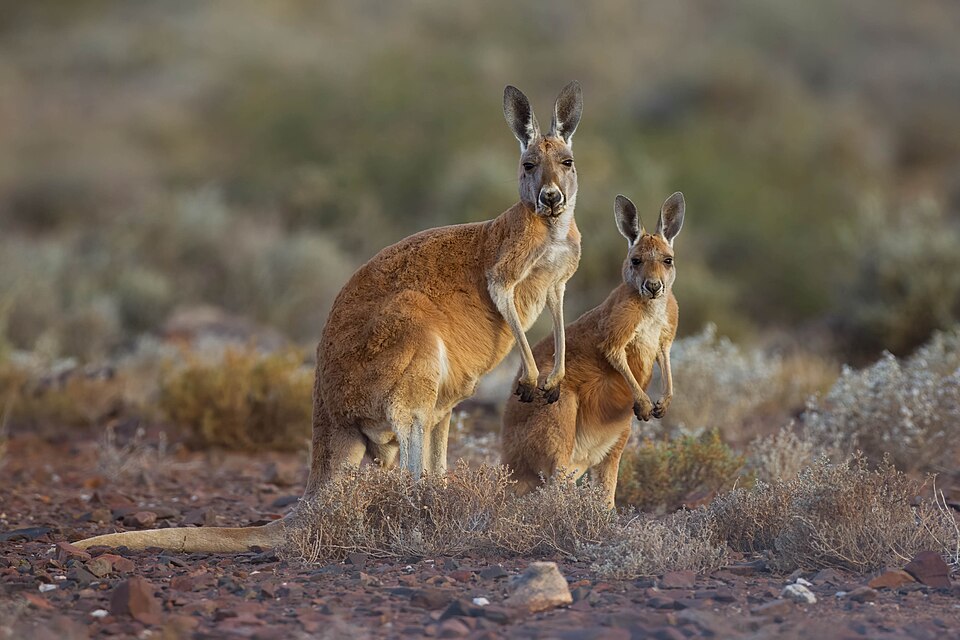
Marsupials are mammals whose young are born at a very early stage of development and complete their growth attached to a teat, usually within a pouch. They are the sister group of the placental mammals, and the two together make up the therians. Today marsupials are concentrated in Australia and New Guinea, with a smaller American group including the opossums, but their fossil record shows a much wider early distribution, running through Asia, North America and then South America and Antarctica into Australia.
Two things have to be held apart to read a question like this. The first appearance of a lineage in the fossil record is not the same as the point at which the lineage split from its sister group, and it is not the same as the point at which the modern group as we define it today came together. The molecular and fossil evidence has moved over the years — one Chinese fossil long treated as the oldest marsupial-line mammal has since been reassigned to the placental side, and a 2022 study placed the earliest strictly crown-group marsupial in the Late Cretaceous. Those refinements are what make option (b) look defensible to a well-read candidate. The key answers the question as textbooks pose it, at the level of the lineage rather than the crown group, and on that reading the Lower Cretaceous is where the record begins. The Jurassic options can be dismissed without any of this, because the therian fossil record simply does not reach back that far on the marsupial side.
- The Cretaceous ran from about 145 to 66 million years ago; its Lower or Early half ends at about 100 million years.
- The earliest fossils placed on the marsupial line come from the Lower Cretaceous of China and of western North America.
- Marsupials and placentals together form the therian mammals and are sister groups.
- Marsupial diversity increased through the Upper Cretaceous, particularly in North America.
- The living marsupials are concentrated in Australia and New Guinea, with the opossums and their relatives in the Americas.
- Choosing the Upper Cretaceous because that is when marsupials became common. The question asks for first appearance.
- Assuming the split between marsupial and placental lines is the same event as the first marsupial fossil. The split is older than the record.
- Placing early mammals in the Jurassic and assuming marsupials must be there too. Jurassic mammals belong to earlier branches.
As a period-to-event match on the geological time scale, as a question on the oldest era or period, or through the mammalian radiation after the Cretaceous extinction.
Which one of the following is the oldest era in Geological History determining the age of various rock types ?
- (a) Precambrian
- (b) Mesozoic
- (c) Cenozoic
- (d) Paleozoic
Answer(a) Precambrian
The same time scale asked at the level of eras. Placing the Cretaceous inside the Mesozoic, between the Palaeozoic and the Cenozoic, is what turns a question about marsupials into a question you can reason about.
- practice — not a real PYQ
The Cretaceous period belongs to which era?
- (a)Palaeozoic
- (b)Mesozoic
- (c)Cenozoic
- (d)Precambrian
Answer(b) Mesozoic — which runs Triassic, Jurassic and Cretaceous and ends with the extinction that closed the age of the dinosaurs.
- practice — not a real PYQ
Marsupials are distinguished from placental mammals chiefly by
- (a)laying eggs
- (b)giving birth to very underdeveloped young that continue to develop attached to a teat
- (c)having no mammary glands
- (d)being cold-blooded
Answer(b) giving birth to very underdeveloped young that continue to develop attached to a teat — egg-laying belongs to the monotremes.