
Solifluction is a geomorphic process involving a special type of soil flow that is noticed in
- (a)desert regions
- (b)karst regions
- (c)permafrost regions
- (d)savanna regions
Correct — C, permafrost regions. Solifluction is the slow downhill flow of soil that has become saturated with water, and it needs a very particular arrangement to happen: a layer that thaws and a layer beneath it that does not. In permafrost country the ground below stays frozen all year, so when the surface active layer thaws in summer the meltwater cannot drain away downwards. The saturated surface material loses its strength and creeps downslope as a viscous mass, even on gradients of only a few degrees, leaving the tongue-shaped lobes and low terraces that mark periglacial hillsides. Where the impermeable layer is frozen ground the process is often given the more exact name gelifluction.
- (a)desert regions — Desert slopes lack the one ingredient the process needs, which is water in quantity. Mass movement in deserts is dominated by dry rockfall and by the occasional debris flow after a downpour, not by a permanently saturated surface layer.
- (b)karst regions — Karst is limestone country, and its characteristic processes are chemical. Water sinks through joints and dissolves the rock, producing sinkholes, caves and collapse features, and free-draining ground is the opposite of what solifluction requires.
- (d)savanna regions — Savanna regions have a strong wet season, but no frozen subsoil to trap the water at the surface. Their typical slope processes are sheet wash, rill and gully erosion, and creep, rather than the saturated flow described here.
Mass movement is the downslope movement of material under gravity, without a transporting agent such as a river, glacier or wind. It is graded by speed and by water content: creep and solifluction are slow, earthflows and mudflows faster, and slumps, rockslides and rockfalls fastest of all. Solifluction sits at the slow, wet end, and it is the signature slope process of periglacial regions — the cold zone just beyond the ice, where the ground freezes and thaws repeatedly.
The way into this item is to ask what has to be true for saturated soil to keep flowing downhill on a gentle slope. Water must be present, and it must be unable to escape downwards. Only one of the four environments guarantees both, because only one has a permanently frozen layer acting as a floor. Karst fails the second test conspicuously, since limestone is the most freely draining ground there is; deserts fail the first. It is worth noticing that solifluction lobes are found in the Indian Himalaya as well as in the Arctic, wherever altitude produces the same freeze and thaw, so periglacial does not mean polar.
- Solifluction is the slow flow of water-saturated soil downslope, and it operates on gradients of only a few degrees.
- It is characteristic of periglacial regions, where a permafrost layer stops the thawed active layer from draining.
- Where the impermeable layer is frozen ground, the process is more precisely called gelifluction.
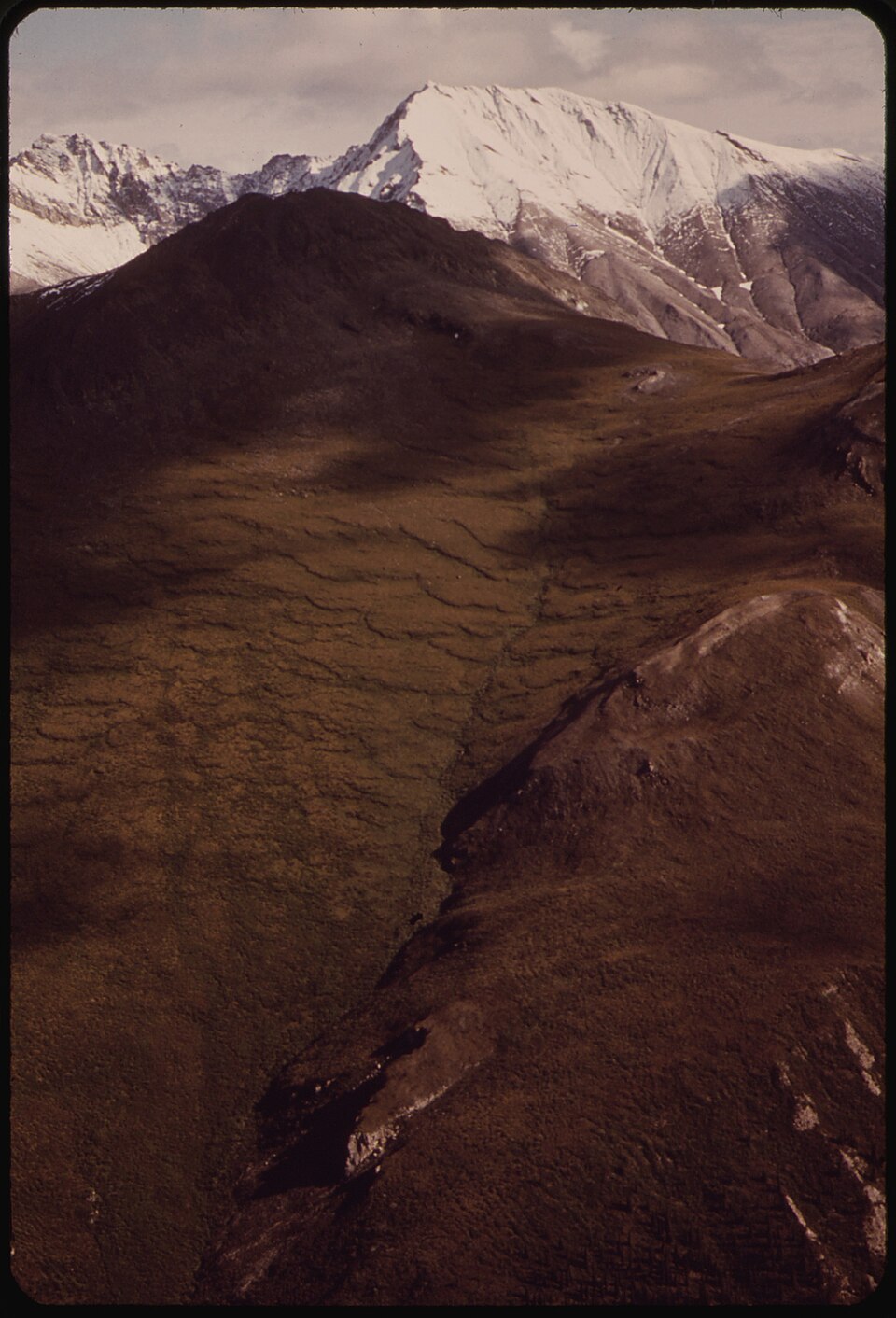
- Its landforms are solifluction lobes and terraces — tongue-shaped ridges of displaced soil on a hillside.
- Mass movements involve no transporting agent; gravity acts on the material directly, which is why they are not classed as erosion.
- Reading 'soil flow' and reaching for a wet tropical answer. The defining condition is frozen ground beneath, not heavy rainfall.
- Assuming a steep slope is needed. Solifluction works on very gentle gradients because the material is saturated.
- Mixing solifluction with soil creep. Creep is drier, slower and does not need a frozen floor.
As a process-to-environment match, as a classification of mass movements by speed, or through the landforms that solifluction leaves behind.
No directly related past PYQ was found.
- practice — not a real PYQ
The layer of ground above permafrost that thaws each summer and refreezes in winter is called the
- (a)active layer
- (b)regolith
- (c)talik
- (d)moraine
Answer(a) active layer — its seasonal thaw over frozen ground beneath is what makes solifluction possible.
- practice — not a real PYQ
Which one of the following is a landform of karst regions?
- (a)Solifluction lobe
- (b)Sinkhole
- (c)Pingo
- (d)Playa
Answer(b) Sinkhole — produced by solution of limestone; the lobe is periglacial, the pingo permafrost and the playa desert.