
Which one of the following organisms belongs to the kingdom Monera?
- (a)Diatom
- (b)Euglena
- (c)Anabaena
- (d)Ulothrix
Correct — C, Anabaena. Anabaena is a filamentous cyanobacterium, and cyanobacteria are prokaryotes — no nucleus bounded by a membrane, no mitochondria, no plastids. Whittaker's five-kingdom scheme places every prokaryote in Monera, so Anabaena belongs there. It is also the nitrogen-fixing partner inside the leaf cavities of the water fern Azolla, which is why it turns up in paddy fields as a biofertiliser.
- (a)Diatom — A diatom is a eukaryotic unicellular alga with a two-part silica cell wall. Its membrane-bound nucleus and chloroplasts put it in Protista, not Monera.
- (b)Euglena — Euglena is a eukaryotic flagellate — the textbook example of an organism that photosynthesises like a plant and swims like an animal, which is exactly why Whittaker placed it in Protista.
- (d)Ulothrix — Ulothrix is a filamentous green alga with a nucleus and a ribbon-shaped chloroplast. Its filamentous shape makes it look like Anabaena under low magnification, but it is a eukaryote.
Whittaker's five kingdoms are Monera, Protista, Fungi, Plantae and Animalia, and the first cut is cellular: Monera holds the prokaryotes — bacteria, cyanobacteria, archaebacteria — and everything else is eukaryotic. Cyanobacteria are still called blue-green algae in older books, and that name is what misleads candidates, because the organisms are bacteria rather than algae.
Three of the four options are microscopic and look alike to a beginner, so the item cannot be answered by appearance. The test is whether a candidate knows that blue-green algae are bacteria. Anabaena, Nostoc, Oscillatoria and Spirulina belong in one group; diatoms, Euglena, Chlamydomonas and Ulothrix in another. Rehearse the two lists as lists and the question is instant.
- Monera contains all prokaryotes, including bacteria and cyanobacteria.
- Anabaena and Nostoc are nitrogen-fixing cyanobacteria used as biofertilisers in rice fields.
- Anabaena azollae lives inside the leaf cavities of the water fern Azolla.
- Diatoms have a silica cell wall in two overlapping halves and are placed in Protista.
- Euglena has both a photosynthetic and a heterotrophic mode, which is why it resists a plant or animal label.
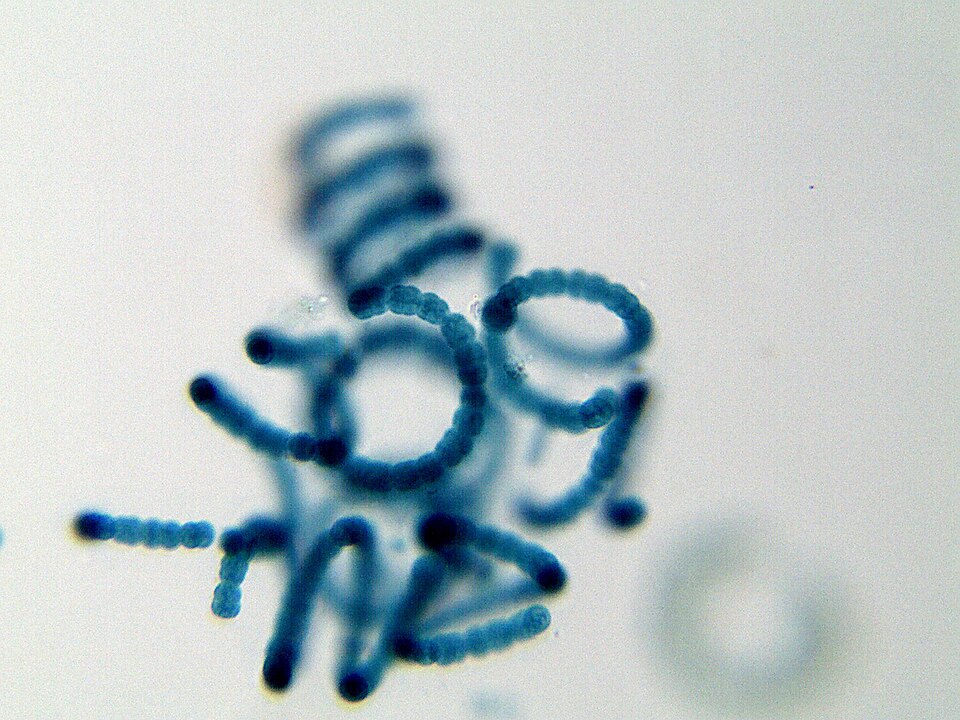
- Reading 'blue-green algae' as algae rather than bacteria.
- Grouping diatoms with bacteria because both are microscopic.
- Assuming any filamentous organism is a cyanobacterium.
Classification items on this list recur through UPSC, CAPF and NDA, usually by asking which organism is a biofertiliser or which of a set are primary producers.
Consider the following organisms: 1. Agaricus 2. Nostoc 3. Spirogyra Which of the above is/are used as biofertilizer/biofertilizers?
- (a) 1 and 2
- (b) 2 only
- (c) 2 and 3
- (d) 3 only
Answer(b) 2 only
Sorts the same three-way confusion. Nostoc is a cyanobacterium like Anabaena and fixes nitrogen; Spirogyra is a green alga and Agaricus a fungus, so neither qualifies.
Consider the following kinds of organisms: 1. Copepods 2. Cyanobacteria 3. Diatoms 4. Foraminifera Which of the above are primary producers in the food chains of oceans?
- (a) 1 and 2
- (b) 2 and 3
- (c) 3 and 4
- (d) 1 and 4
Answer(b) 2 and 3
Puts cyanobacteria and diatoms side by side, as this CAPF item does; both photosynthesise, but only the cyanobacteria are prokaryotic and therefore in Monera.
Which of the following kingdoms has/have only unicellular organisms?
- (a) Monera only
- (b) Protista only
- (c) Monera and Protista both
- (d) Protista and Fungi both
Answer(c) Monera and Protista both
Names the two kingdoms this question asks you to separate, and closes off the shortcut of sorting by cell number rather than by nuclear organisation.
- practice — not a real PYQ
Which one of the following is a prokaryote?
- (a)Yeast
- (b)Nostoc
- (c)Chlamydomonas
- (d)Paramecium
Answer(b) Nostoc — a cyanobacterium, and therefore in Monera; the other three are eukaryotes.
- practice — not a real PYQ
The nitrogen-fixing cyanobacterium associated with the water fern Azolla is
- (a)Rhizobium
- (b)Azotobacter
- (c)Anabaena
- (d)Spirogyra
Answer(c) Anabaena — Anabaena azollae lives in the leaf cavities of Azolla and fixes nitrogen there.