
Which of the following statements about Akbar are correct? 1. In 1560s, Akbar had the Fort of Agra constructed. 2. In 1570s, Akbar decided to build a new capital at Fatehpur Sikri. 3. Akbar also commissioned a white marble tomb of Shaikh Salim Chishti at Sikri. 4. In 1585, Akbar decided to shift the capital back to Agra. Select the correct answer using the code given below.
- (a)1, 2 and 4
- (b)1, 2 and 3
- (c)2, 3 and 4
- (d)3 and 4 only
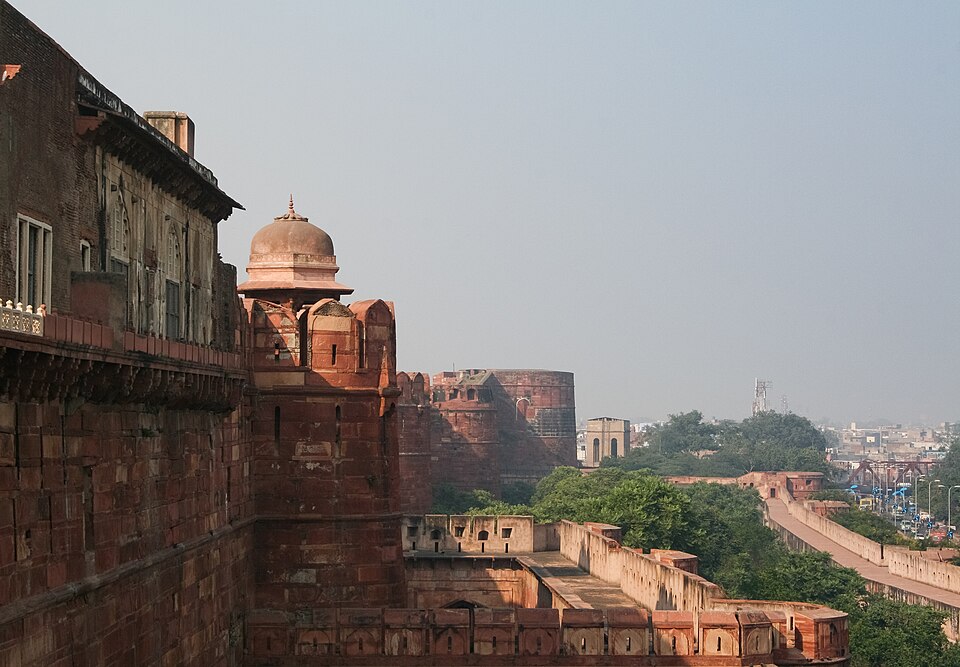
Correct — B, 1, 2 and 3. Akbar had the fort at Agra built in the 1560s from red sandstone quarried in Rajasthan; he began a new capital at Sikri in the 1570s; and a white marble tomb was raised there for Shaikh Salim Chishti beside the great Friday mosque. Statement 4 is the one that fails. The move of 1585 was to Lahore, not back to Agra, and it was made to keep the north-west frontier under watch while Abdullah Khan Uzbek pressed on Kabul and Qandahar. The court stayed at Lahore for thirteen years and reached Agra again only in 1598.
- (a)1, 2 and 4 — Keeps the two securely dated building projects but also keeps the 1585 claim, which puts the capital in the wrong city.
- (c)2, 3 and 4 — The combination the circulating derived answer marks. It needs the Agra fort of the 1560s to be wrong — it is not — and needs the 1585 move to have been to Agra, which it was not.
- (d)3 and 4 only — Discards both datable building statements and retains the single statement that misstates the destination of the 1585 move.
Akbar's reign is conventionally read in three phases, and the seat of government moved with them. Agra was the capital from 1558. Sikri was begun about 1571 and occupied for roughly fourteen years, its choice tied to the road to Ajmer and to Akbar's relationship with the Chishti shaikh who lived there. In 1585 the court went to Lahore, close enough to the passes to manage the Uzbek threat, and it returned to Agra in 1598 once that frontier had quietened.
This is a four-statement item where three statements are easy and the fourth decides the answer. The derived answer in circulation marks the option built on statements 2, 3 and 4, which requires the Agra fort statement to be false and the 1585 statement to be true — the reverse of both. Since UPSC has released no key for this paper, the card publishes the reading the sources support and the conflict is recorded rather than hidden. One honest qualification on statement 3: the tomb was raised in Akbar's reign, but the delicate marble screens that give it its familiar look were completed under Jahangir.
- Agra Fort was begun in 1565 and largely finished by 1573, built in red sandstone.
- Fatehpur Sikri was founded about 1571 and served as the capital for roughly fourteen years.
- Sikri lay on the direct road to Ajmer, where the dargah of Shaikh Muinuddin Chishti drew pilgrims.
- The transfer of 1585 was to Lahore, held for thirteen years against Uzbek pressure on Kabul and Qandahar.
- Akbar's court came back to Agra in 1598, and he died at Agra in 1605.
- Assuming that any move away from Fatehpur Sikri must have been a move back to Agra.
- Dating Agra Fort to the Fatehpur Sikri years rather than a decade earlier.
A four-statement item that turns on one date and one city, with the other three statements serving as padding.
Ibadat Khana at Fatehpur Sikri was
- (a) the mosque for the use of Royal Family
- (b) Akbar’s private prayer chamber
- (c) the hall in which Akbar held discussions with scholars of various religions
- (d) the room in which the nobles belonging to different religions gathered to discuss religious affairs
Answer(c) the hall in which Akbar held discussions with scholars of various religions
The same capital seen from inside. The Ibadat Khana was built at Sikri in 1575, which fixes the city as a working capital in the 1570s and supports the second statement of this item.
- practice — not a real PYQ
In 1585 Akbar shifted his capital from Fatehpur Sikri to which city?
- (a)Lahore
- (b)Agra
- (c)Delhi
- (d)Ajmer
Answer(a) Lahore — the move put the court within reach of the north-west frontier, and it stayed there thirteen years.
- practice — not a real PYQ
The tomb of Shaikh Salim Chishti at Fatehpur Sikri was commissioned during the reign of
- (a)Humayun
- (b)Akbar
- (c)Jahangir
- (d)Shah Jahan
Answer(b) Akbar — the tomb stands beside the Jama Masjid at Sikri, though its marble screens were finished later under Jahangir.