
In which one of the following soils, the salt content is so high that common salt is obtained by evaporating the saline water in some areas?
- (a)Peaty soil
- (b)Alluvial soil
- (c)Laterite soil
- (d)Arid soil
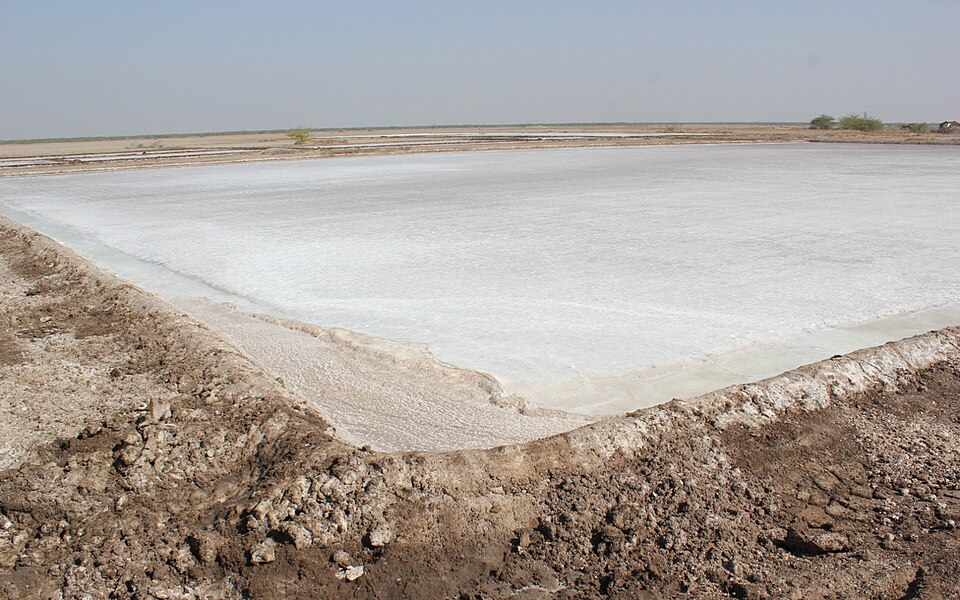
Correct — D, Arid soil. Arid soils cover western Rajasthan and the adjoining tracts of Gujarat and Haryana, where evaporation runs well ahead of rainfall. Salts dissolved in groundwater are pulled upward by capillary action and left behind as the water leaves, instead of being flushed downward as they are in a wet climate. In the Rann of Kutch and the salt tracts nearby the saline water is led into shallow beds and allowed to evaporate, and what stays behind is common salt. The rest of the profile fits the same story — sandy texture, very little humus, low moisture, and a kankar horizon of calcium carbonate lower down that stops water percolating.
- (a)Peaty soil — Peaty soils form where heavy rain and high humidity leave dead plant matter undecomposed, as in the backwater districts of Alappuzha and Kottayam in Kerala. They are black, heavy, acidic and waterlogged — the accumulation is organic matter, not salt.
- (b)Alluvial soil — The soil of the northern plains and the great deltas, renewed by silt the rivers bring down. It is India's most productive soil, well supplied with potash, phosphoric acid and lime and short of nitrogen. Its drainage carries salts away rather than concentrating them.
- (c)Laterite soil — Laterite develops in the humid tropics under a sharply alternating wet and dry season; intense leaching strips the silica and leaves iron and aluminium oxides. Its weakness is infertility from leaching, not salinity, and it carries tea, coffee and cashew in Karnataka, Kerala and the Western Ghats.
India's soils are grouped by how and where they formed. The arid or desert group belongs to a climate in which potential evaporation exceeds rainfall, and that one hydrological fact explains everything the group is known for. Water moving upward through a sandy profile carries dissolved salts to the surface and deposits them there; sparse plant cover means almost no organic matter reaches the ground; and a hard kankar layer builds up below, blocking infiltration.
Three options can be struck out on climate alone. Peaty and laterite soils both need heavy rain, and heavy rain washes salts down the profile rather than concentrating them at the top. Alluvial soils lie on well-drained flood plains. That leaves only the arid belt, where saline groundwater meets an evaporation surplus. The sentence in the stem sits very close to the school-textbook description of arid soils, so candidates who had read that line recognised it outright.
- Arid soils are sandy, saline, low in humus and low in moisture, and cover much of western Rajasthan.
- A kankar horizon of calcium carbonate below the surface restricts the downward movement of water.
- Salt is harvested by evaporating saline water in shallow pans; Gujarat is by far the largest salt producer in India, with Tamil Nadu and Rajasthan next.
- Irrigation, most visibly through the Indira Gandhi Canal, has brought parts of the arid belt under cultivation.
- Peaty soil is the mirror case — organic matter piling up under waterlogging in Kerala's backwater districts.
- Reading the word salt as a coastal clue and reaching for deltaic alluvium.
- Confusing peaty soil, which is waterlogged and acidic, with saline soil.
A one-line recall item lifted almost word for word from the standard textbook description of arid soils.
Which of the following statements regarding laterite soils of India are correct? 1. They are generally red in colour. 2. They are rich in nitrogen and potash. 3. They are well-developed in Rajasthan and UP. 4. Tapioca and cashew nuts grow well on these soils. Select the correct answer using the codes given below.
- (a) 1, 2 and 3
- (b) 2, 3 and 4
- (c) 1 and 4
- (d) 2 and 3 only
Answer(c) 1 and 4
The other end of the same classification. Laterite is defined by leaching under heavy rain and is placed in the humid peninsular belt, which is precisely why the option that puts it in Rajasthan fails there and why laterite cannot be the salt-crusted soil here.
- practice — not a real PYQ
Which soil of India is formed by the leaching away of silica under alternating wet and dry tropical conditions?
- (a)Alluvial soil
- (b)Laterite soil
- (c)Black soil
- (d)Arid soil
Answer(b) Laterite soil — heavy rain removes the silica and leaves iron and aluminium oxides, which give the soil its red colour.
- practice — not a real PYQ
Peaty soils are most extensively found in which State?
- (a)Kerala
- (b)Punjab
- (c)Odisha
- (d)Rajasthan
Answer(a) Kerala — the backwater districts of Alappuzha and Kottayam, where waterlogging leaves plant matter undecomposed.