
Which one of the following metals produces hydrogen with cold water?
- (a)Silver
- (b)Sodium
- (c)Copper
- (d)Iron
Correct — B, Sodium. Sodium is high in the reactivity series and reacts with cold water at once: 2Na + 2H2O → 2NaOH + H2. The reaction is vigorous and exothermic, the metal melts into a ball from its own heat and skates across the surface, and the hydrogen released often ignites. Because it also reacts with the oxygen and moisture of the air, sodium is kept under kerosene or oil in the laboratory. Potassium and calcium behave the same way with cold water; magnesium needs hot water, and iron needs steam.
- (a)Silver — Silver is a noble metal, below hydrogen in the reactivity series. It does not react with water in any form, hot, cold or as steam.
- (c)Copper — Copper is also below hydrogen and does not displace it from water or from dilute acids. Copper vessels do not corrode in water for this reason.
- (d)Iron — Iron does not react with cold water. It reacts with steam at high temperature to give the magnetic oxide Fe3O4 and hydrogen, and in air with moisture it rusts slowly, which is a different process.
How a metal behaves towards water tracks its position in the reactivity series exactly. Potassium, sodium, lithium and calcium react with cold water and release hydrogen; magnesium reacts with hot water; aluminium, zinc and iron react only with steam; and copper, silver, gold and platinum do not react with water at all. The hydroxide or oxide produced and the vigour of the reaction both follow the same ranking.
The four options are spread deliberately across the series, one from the top and three from the bottom half, so the item can be answered by locating each metal rather than by recalling a specific reaction. Iron is the option worth pausing on. Rusting is not the same as reacting with cold water — it is a slow electrochemical process needing both air and moisture, and it releases no hydrogen. A metal that gives hydrogen from cold water has to be near the top, and only sodium qualifies here.
- 2Na + 2H2O → 2NaOH + H2, and the reaction is vigorous enough to melt the sodium.
- Potassium, sodium, lithium and calcium react with cold water; magnesium needs hot water.
- Aluminium, zinc and iron react with steam but not with cold water.
- Copper, silver, gold and platinum do not react with water at all.
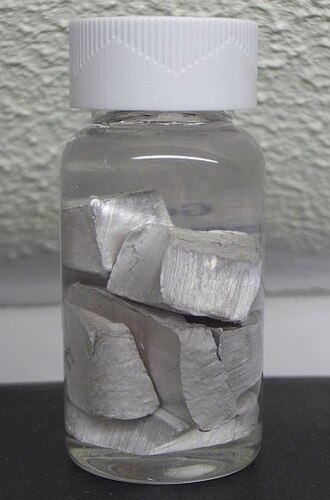
- Sodium is stored under kerosene because it reacts with both the oxygen and the moisture of the air.
- Choosing iron on the strength of rusting, which is a different reaction and gives no hydrogen.
- Assuming any metal will release hydrogen from water given enough time.
- Mixing up the reactivity series with the order of the metals in the periodic table.
A reactivity-series item with the options drawn from opposite ends; NDA asks the same content in the negative form, naming the metal that does not react with cold water.
Assertion (A): Sodium metal is stored under kerosene. Reason (R): Metallic sodium melts when exposed to air.
- (a) Both A and R are true, and R is the correct explanation of A
- (b) Both A and R are true, but R is NOT a correct explanation of A
- (c) A is true, but R is false
- (d) A is false, but R is true
Answer(c) A is true, but R is false
Turns on the same reactivity. Sodium is kept under kerosene because it attacks air and moisture on contact, which is the property that answers this CAPF item.
Which one of the following metals does NOT react with cold water to liberate hydrogen gas ?
- (a) Potassium
- (b) Iron
- (c) Calcium
- (d) Sodium
Answer(b) Iron
The mirror image of this question, and it settles the distractor most candidates hesitate over — iron rusts, but it does not liberate hydrogen from cold water.
- practice — not a real PYQ
Which one of the following metals reacts with steam but not with cold water?
- (a)Potassium
- (b)Calcium
- (c)Iron
- (d)Gold
Answer(c) Iron — with steam it gives Fe3O4 and hydrogen, but cold water leaves it alone.
- practice — not a real PYQ
The gas released when sodium is dropped into cold water is
- (a)oxygen
- (b)hydrogen
- (c)carbon dioxide
- (d)chlorine
Answer(b) hydrogen — sodium hydroxide is left in solution.