
Which one of the following organisms does not possess notochord at any stage of its life cycle?
- (a)Holothuria
- (b)Herdmania
- (c)Exocoetus
- (d)Salamander
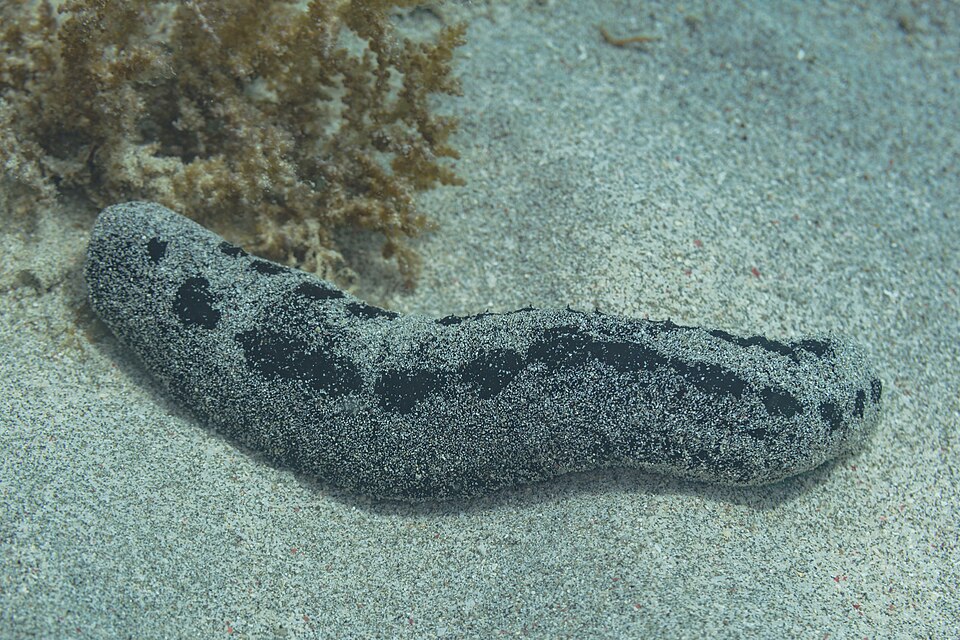
Correct — A, Holothuria. Holothuria is the sea cucumber, a member of phylum Echinodermata — spiny-skinned marine animals with radial symmetry as adults, a calcareous endoskeleton and a water vascular system with tube feet. Echinoderms are not chordates and no stage of their life cycle carries a notochord. The other three all do, though one of them only briefly.
- (b)Herdmania — Herdmania is a sea squirt, a urochordate. The adult is a sessile bag with no notochord, but its free-swimming tadpole larva has one in the tail — which is exactly why the question says 'at any stage'.
- (c)Exocoetus — Exocoetus is the flying fish, a bony fish and therefore a vertebrate. The notochord of the embryo is replaced by a vertebral column as it develops.
- (d)Salamander — The salamander is an amphibian, again a vertebrate, with a notochord in the embryo that gives way to a backbone.
The notochord is a flexible rod along the back that defines the phylum Chordata, alongside a dorsal hollow nerve cord and pharyngeal gill slits. In vertebrates it appears in the embryo and is replaced by the vertebral column. In protochordates it persists differently — in urochordates only in the larval tail, in cephalochordates such as Amphioxus throughout life. Echinoderms sit outside the phylum entirely, though they are the closest invertebrate relatives of chordates.
The phrase 'at any stage of its life cycle' is doing all the work, and it is aimed squarely at Herdmania. A candidate who checks only the adult finds a shapeless sessile animal with no notochord and marks it, which is the intended error. Once the larval tail is remembered, three of the four options are chordates and the sea cucumber is left alone. Nothing in the item requires knowing anything about Holothuria beyond its phylum.
- A notochord, a dorsal hollow nerve cord and pharyngeal gill slits are the defining chordate features.
- Holothuria is a sea cucumber and belongs to phylum Echinodermata.
- Herdmania is a urochordate whose notochord is confined to the tail of the larva.
- In vertebrates the embryonic notochord is replaced by the vertebral column.
- Echinoderms are radially symmetrical as adults but bilaterally symmetrical as larvae.
- Judging Herdmania by the adult alone and missing the larval notochord.
- Assuming any marine invertebrate is automatically a non-chordate — sea squirts are chordates.
- Confusing the notochord with the nerve cord or the vertebral column.
A phylum-recognition item whose whole difficulty is the phrase 'at any stage'; CDS asks the same boundary through the group that has a notochord but never a vertebral column.
Octopus is
- (a) an arthropod
- (b) an echinoderm
- (c) a hemichordate
- (d) a mollusc
Answer(d) a mollusc
The same sorting exercise among marine invertebrate phyla, with echinoderm and hemichordate offered as the traps that this CAPF item resolves in the other direction.
Animals which are marine, bilaterally symmetrical, have a coelom and a notochord, but never form a vertebral column are placed under which one of the following groups ?
- (a) Chordata
- (b) Protochordata
- (c) Vertebrata
- (d) Mammalia
Answer(b) Protochordata
Names the group Herdmania belongs to and states its defining feature — a notochord without a vertebral column — which is why the sea squirt cannot be the answer here.
- practice — not a real PYQ
The notochord persists throughout life in
- (a)Amphioxus
- (b)Herdmania
- (c)Frog
- (d)Rabbit
Answer(a) Amphioxus — in cephalochordates the notochord is retained for life, unlike in the other three.
- practice — not a real PYQ
Which one of the following belongs to phylum Echinodermata?
- (a)Starfish
- (b)Octopus
- (c)Prawn
- (d)Earthworm
Answer(a) Starfish — octopus is a mollusc, prawn an arthropod and earthworm an annelid.