
Which one of the following statements about life processes in single-celled organisms is not correct?
- (a)They require separate organ for food uptake.
- (b)Separate organ is not needed for respiration.
- (c)Waste of excretory material is produced by these organisms.
- (d)They remain in contact with external environment.
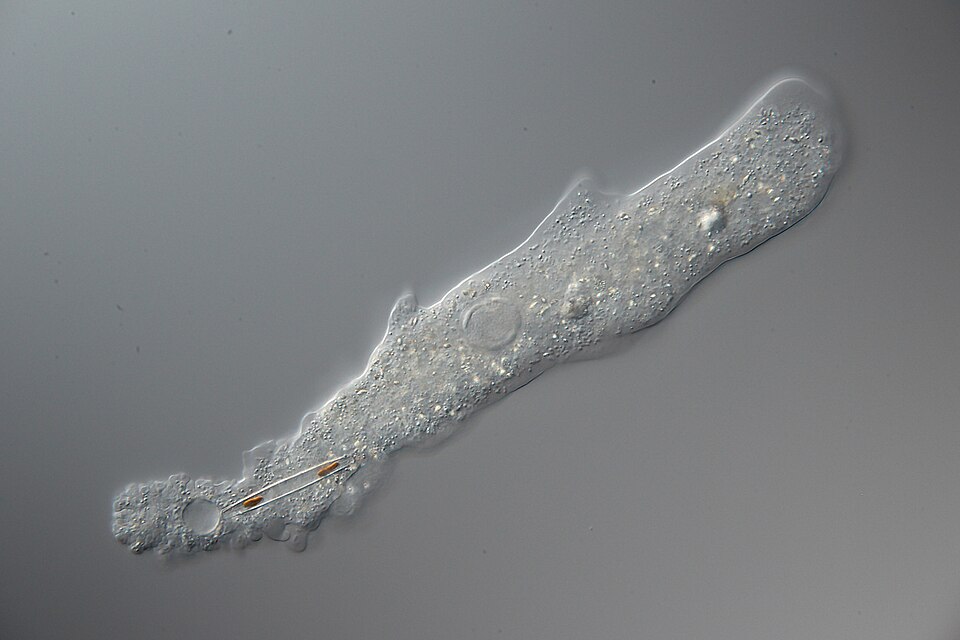
Correct — A, They require separate organ for food uptake. In a single-celled organism the whole body is one cell in contact with the surrounding water, so food, gases and wastes cross the cell surface directly. Amoeba engulfs a food particle by extending pseudopodia around it; Paramecium sweeps particles into an oral groove lined with cilia. Neither uses an organ in the sense a multicellular animal does, and the ratio of surface to volume is large enough that simple diffusion is enough. Multicellular bodies developed digestive, respiratory and excretory organs precisely because their inner cells are no longer at the surface.
- (b)Separate organ is not needed for respiration. — This is correct and so cannot be the answer. Gas exchange in a unicellular organism happens by diffusion across the cell surface, with no respiratory organ involved.
- (c)Waste of excretory material is produced by these organisms. — Also correct. Metabolism produces nitrogenous waste and carbon dioxide in these organisms as in any other; they remove it by diffusion, and Amoeba and Paramecium expel excess water through a contractile vacuole.
- (d)They remain in contact with external environment. — Correct as well. Living in direct contact with the external medium is the reason diffusion suffices for every exchange the cell has to make.
Life processes are the same in all organisms — nutrition, respiration, transport, excretion — but the machinery scales with size. A single cell has a large surface area relative to its volume, so every part of it is close to the outside and diffusion moves material fast enough. As bodies grow, that ratio falls, interior cells lose direct access to the medium, and specialised organs and transport systems become necessary.
The stem asks for the statement that is not correct, and three of the four options are plainly true, so the item is a reading test as much as a biology test. The one to watch is the third — a candidate can talk themselves out of it on the grounds that a single cell is 'too simple' to excrete, which is false. Producing waste is a consequence of metabolism, not of complexity; what unicellular organisms lack is not the waste but the organ.
- Unicellular organisms exchange food, gases and wastes directly across the cell surface.
- Amoeba takes in food by phagocytosis using pseudopodia; Paramecium uses cilia and an oral groove.
- The contractile vacuole expels excess water and some wastes in freshwater protists.
- A high surface-area-to-volume ratio is what makes diffusion sufficient at this size.
- Multicellular organisms need specialised organs because their inner cells are not in contact with the external medium.
- Assuming a single-celled organism produces no waste.
- Overlooking the word 'not' in the stem and marking a true statement.
- Treating the food vacuole of Amoeba as an organ.
Set as a negative statement item on the life processes chapter; the sibling papers approach the same material through the organelle that expels excess water and through the mode of nutrition of particular groups.
Which one of the following cell organelles may play a role in expelling excess water and wastes in case of unicellular organisms?
- (a) Lysosome
- (b) Vacuole
- (c) Golgi body
- (d) Endoplasmic reticulum
Answer(b) Vacuole
Confirms the third statement here directly: unicellular organisms do produce waste and do remove it, using a contractile vacuole rather than an excretory organ.
In which of the following groups of organisms, is food material broken down outside the body and absorbed?
- (a) Yeast, mushroom, bread mould
- (b) Mushroom, Amoeba, green plants
- (c) Caserta, tapeworm, lice
- (d) Paramecium, Amoeba, Caserta
Answer(a) Yeast, mushroom, bread mould
Shows the other way a body can feed without a digestive organ — by digesting outside itself — and sets Amoeba apart, since Amoeba engulfs its food instead.
- practice — not a real PYQ
In Amoeba, food is taken in by
- (a)a mouth
- (b)pseudopodia forming a food vacuole
- (c)cilia lining a gullet
- (d)diffusion through the nucleus
Answer(b) pseudopodia forming a food vacuole — the process is phagocytosis.
- practice — not a real PYQ
Gaseous exchange in a unicellular organism takes place mainly by
- (a)diffusion across the cell surface
- (b)tracheae
- (c)gills
- (d)a contractile vacuole
Answer(a) diffusion across the cell surface — no respiratory organ is involved.