
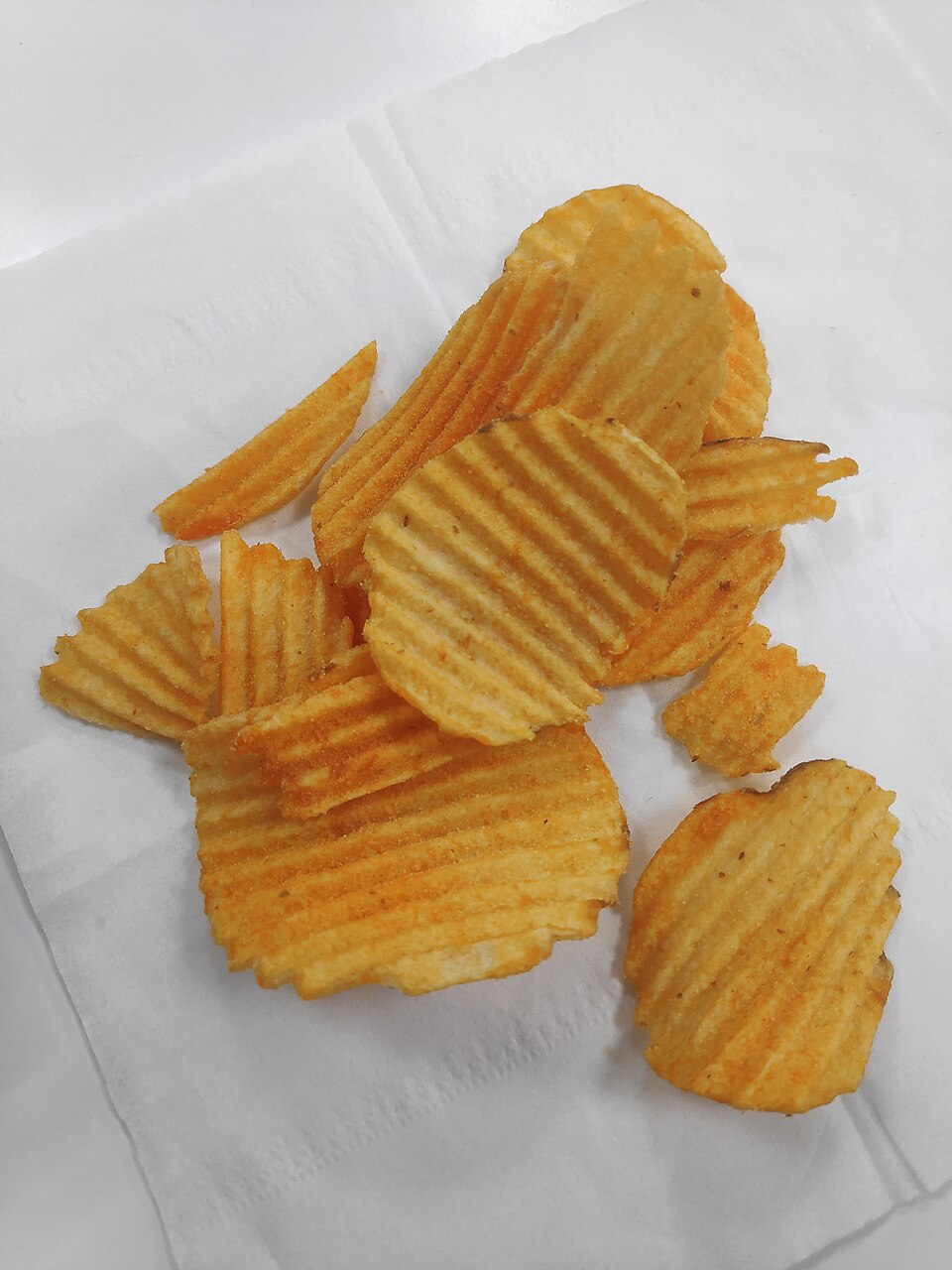
Packets of potato chips are usually flushed with which one of the following gases to prevent rancidity?
- (a)Carbon dioxide
- (b)Hydrogen
- (c)Nitrogen
- (d)Oxygen
Correct — C, Nitrogen. Rancidity is the oxidation of the fats and oils in a food, and it is oxygen from the air that starts it. Flushing a packet with nitrogen sweeps the oxygen out and replaces it with a gas that will not react with the food at ordinary temperatures. Nitrogen makes up 78 per cent of the atmosphere, so it is cheap to obtain, and it doubles as a cushion — the puffed-up packet is what keeps brittle crisps from being crushed in transport.
- (a)Carbon dioxide — Carbon dioxide is used in some modified-atmosphere packing, but it dissolves readily into the fat and moisture of a food, which collapses the pack and can leave an acid taste. It is not the gas used for crisps.
- (b)Hydrogen — Hydrogen is flammable across a wide range of concentrations in air. Sealing it into a food packet would be an obvious hazard, and it is also a reducing agent rather than an inert filler.
- (d)Oxygen — Oxygen is the cause of the problem, not the cure. Flushing a packet with oxygen would make the food turn rancid faster than leaving it in ordinary air.
Fats and oils containing unsaturated bonds react with atmospheric oxygen to form peroxides and then aldehydes and short-chain acids, which is what produces the stale smell and taste of an old packet of fried food. Since the reaction needs oxygen, the standard defences all attack the same step — flush the pack with an unreactive gas, add antioxidants, keep the food in airtight containers, and store it cold and out of the light.
The examiner is really asking two questions at once: what causes rancidity, and which gas is least likely to interfere. Answer the first and oxygen is eliminated at once; answer the second on reactivity and hydrogen goes too. The remaining choice between nitrogen and carbon dioxide turns on solubility — carbon dioxide dissolves into fatty and moist foods, nitrogen does not, which is why the crisp packet is a nitrogen packet.
- Rancidity is the oxidation of fats and oils in a food on exposure to air.
- Nitrogen is used to flush fried-food packets because it is inert, abundant and cheap.
- Nitrogen forms about 78 per cent of the atmosphere by volume.
- Antioxidants, airtight containers, refrigeration and dark storage are the other standard defences against rancidity.
- The inflated packet also protects brittle contents from mechanical damage during transport.
- Choosing carbon dioxide because it is the familiar packaging gas from fizzy drinks.
- Treating rancidity as a bacterial spoilage problem rather than a chemical oxidation.
- Assuming any gas other than oxygen will do, without checking flammability.
Asked as a straight application item connecting rancidity to the gas used in packaging; CDS has asked the same chemistry by listing rancidity among candidate oxidation reactions.
Which one of the following is not an oxidation reaction?
- (a) Rusting of iron
- (b) Opening of soda bottle
- (c) Rancidity
- (d) Combustion
Answer(b) Opening of soda bottle
Places rancidity squarely among the oxidation reactions, which is the fact that decides which gas belongs in the packet here.
Which one of the following is not an example of an oxidation reaction?
- (a) The taste of butter changes if left for a longer period.
- (b) A white substance is formed when an aqueous solution of barium chloride is mixed with sodium sulphate solution.
- (c) A reddish-brown powder gets coated on articles made of iron.
- (d) Wine gets sour with time.
Answer(b) A white substance is formed when an aqueous solution of barium chloride is mixed with sodium sulphate solution.
Describes rancidity in its everyday form — butter changing taste on standing — and marks it as oxidation, the same reasoning this CAPF item rests on.
- practice — not a real PYQ
Rancidity in packed fried food is caused mainly by
- (a)reduction of fats
- (b)oxidation of fats
- (c)hydrolysis of starch
- (d)fermentation by yeast
Answer(b) oxidation of fats — atmospheric oxygen attacks the unsaturated bonds in the fat.
- practice — not a real PYQ
Which one of the following is not a way of slowing down rancidity?
- (a)Adding antioxidants
- (b)Refrigerating the food
- (c)Packing in an airtight container
- (d)Increasing the oxygen in the pack
Answer(d) Increasing the oxygen in the pack — more oxygen speeds the oxidation up.