
Which one of the following statements about alkaline earth metals is NOT true?
- (a)Strontium salts burn with a red flame
- (b)Barium metal is used in medicine to examine the alimentary canal of a patient by X-ray
- (c)Green plants need magnesium in order to make the chlorophyll that trap the energy from sunlight in photosynthesis
- (d)Red colour of gemstone Ruby is due to the element beryllium present in it
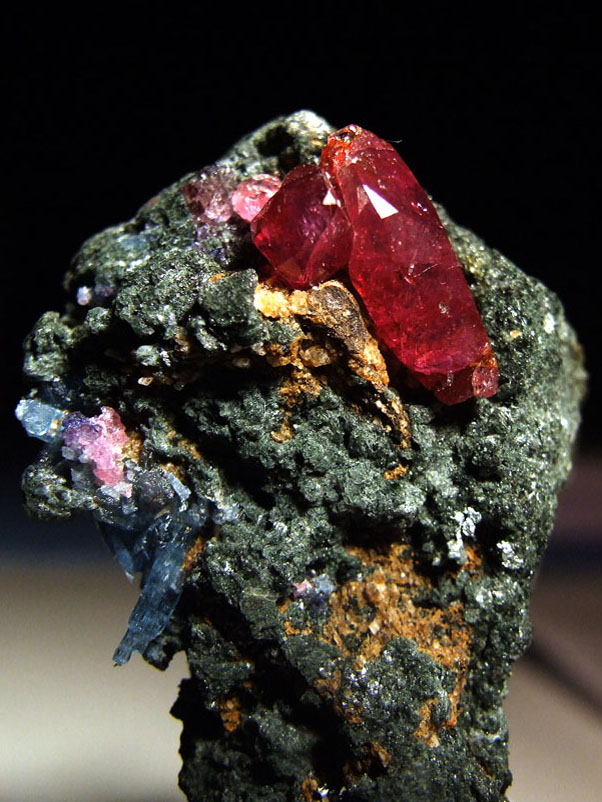
Correct — D, Red colour of gemstone Ruby is due to the element beryllium present in it. Ruby is corundum, crystalline aluminium oxide, and its red comes from a small proportion of chromium replacing aluminium in the lattice. Beryllium has no part in it. Beryllium is the metal of beryl, the mineral family that gives emerald and aquamarine, and even there the green of emerald comes from chromium or vanadium rather than from beryllium itself.
- (a)Strontium salts burn with a red flame — True, and used in practice. Strontium salts give the crimson red of fireworks and distress flares, which is the standard flame test for the element.
- (b)Barium metal is used in medicine to examine the alimentary canal of a patient by X-ray — True. A barium sulphate meal is swallowed before a gastrointestinal X-ray because barium's high atomic number absorbs X-rays strongly and outlines the gut against the surrounding soft tissue.
- (c)Green plants need magnesium in order to make the chlorophyll that trap the energy from sunlight in photosynthesis — True. Magnesium sits at the centre of the chlorophyll molecule, so a plant short of magnesium cannot build the pigment that captures sunlight.
The alkaline earth metals of group 2 are beryllium, magnesium, calcium, strontium, barium and radium. Reactivity increases down the group, and the heavier members give characteristic flame colours — calcium brick red, strontium crimson, barium apple green. Their compounds run through medicine, agriculture, pyrotechnics and construction, so examiners can build an entire item out of applications without asking any theory.
Gemstone colour is nearly always an impurity effect, and that is the point being tested. Corundum, pure aluminium oxide, is colourless; a trace of chromium makes it ruby, while iron and titanium together make it blue sapphire. Beryl is likewise colourless when pure and becomes emerald with chromium or vanadium, aquamarine with iron. Ruby and emerald therefore share a colouring agent while belonging to entirely different mineral families — which is exactly the confusion this option is built on.
- Ruby is corundum, aluminium oxide, coloured red by traces of chromium.
- Blue sapphire is the same mineral coloured by iron and titanium instead.
- Beryllium belongs to beryl, whose green variety emerald owes its colour to chromium or vanadium.
- Strontium gives a crimson flame and barium an apple-green one; both are used in fireworks.
- Barium sulphate is used as an X-ray contrast medium because it is dense, radio-opaque and insoluble enough not to poison the patient, unlike soluble barium salts.
- Pairing beryllium with ruby because beryl sounds like a gemstone word.
- Assuming the colouring element is the main constituent, when it is almost always a trace impurity.
- Forgetting that emerald and ruby share chromium as a colouring agent despite being different minerals.
A NOT-true item across four applications of one group. Three options are textbook uses; the fourth swaps one element for another inside a familiar-sounding claim.
Barium in a suitable form is administered to patients before an X-ray examination of the stomach, because
- (a) barium allows X-rays to pass through the stomach on account of its transparency to X-rays
- (b) barium compound, like magnesium sulphate helps in cleaning the stomach before X-ray examination
- (c) barium is a good absorber of X-rays and this helps the stomach to appear clearly in contrast with the other regions in the picture
- (d) barium salts are white in colour and this helps the stomach to appear clearly in contrast with other regions in the picture
Answer(c) barium is a good absorber of X-rays and this helps the stomach to appear clearly in contrast with the other regions in the picture
Prelims asked why the barium meal works, where this item only asks that it does. The reason is absorption of X-rays by a heavy element, not colour — which also disposes of the tempting white-powder explanation.
A patient’s abdomen (alimentary canal) can be examined by X-ray after administering which one of the following metal salts in the patient’s meal?
- (a) Barium sulphate
- (b) Barium chloride
- (c) Strontium sulphate
- (d) Magnesium chloride
Answer(a) Barium sulphate
The same use pinned down to the exact salt. Sulphate is chosen because it is insoluble and therefore not absorbed; soluble barium salts such as the chloride are poisonous.
- practice — not a real PYQ
The red colour of ruby is due to the presence of
- (a)chromium
- (b)beryllium
- (c)iron
- (d)cobalt
Answer(a) chromium — ruby is corundum in which a small fraction of the aluminium has been replaced by chromium.
- practice — not a real PYQ
Which one of the following gives a crimson red colour in a flame test?
- (a)Barium
- (b)Strontium
- (c)Sodium
- (d)Copper
Answer(b) Strontium — barium burns apple green, sodium golden yellow and copper bluish green.