
Which one of the following gases produces a red light when electricity flows through it?
- (a)Helium
- (b)Argon
- (c)Nitrogen
- (d)Neon
Correct — D, Neon. Pass an electric discharge through low-pressure neon and it glows a distinctive orange-red. That colour is the reason the gas gave its name to an entire advertising industry, and a tube filled with pure neon needs no coating or filter to produce it. The colour comes from the particular set of energy levels in the neon atom, so each gas in a discharge tube glows in its own characteristic way.
- (a)Helium — Helium in a discharge tube glows pale peach or whitish pink, not red.
- (b)Argon — Argon gives a pale lilac or violet-blue glow. It is the commonest filler in fluorescent tubes, usually mixed with a little mercury vapour.
- (c)Nitrogen — Nitrogen is not a noble gas and is not used this way; a nitrogen discharge glows pinkish-purple rather than red.
In a gas discharge, electrons accelerated by the applied voltage collide with gas atoms and knock their electrons into higher energy levels. The excited atoms fall back almost at once, releasing the difference as light. Because the energy levels are fixed and different for every element, each gas emits its own set of wavelengths, and the colour we see is the sum of them.
The everyday 'neon sign' in other colours is not neon at all — the tube is filled with a different gas, or coated inside with a phosphor, or made of tinted glass. Only the orange-red one is genuine neon. The same principle of element-specific emission runs through the sodium-vapour street lamp's yellow, the mercury lamp's blue-white and the whole science of spectroscopy, in which an unknown source is identified from the wavelengths it emits.
- Neon in a discharge tube glows orange-red, and that colour needs no coating or filter.
- Helium glows pale pinkish-white, argon pale lilac, krypton whitish and xenon blue.
- The colour arises from transitions between fixed atomic energy levels, so it identifies the element.
- Neon was discovered in 1898 by William Ramsay and Morris Travers, along with krypton and xenon.
- Modern coloured tube signs use other gases, phosphor coatings or tinted glass, so most are not neon.
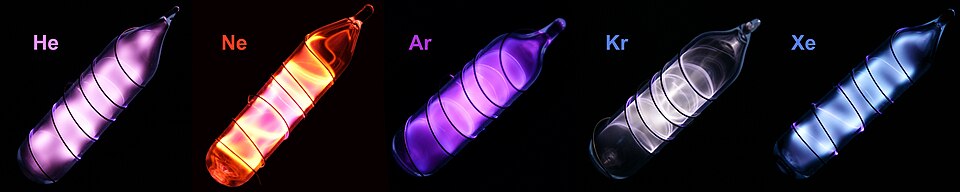
- Assuming every coloured tube sign contains neon.
- Treating nitrogen as a noble gas because it is unreactive at ordinary temperatures.
- Mixing up the colour a gas emits in a discharge with the colour of its flame test, which is a different experiment.
Straight property recall across the noble gases. Fixing neon as red and argon as the fluorescent-tube filler covers most of what is asked from this corner.
No directly related past PYQ was found.
- practice — not a real PYQ
Which one of the following gases is used along with a small quantity of mercury vapour in ordinary fluorescent tube lights?
- (a)Neon
- (b)Argon
- (c)Helium
- (d)Radon
Answer(b) Argon — argon plus a trace of mercury sustains the discharge, and the phosphor coating converts its ultraviolet output into visible light.
- practice — not a real PYQ
The characteristic colour of light emitted by a gas in a discharge tube depends mainly on
- (a)the pressure of the gas alone
- (b)the applied voltage alone
- (c)the energy levels of the atoms of that gas
- (d)the material of the tube
Answer(c) the energy levels of the atoms of that gas — the emitted wavelengths correspond to fixed differences between those levels.