
Which one of the following is the correct description of Kandaria Mahadeo?
- (a)A Shiva temple at Elephanta
- (b)The title of a work by Bhatti
- (c)The capital of Chandella kings
- (d)A temple at Khajuraho
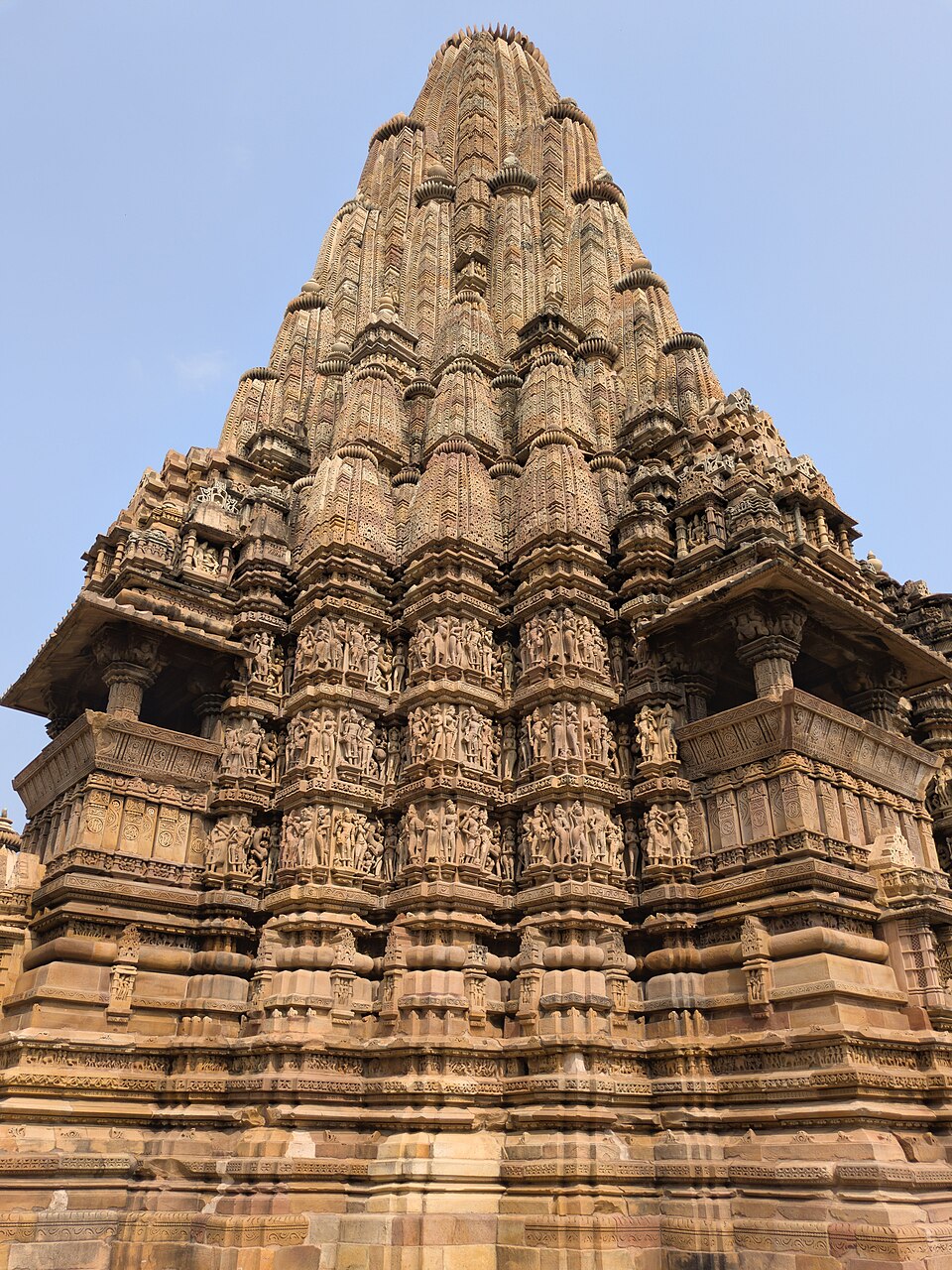
Correct — D, A temple at Khajuraho. The Kandariya Mahadeva is the largest and the most elaborate of the Khajuraho temples, built in about the eleventh century under the Chandella ruler Vidyadhara. It is a Shiva temple in the Nagara style, raised on a high platform, with a shikhara that gathers dozens of subsidiary spires rising towards a single peak in imitation of a mountain range. The other three options are each a true fact fastened to the wrong name, which is what makes the item worth reading carefully.
- (a)A Shiva temple at Elephanta — Elephanta does have a great Shiva sanctuary — a rock-cut cave with the three-headed Sadashiva image — but it is not called Kandariya Mahadeva, and it is cut into rock rather than built.
- (b)The title of a work by Bhatti — Bhatti's work exists and is called the Bhattikavya or Ravanavadha. The option borrows a real author and gives him a title that belongs to a building.
- (c)The capital of Chandella kings — The nearest miss. Khajuraho was a Chandella centre and the Chandellas built this temple, but Kandariya Mahadeva names the temple itself, not the city or the kingdom.
Nagara is the northern temple style, recognised by a curvilinear shikhara over the sanctum, a plan raised on a plinth, and no enclosing boundary wall of the kind southern temples have. At Khajuraho the style reaches its most developed form — the sanctum, vestibule, hall and porch are set on one continuous platform, and the roofs rise in a deliberate sequence from the low porch to the tall spire, so that the building reads as a mountain range from a distance.
The Chandellas ruled Bundelkhand between roughly the ninth and the thirteenth centuries, with strongholds at Kalinjar and Mahoba and their temple site at Khajuraho, where about twenty-five of an original eighty-odd temples survive in western, eastern and southern groups. The group is a UNESCO World Heritage Site. Two things are worth separating when this material is asked about. The sculpture on the outer walls covers the whole range of life and the erotic panels are a small part of it, though they attract most of the attention. And the site is not exclusively Hindu — the eastern group includes Jaina temples, of which the Parshvanatha is the best known.
- The Kandariya Mahadeva at Khajuraho is a Shiva temple and the largest of the group, built under the Chandella ruler Vidyadhara.
- It is in the Nagara style, with the sanctum, vestibule, hall and porch set on a single high platform and roofs rising in sequence to the shikhara.
- The Chandellas ruled Bundelkhand with strongholds at Kalinjar and Mahoba; Khajuraho was their temple city.
- About twenty-five temples survive at Khajuraho out of an original number usually given as eighty-five, in western, eastern and southern groups.
- The eastern group includes Jaina temples, the Parshvanatha among them, so the site is not exclusively Hindu.
- Choosing the capital option because the dynasty and the site are correctly associated; the name still belongs to the temple.
- Confusing Khajuraho with Elephanta because both have famous Shiva shrines.
- Assuming a Sanskrit-sounding name in an option list must be a literary work.
Description items give one name and four categories. Fix what kind of thing the name is — a building, a text, a city — before deciding which instance it is.
Match List I with List II and select the correct answer using the code given below the lists: List I I. Gupta II. Chandella III. Chalukya IV. Pallava List II A) Badami B) Panamalai C) Khajuraho D) Deogarh Codes:
- (a) I–D, II–C, III–A, IV–B
- (b) I–D, II–B, III–C, IV–A
- (c) I–B, II–C, III–D, IV–A
- (d) I–C, II–D, III–A, IV–B
Answer(a) I–D, II–C, III–A, IV–B
The dynasty-and-site pairing this question depends on, tested directly. Chandella goes with Khajuraho there, which is why option (c) here is so nearly right and still wrong.
Consider the following pairs: King — Dynasty 1. Nannuka — Chandela 2. Jayashakti — Paramara 3. Nagabhata II — Gurjara-Pratihara 4. Bhoja — Rashtrakuta How many pairs given above are correctly matched?
- (a) Only one pair
- (b) Only two pairs
- (c) Only three pairs
- (d) All four pairs
Answer(b) Only two pairs
The dynasty behind the temple, tested through its kings. Nannuka founded the Chandella line, and the same examiners' habit of mixing Chandella with Paramara and Pratihara names runs through both questions.
At which one of the following places is the Vitthala temple located?
- (a) Elephanta
- (b) Chidambaram
- (c) Hampi
- (d) Nagarjunakonda
Answer(c) Hampi
Its companion in this paper, five questions later, and built exactly the same way — one temple name and four places, only one of which is right. Preparing temple names as name-with-place pairs answers both.
- practice — not a real PYQ
The Khajuraho group of temples was built chiefly under which dynasty?
- (a)The Paramaras
- (b)The Chandellas
- (c)The Gurjara-Pratiharas
- (d)The Solankis
Answer(b) The Chandellas — who ruled Bundelkhand with strongholds at Kalinjar and Mahoba.
- practice — not a real PYQ
A curvilinear shikhara rising over the sanctum is the defining feature of which temple style?
- (a)Dravida
- (b)Nagara
- (c)Vesara
- (d)Hoysala
Answer(b) Nagara — the Dravida style raises a stepped vimana instead and encloses the temple within a walled compound.